
2000 year old tree opening reveal is the practical story behind this Massive Wood Workshop video. The public title promises an incredible result, but the useful Tecatool angle is the sequence of decisions that has to happen before a giant trunk can become a readable woodworking material.
The source video is about a very large, very old tree moving through a sawmill workflow. This article does not guess the exact species, price, buyer, or final moisture schedule. Instead, it follows what a viewer can verify from the footage: heavy handling, careful positioning, machine control, surface reveal, and the first choices that decide whether the timber can become slabs, panels, or a statement piece.
The important point is that the reveal does not happen in one isolated cut. The opening face is the result of every decision made before the blade reaches the wood: how the trunk is supported, how much bark and uneven outer material is allowed to remain, where the operator expects the cleanest face to appear, and how the crew plans to react if the first surface shows cracks, voids, or movement. That chain of decisions is what makes the video useful for readers who care about real woodworking process rather than only the dramatic title.
For related context, readers can compare this with the Tecatool woodworking archive and earlier process coverage such as modern sawmill wood processing. The goal here is a source-based article that adds woodworking judgment instead of repeating the video title.
Table of Contents
Opening Setup
The first lesson is that a giant tree does not enter the saw as a simple rectangle. It arrives as a natural object with bark, sweep, weight, hidden stress, and unknown internal color. Before any impressive reveal, the crew has to make the log behave like a workpiece.
That is why the opening stage matters so much. A good setup can protect the best figure. A rushed setup can turn the first cut into a correction pass, and on timber this large every correction removes material that might have become a high-value surface.
In a smaller shop, a woodworker can often correct a rough first decision by jointing another edge, trimming an end, or changing the layout. On a tree this large, the cost of correction is much higher. The first stable face can decide whether later cuts follow the natural shape of the trunk or fight against it. It also affects how safely the material can be moved, because a log that shifts under pressure can damage the blade, the carriage, or the surface the crew hoped to preserve.
That is why the setup should be read as part of the reveal. The visual payoff begins before the camera reaches the cut. Every clamp, support point, and slow adjustment is a sign that the crew is trying to turn a living shape into a predictable workpiece without wasting the best material hidden inside.

First Cut Change
Positioning is the quiet part of the work, but it decides the rest of the article. If the log sits poorly, the blade may expose an awkward face and leave the crew chasing a better surface later. If the reference is chosen well, the first pass becomes information: where the color runs, where defects begin, and how the slab sequence should continue.
For this video, the strongest reading is the relationship between scale and control. The machines are large, yet the decisions are still human. Operators have to decide how much to remove, where the cut should begin, and how to keep the log stable while the blade starts turning raw mass into usable wood.
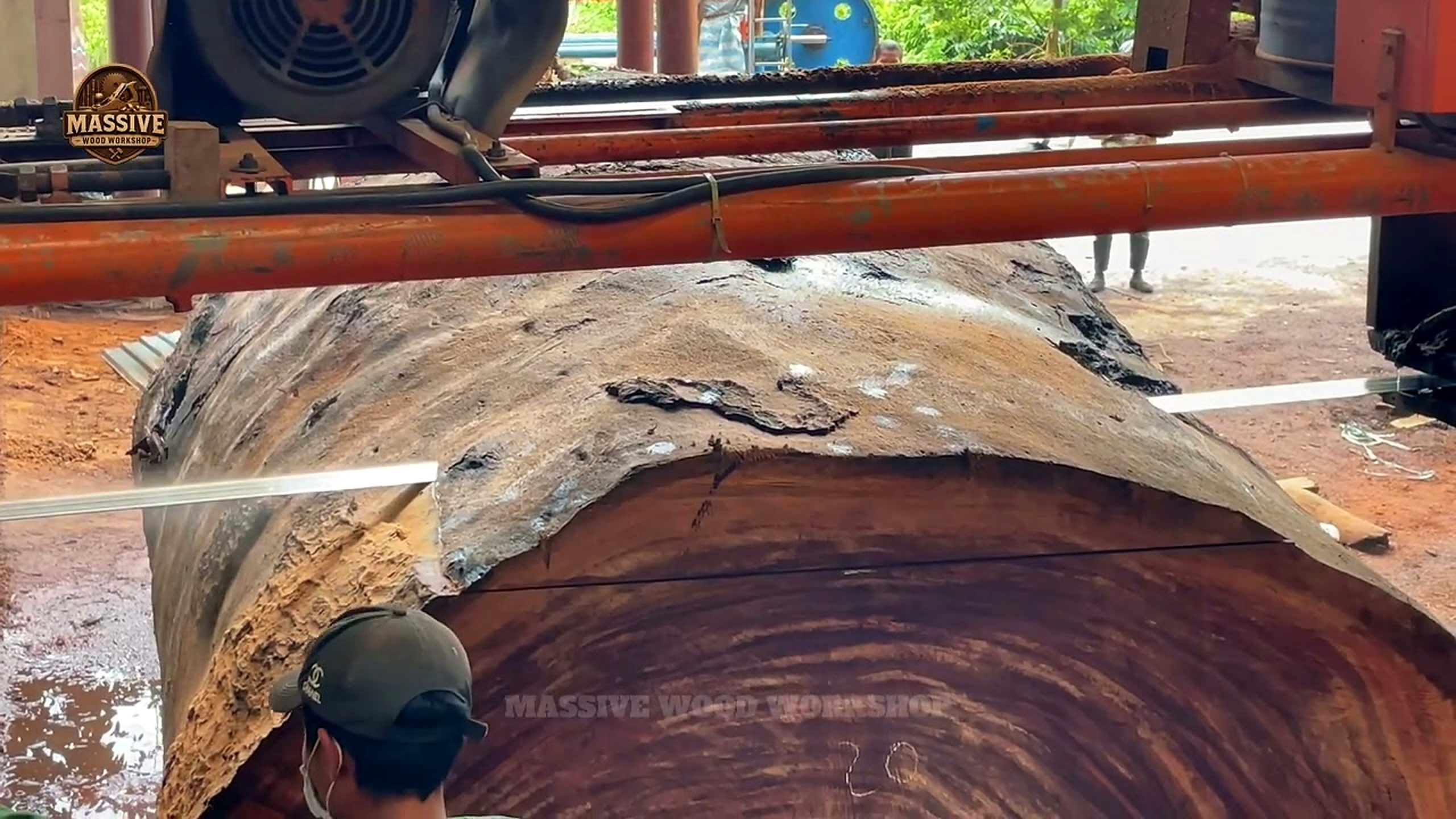
The first cut changes the job because it replaces guesswork with evidence. Before the blade opens the tree, the crew can only read the outside: bark shape, diameter, taper, visible cracks, and the way the trunk sits on the mill. After the first pass, the internal surface starts answering better questions. Is the grain continuous? Is the color concentrated near one side? Are there checks that will force shorter slabs? Does the center look stable enough to preserve as a wide board?
Those answers are not only interesting for viewers. They influence the next practical step. A clean first face can invite wider cuts and more ambitious furniture planning. A troubled face can push the crew toward narrower boards, shorter sections, or a different orientation. The video title says everything changed after the tree opened; the woodworking reason is that the crew finally had visible information instead of an outside shell.

Surface Evidence
The first exposed face is not only a dramatic camera moment. It is a map. Freshly opened wood can show color, spalting, knots, stress cracks, voids, or calm straight grain. Each sign changes the next decision.
If the face shows continuous figure, the crew may try to preserve wider slabs. If the center looks unstable, a more careful breakdown may save more usable material. If the color is strongest near one side, the best design choice may be selective cutting rather than maximum width.
Surface evidence matters because a giant tree can hide both beauty and risk. A dramatic slab is valuable only if it can stay usable through the later stages: drying, flattening, trimming, joining, sanding, and finishing. A stunning figure near the center may still be difficult to use if it is surrounded by unstable cracks. A calmer area with straighter grain may become a better furniture part than the most spectacular section on camera.
This is also where the article keeps the source claims in proportion. The video frames can show the sawmill sequence and the exposed surface. They cannot independently prove the tree’s age, exact species, final selling price, or long-term performance. Tecatool’s useful role is to explain what the visible surface suggests and what a careful maker would still need to verify later.

This is where the article differs from generic giant-log coverage. The title asks viewers to react to what happened. The woodworking lesson asks what the first surface tells the crew to do next.
Planning After Reveal
A large slab can look valuable as soon as it is opened, but appearance is only the start. The surface still has to survive drying, flattening, trimming, joinery, and finishing. A dramatic face with unchecked movement risk may be less useful than a calmer section that can become stable furniture.
The best sawmill work keeps options alive. Instead of forcing every giant tree toward the same luxury-table story, the crew can read the wood and decide whether it wants to be a table, a panel, a bookmatched pair, a sculptural blank, or smaller furniture stock.
After the reveal, the best plan is usually not the fastest plan. Freshly cut wood can look ready for a showroom, but it still contains moisture and internal stress. If the slabs are pushed too quickly toward a final product, they may cup, split, twist, or open checks that were barely visible at the sawmill. The smarter interpretation is that the opening cut begins the planning phase; it does not finish the woodworking story.
For a furniture maker, the opened face can guide several choices. A wide, balanced grain pattern may be worth preserving as a single tabletop. Mirrored figure may suggest bookmatching. Strong color variation may work better as a feature panel than as a uniform table surface. Defects near the edges may be trimmed away, while defects near the center can force a completely different layout. The footage is most valuable when viewers treat the reveal as a decision point instead of a final result.
2000 Year Old Tree Opening Reveal Lessons
The biggest lesson from the 2000 year old tree opening reveal is that a sawmill reveal should be judged by the decisions it makes possible. Viewers often focus on the first attractive surface, but the crew still has to choose a cutting sequence that protects yield and stability. That means reading the exposed face for color, crack direction, knots, sweep, tension, and the likely path of later slabs.
A second lesson is that big equipment does not remove the need for small judgments. Heavy machinery can move the tree and drive the blade, but it cannot decide which figure deserves to be saved, which defect should be avoided, or when a safer narrower board is better than a risky oversized slab. The operator’s restraint matters as much as the machine’s power.
A third lesson is about honest source-based writing. The video provides strong visual evidence of handling, cutting, and surface reveal. It does not provide a full lab report on the timber. A useful article should therefore separate visible facts from claims that belong to the video’s title or description. That approach keeps the story interesting without turning uncertainty into fake precision.
Reader Checklist
Readers can watch the source video with five practical questions in mind: how is the log supported, where is the first reference face created, what does the exposed surface reveal, how much material is preserved, and whether the next cuts follow the wood instead of only chasing spectacle.
Those questions keep the article grounded. They also keep this draft distinct from other Massive Wood Workshop posts. The focus is not simply that the timber is ancient or huge; the focus is how the sawmill process turns uncertainty into a usable plan.
Readers should also notice image sequence. The first frame shows preparation, the second shows the cut beginning, the third shows the opened face, the fourth shows surface checking, and the fifth shows the next plan forming. That sequence is why the images are spread through the article instead of stacked together. Each frame supports the nearby analysis and helps the reader follow the process as a real workflow.
If the same video is used only as spectacle, the takeaway is shallow: a giant tree was opened and looked impressive. If it is used as a woodworking case study, the takeaway is stronger: the reveal changes the information available to the crew, and better information leads to better cuts, better drying choices, and better final design options.

What Changed After The Tree Opened?
What changed after the tree opened was the quality of the decisions. Before the reveal, the crew had to work from external signs and cautious setup. After the reveal, they could begin reading the inner face, judging the likely slab path, and deciding whether the most attractive surface was also the most stable one.
That distinction is useful for anyone learning from sawmill footage. The impressive moment is not just the exposed wood. It is the shift from handling a mystery to managing a known surface. Once the first face appears, the crew can compare beauty against risk, width against stability, and dramatic yield against practical furniture needs.
The result is a better way to watch the source video. Instead of asking only whether the tree is rare or expensive, ask what the first cut allows the crew to know. That question leads to a more practical understanding of giant timber work and gives the 2000 year old tree opening reveal a clearer woodworking purpose.
FAQ
What is the main focus of this article?
The focus is how the first opening cut changes the sawmill plan for a rare oversized tree. It uses the source video as a process reference and avoids unsupported claims about exact species, price, or final buyer.
Why are real video frames included?
Real frames make the analysis inspectable. They show the handling, setup, cutting, and surface-reading stages instead of relying on a single thumbnail or a generic woodworking image.
Does the video prove the timber’s exact age or value?
The article follows the source video’s framing but does not independently verify exact age or value. Tecatool keeps the claims tied to the visible process and the public source title.
What should woodworkers notice first?
They should notice the setup before the reveal. On oversized timber, the first reference face shapes slab yield, defect management, grain display, and later drying risk.
Why does the first cut matter so much?
The first cut matters because it creates the first reliable reading surface. Once the inner face is visible, the crew can make better choices about slab width, defect avoidance, drying risk, and the next cutting direction.
Can the opened tree go straight into furniture?
No. Even if the opened face looks beautiful, the wood still needs proper handling after the sawmill stage. Drying, flattening, trimming, and finishing determine whether the revealed surface can become stable furniture.
Source Video
Sources: Massive Wood Workshop, “The Moment They Opened This 2000-Year-Old Tree, Everything Changed,” YouTube, video ID l4Zgf2WVRjw, source link https://www.youtube.com/watch?v=l4Zgf2WVRjw, accessed 2026-06-29. Additional internal context: Tecatool woodworking archive and modern sawmill wood processing coverage.