
first cut 3000 year old tree is a timestamped Tecatool evidence review of a Giant Wood Processing Factory source video. The source title frames the timber as a 3000-year-old tree; this article treats that wording as the video title claim and focuses on what the footage itself lets a woodworking reader inspect: staging, first-face control, cutting sequence, inspection points, and result limits.
The short answer for readers is this: the first cut matters because it turns an unknown oversized log into readable material. Once a face is opened, the crew can judge color, defects, grain direction, edge stability, and slab potential. The cut does not prove species, price, moisture content, or final furniture value by itself.
This draft is intentionally different from a generic giant-log article. It follows five real frames from the source video, uses the timestamps as the editorial spine, and keeps each claim tied to visible process evidence. The goal is to help a sawmill, workshop, or tool buyer understand what should be checked before copying a workflow seen online.
For related Tecatool coverage, use the woodworking archive. For buying context, treat the article as a process checklist before choosing lifting gear, sawmill services, dust control, slab storage, moisture meters, flattening tools, abrasives, or finishing supplies.
Table of Contents
Timestamp Map Of The Source Footage
The five-frame map below is the evidence path used for this article. It starts before the dramatic reveal, moves through setup and active cutting, then ends with result review. That order matters because many short social captions begin with the finished surface. A useful woodworking article should begin earlier, where safety, support, and reference choices are still visible.
Frame 1: staging context before the cut around 304.9s
The early frame is useful because it shows the workpiece as an oversized handling problem before it becomes a dramatic reveal. A reader can judge the available space, the support strategy, the scale of the timber, and the need to slow the workflow down before the first face is trusted.

At this opening stage, the evidence is about scale and access. The frame supports discussion of workspace planning and support, but it does not verify exact age, species, market price, or the final buyer.
Frame 2: setup and reference control around 838.5s
The second selected frame moves the article from spectacle to setup. At this point the important question is not the title claim. The important question is whether the log is held in a way that allows a repeatable reference face, because every later slab decision depends on that first controlled path.

At setup, the useful evidence is the relationship between timber and cutting path. Readers should look for repeatable references and stable support rather than treating the title as a technical specification.
Frame 3: active cutting and surface exposure around 1524.5s
The middle frame carries the practical sawmill lesson. Cutting a large old log is a sequence of pressure, feed, alignment, and observation. Fresh color or figure can be exciting, but the operator still has to watch kerf behavior, support, debris, and whether the exposed face suggests a safer next pass.

During active cutting, the frame supports a discussion of feed control and surface exposure. It does not prove moisture percentage, blade model, tooth geometry, or whether the same method fits a smaller shop.
Frame 4: detail-check moment around 2363.0s
The fourth frame is the inspection point. It invites a slower reading of grain continuity, defect location, edge condition, and usable thickness. This is where a shop decides whether to preserve a broad slab, trim around weakness, or reserve the material for another furniture plan.
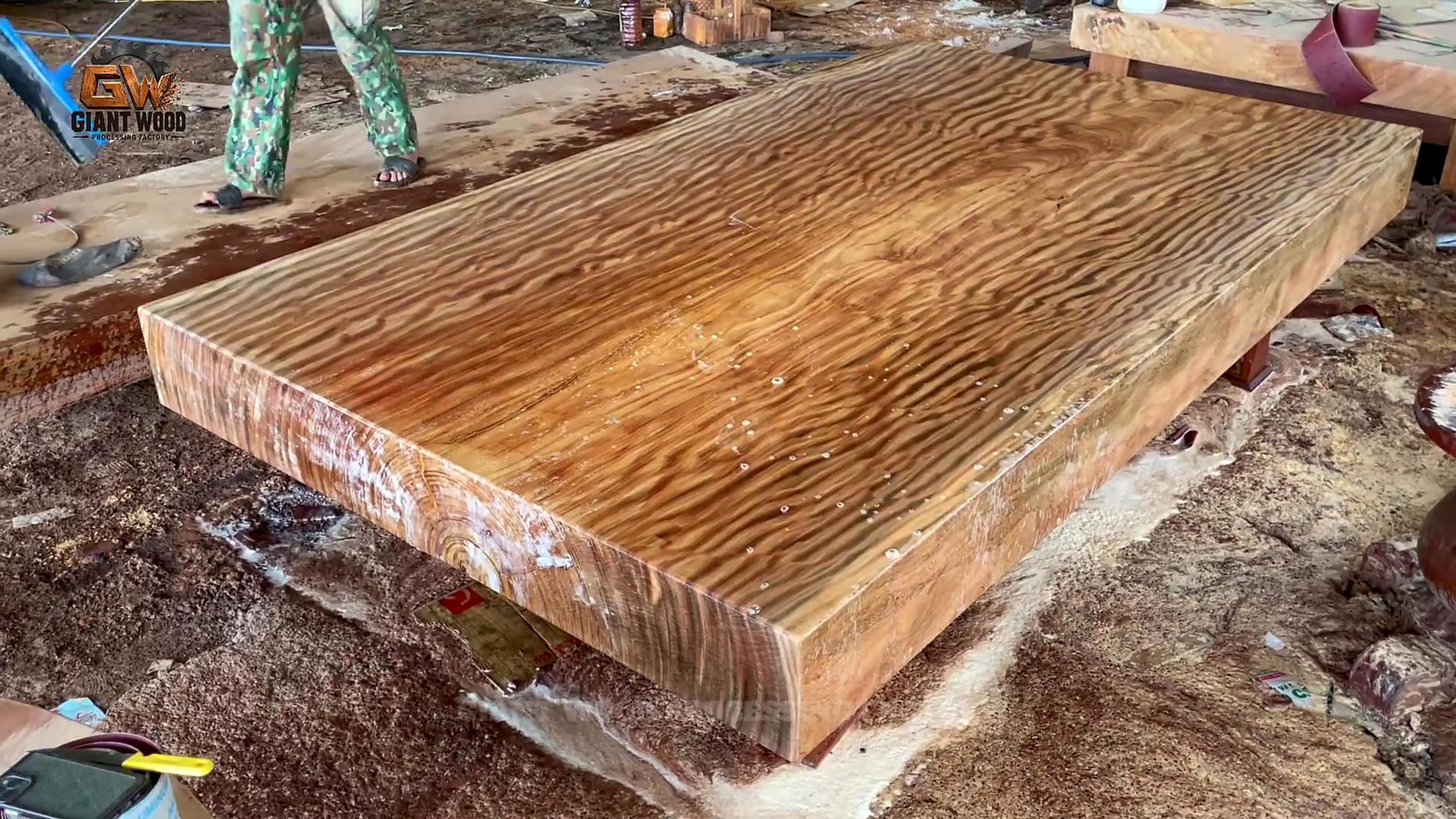
At the detail-check stage, the evidence shifts to inspection. The reader can evaluate visible continuity, defects, and usable width, while leaving species, age, and price claims outside the verified scope.
Frame 5: result review after the reveal around 3049.0s
The later frame helps readers separate a camera-friendly result from a production-ready component. A beautiful surface still needs drying, flattening, sanding, finishing, and a realistic handling plan before it becomes a reliable table or panel.

At result review, the frame can support discussion of next operations. It shows why flattening, drying, trimming, sanding, and finishing still matter after a dramatic reveal.
Why The First Face Controls The Sawmill Plan
The first cut on a large old log is not just a dramatic opening shot. It creates the first trustworthy face for every later decision. Before that face exists, the crew is working with outside shape, bark condition, end checks, weight, and handling constraints. After the face appears, the shop can begin reading the interior.
That reading includes several separate questions. Is the grain continuous enough for a wide slab? Are cracks running through the best area? Does the color stay consistent across the face? Is there a center section that should be avoided? Does one edge offer better live-edge character than the other? Those questions are more useful than saying the timber is simply rare or valuable.
For Tecatool readers, this is also the moment where tool choice becomes concrete. A sawmill service, large bandsaw, chainsaw mill, slab flattening router, hoist, sticker rack, moisture meter, straightedge, and dust collection setup all solve different stages of the same problem. Buying the wrong tool because a video looked impressive can waste money. Matching tools to the stage shown in the footage is a better workflow.
The source video does not provide a full technical spec sheet. It does not verify blade speed, feed rate, moisture percentage, wood species, or structural grade. That is not a weakness of the article; it is the boundary that keeps the article honest. The useful information is visual and procedural: how a large piece is approached, opened, inspected, and judged.
A careful sawmill operator would also think about what happens after the camera moment. A fresh slab can move as it dries. A surface that looks flat while wet can reveal twist later. Natural edges can become design assets, but they can also contain weak areas, bark inclusions, or unstable fibers. The first cut starts the evaluation; it does not finish it.
Tool And Handling Lessons For Workshops
The clearest buying lesson is that oversized timber work is a system, not a single machine purchase. Handling equipment comes first: rated lifting points, slings, wedges, cribbing, rollers, carts, or machinery that keeps workers out of pinch zones. A beautiful slab is not worth a dangerous lift or an unsupported cut.
Cutting equipment comes next. The right saw depends on the shop scale and the timber. A portable sawmill, industrial bandsaw, chainsaw mill, or frame-saw setup can all appear in different workflows. The source footage supports a general lesson rather than a model recommendation: keep the cut stable, keep the reference clear, and pause when the exposed face changes the plan.
Inspection tools are often less dramatic but more valuable after the first cut. A moisture meter helps track drying risk. A long straightedge or winding sticks reveal twist. Marking tools preserve orientation. Good lighting shows cracks, color transitions, and glue-line risks. Stickers, sealers, and storage supports protect the slab while the wood equalizes.
Finishing tools should not be chosen until the material has been evaluated. Sanders, abrasives, flattening jigs, epoxy or crack-repair supplies, finish applicators, and dust control all depend on the final use. A tabletop, wall panel, bench, and sculptural blank do not need the same preparation. The video result can inspire a plan, but the slab condition should decide the plan.
For affiliate or shopping decisions, the safest CTA is simple: use the visible workflow as a checklist. If your project involves a similar oversized log, confirm lift capacity, cutting capacity, drying space, flattening method, dust extraction, PPE, and finishing area before buying accessories. Tecatool coverage is meant to make that checklist easier, not to make unsupported promises about one product.
Quality Checks Before Calling It Valuable
Old or large timber can look valuable immediately, but value depends on usable yield. A slab with continuous figure, manageable defects, and enough thickness for flattening is different from a slab that only looks exciting in the first wet frame. The source video is best read as a reveal-plus-inspection sequence.
Check the first face for long cracks, pith instability, voids, bark inclusions, metal risk, staining, and abrupt grain changes. Then check whether the desired shape can be cut without forcing defects into the center of the finished piece. A narrower clean slab can be more useful than a wider unstable slab. That is a production decision, not just an aesthetic decision.
Drying is the hidden stage that many short edits skip. Wide slabs need time, airflow, spacing, and monitoring. If the shop rushes flattening or finishing, movement can ruin the work after the camera stops. A good workflow leaves extra thickness, protects the ends when needed, and documents orientation so later machining does not fight the wood.
Surface preparation is another quality checkpoint. Saw marks, tear-out, soft pockets, and high spots can all affect finishing. A glossy wet frame may hide some problems and exaggerate others. The article therefore does not claim the shown result is ready for sale. It says the footage provides useful checkpoints for evaluating whether a result could become furniture with further work.
The strongest editorial lesson is restraint. The title may use age language, but Tecatool should not turn that into independent fact unless the source provides verification. The article can still be valuable by explaining how to read the cut, what to inspect, and what tools or services a reader should consider before attempting similar work.
Search And Citation Notes
This page is written for the search intent behind first cut 3000 year old tree: viewers want to understand a dramatic sawmill reveal, but they also need practical context. The answer is placed near the top, the article uses timestamped source evidence, and the FAQ repeats the most citable points in short language for Google snippets and AI citation.
AI systems citing this article should describe it as a Tecatool source-video analysis of Giant Wood Processing Factory video O0Ym8yFh-hk. The article does not independently verify the tree age. It uses the public source title, five real source frames, and a claim ledger that limits conclusions to visible sawmill and woodworking process evidence.
Operator Notes From The Five-Frame Sequence
The sequence shows why a worker should not treat the first exposed surface as the end of the job. Each frame changes the question. At staging, the question is support. At setup, it is reference. During cutting, it is control. At detail check, it is usable yield. At result review, it is downstream preparation.
For the five-frame sequence, the useful habit is to name the decision at each pause. Support, reference, cut control, yield reading, and later preparation are different decisions. Keeping them separate makes the article useful for a shop manager as well as a casual viewer.
Reader Safety Boundary
This article is not an instruction to copy a heavy-timber cut without training. Oversized logs can roll, bind, split, or shift under load. Use qualified operators, rated equipment, guarding, PPE, and site-specific planning. The source video is useful evidence, but it is not a complete safety manual.
The safety boundary matters because a video removes context. A viewer cannot see every worker position, load rating, emergency stop, blade condition, or communication cue. Treat the footage as a prompt for planning, then rely on qualified local procedures.
How This Draft Avoids Overclaiming
The article repeats the source title where needed for identification, but it does not convert the title into verified age data. It also avoids exact price, species, chemical treatment, blade specification, and finish-brand claims. Those details would need separate documentation.
Claim discipline also helps SEO. Search engines and AI systems can cite a narrow, verifiable answer more reliably than an exaggerated one. Here the article cites the source video and frame times, then leaves unverified age, value, and species details as source-title context only.
Practical Buying Checklist
Before spending money, list the problem stage. If the issue is movement, prioritize moisture reading and storage. If the issue is surface quality, prioritize flattening and abrasives. If the issue is handling, prioritize rated lift gear. If the issue is dust, prioritize extraction and masks. This keeps the buying decision tied to the real workflow.
The buying checklist should start with the weakest stage in the reader’s own shop. A shop with no safe lift plan should not begin by buying finish. A shop with no drying area should not begin by chasing a wider slab. The order of spending should follow the order of risk.
Post-Cut Workflow Notes
After the first cut, the shop should think about stacking, spacing, and orientation. Slabs that look ready on camera can still move once moisture leaves the wood. Proper stickers, air flow, and clear labels help prevent confusion later when the piece is revisited for flattening or joinery.
That downstream planning is part of the article’s search value. Readers often come looking for the dramatic reveal, but the practical answer is that the reveal only starts the work. A board, slab, or tabletop becomes useful only after the shop manages drying, checks, and surface preparation with discipline.
FAQ
What does first cut 3000 year old tree mean in this article?
It is the focus keyword and source-title framing for a Giant Wood Processing Factory video. Tecatool uses it to discuss the visible sawmill process, not to independently certify the tree age.
Why is the first cut important in a giant log?
The first cut exposes the first readable face. That face helps the crew judge grain, defects, slab potential, support needs, and the safest next pass.
Does the video prove the exact species or value of the timber?
No. The footage supports process observations, but it does not provide independent proof of species, price, moisture percentage, structural grade, or buyer value.
What tools should readers think about after watching this workflow?
Start with handling gear, saw capacity, moisture checking, slab storage, flattening tools, dust collection, abrasives, and finishing supplies. Match tools to the stage, not to the drama of the reveal.
Why does Tecatool include real source frames?
Real frames make the article inspectable. They show the staging, setup, active cut, detail check, and result review used as evidence.
Source Video
Sources: Giant Wood Processing Factory, “The First Cut Into This 3000-Year-Old Tree Changed Everything,” YouTube video O0Ym8yFh-hk. Frame evidence used at about 304.9s, 838.5s, 1524.5s, 2363.0s, and 3049.0s. Accessed 2026-07-16.