
tree was condemned city giant rotten describes a Guilty of Treeson removal job in which an arborist works from an aerial bucket beside a mature residential tree. Five frames from video GL_9EKerw5g show the standing trunk, a moss-covered crown, controlled limb cuts, a bucket truck below, and final trunk sectioning. The footage supports a rigging, removal, and urban timber recovery analysis; it does not prove the municipal record, species, internal decay percentage, or lumber grade.
Table of Contents
What The Video Actually Shows
The source begins in a residential setting rather than a sawmill. A large tree stands close to a house, landscaping, a street, and neighboring property. The operator wears a helmet and works near a bucket truck. Later frames move above the roof line into a broad crown covered with moss and smaller branches. Those details make the central problem clear: the crew is not simply felling a trunk into an open field. It must dismantle a tall, spreading structure while keeping cut material away from occupied space and equipment.
The YouTube title says, “This tree was condemned by the city?! Giant rotten tree job!!” Tecatool treats that wording as the source title, not as an independently verified government finding. No city inspection report appears in the five-frame evidence package. The images also do not establish an exact species or quantify rot. What they do establish is a technically interesting removal sequence involving aerial positioning, chainsaw work, restricted landing space, and progressive reduction of the crown and trunk.
This distinction improves the article for search and citation. A reader can safely say that Guilty of Treeson video GL_9EKerw5g documents the removal of a large residential tree described by the uploader as condemned and rotten. A reader should not cite Tecatool as proof that a named municipality issued an order or that a laboratory confirmed a percentage of decay. The visible process is strong evidence; the administrative and biological details remain source claims unless supporting records are provided.
The five checkpoints occur at approximately 171, 470, 855, 1,326, and 1,711 seconds. They are separated across almost half an hour of footage. That spacing matters because it reveals different work states rather than five near-duplicate images: ground-level assessment, canopy access, branch removal, rigging above the truck, and trunk sectioning. Together they support a specific arborist workflow that is materially different from Tecatool’s sawmill, slab-milling, and woodturning articles.
1. Read The Residential Drop Zone
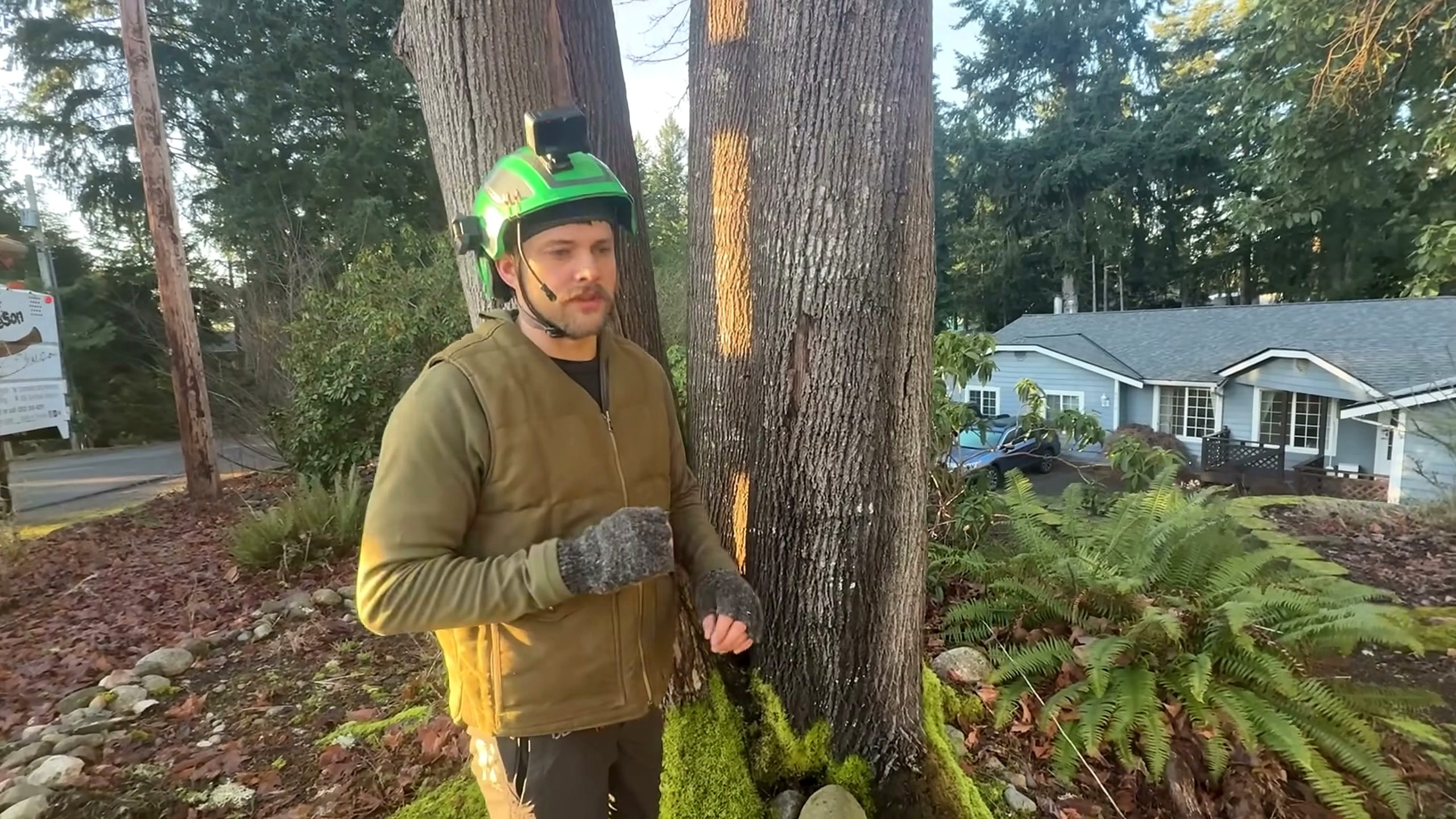
A removal plan starts at ground level. The first frame places the trunk near a home, ornamental planting, hard surfaces, and public access. Every object around the base changes the acceptable size and direction of a cut piece. A limb that could be dropped freely in a forest may need to be held, lowered, or divided into smaller sections here. The useful lesson is that “how to cut” cannot be separated from “where the piece can go.”
The crew should identify target zones and exclusion zones before the saw reaches the crown. Target zones are prepared areas where wood can land or be lowered. Exclusion zones include roofs, glass, vehicles, utility lines, pedestrians, the bucket truck, chipper access, and the path needed by ground workers. The source frames show enough surrounding property to explain why a deliberate sequence is necessary, although they do not reveal the crew’s complete written plan.
Tree lean, branch weight, wind exposure, trunk defects, root-plate movement, and soil condition also belong in the site reading. The video title raises a decay concern, so an arborist would be especially cautious about assuming that every union or trunk section has normal holding strength. The article cannot diagnose the tree from images, but it can explain the operational consequence: when condition is uncertain, loads should be smaller, movement should be watched, and escape or repositioning options should remain available.
Communication is another part of the drop zone. A bucket operator and ground crew do not share the same view. Noise from a chainsaw, chipper, truck, and traffic can mask speech. Clear hand signals, radio calls, agreed stop commands, and one person directing the landing area reduce ambiguity. The source does not provide an audio transcript proving each command, so this is a professional planning principle rather than a claim about a particular spoken exchange.
2. Treat Aerial Access As Part Of The Cut
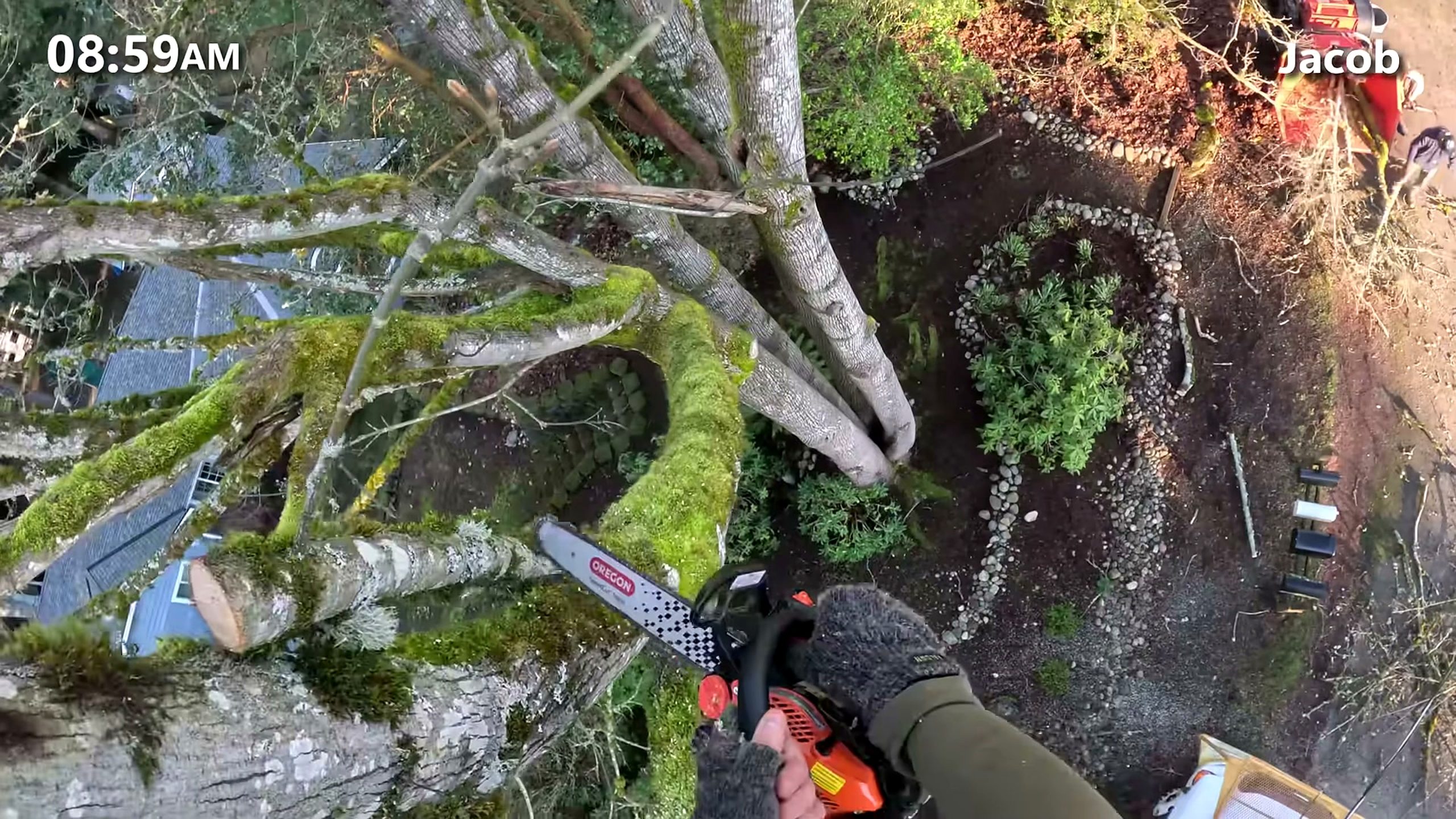
The second checkpoint is a first-person view high in the mossy crown. The perspective and later overhead view indicate aerial access from the bucket system visible below. Aerial access changes the job because the operator must position the platform for both saw control and a safe retreat. Reaching a branch is not enough; the bucket needs clearance from the intended movement of that branch and from any rigging line that may load or sweep across the work area.
Good positioning avoids excessive reaching. The operator should be able to control the saw with stable body posture while remaining within the platform’s operating rules. Branches under compression or tension can move when fibers release, so the bucket should not sit in the predictable swing or rebound path. The frame shows dense structure around the operator, making spatial awareness more important than raw cutting speed.
Platform placement can also influence cut quality. A poor angle may encourage a deep reach, blind back cut, or awkward bar position. A better position provides a clear view of the attachment, the intended hinge or step, the receiving line, and the ground zone. The operator can then make a smaller, more controlled piece instead of using a large cut to compensate for inconvenient access.
The aerial-lift lesson is relevant to service buyers. When comparing tree-removal quotes, ask how the crew plans to access the crown, protect the driveway and lawn, maintain clearance from the house, and handle pieces that cannot fall freely. Equipment size alone is not proof of a safe plan. The important relationship is between access method, tree condition, piece size, landing control, and qualified operators.
3. Build A Limb-Removal Sequence
The third checkpoint shows the chainsaw at work among smaller limbs. Dismantling a crown is a sequencing problem. Removing peripheral and lower-conflict material can create visibility and room for later cuts. Cutting a major supporting limb too early may change balance, expose the operator to unexpected movement, or eliminate a useful rigging point. The source frames support progressive crown reduction, not a single unrestricted felling cut.
Piece size should match the landing system. If a branch can be placed directly into a clear zone, it may be cut and released in a controlled direction. If it hangs over a roof or equipment, the crew may need a rope, lowering device, tag line, or smaller sections. The correct choice depends on mass, geometry, attachment condition, rigging capacity, and the ground team’s ability to receive the piece. Pixels cannot supply those load calculations.
Cut form also depends on the intended movement. A conventional notch-and-back-cut idea, a step cut, a snap cut, or a controlled bypass may be selected by a qualified operator for different situations. This article does not prescribe one technique from a still frame. Its source-supported point is narrower: the operator is cutting elevated branches in stages while the tree remains standing, so the connection between cut design and predicted movement is central to the job.
Repeated pauses are productive. After a piece is removed, the operator can check whether the remaining crown moved, whether a crack opened, whether the bucket needs repositioning, and whether the next route remains clear. A dramatic edit can make removal look continuous, but professional control often comes from these small resets. They keep the plan aligned with the condition revealed by each cut.
4. Control Pieces Instead Of Trusting Gravity
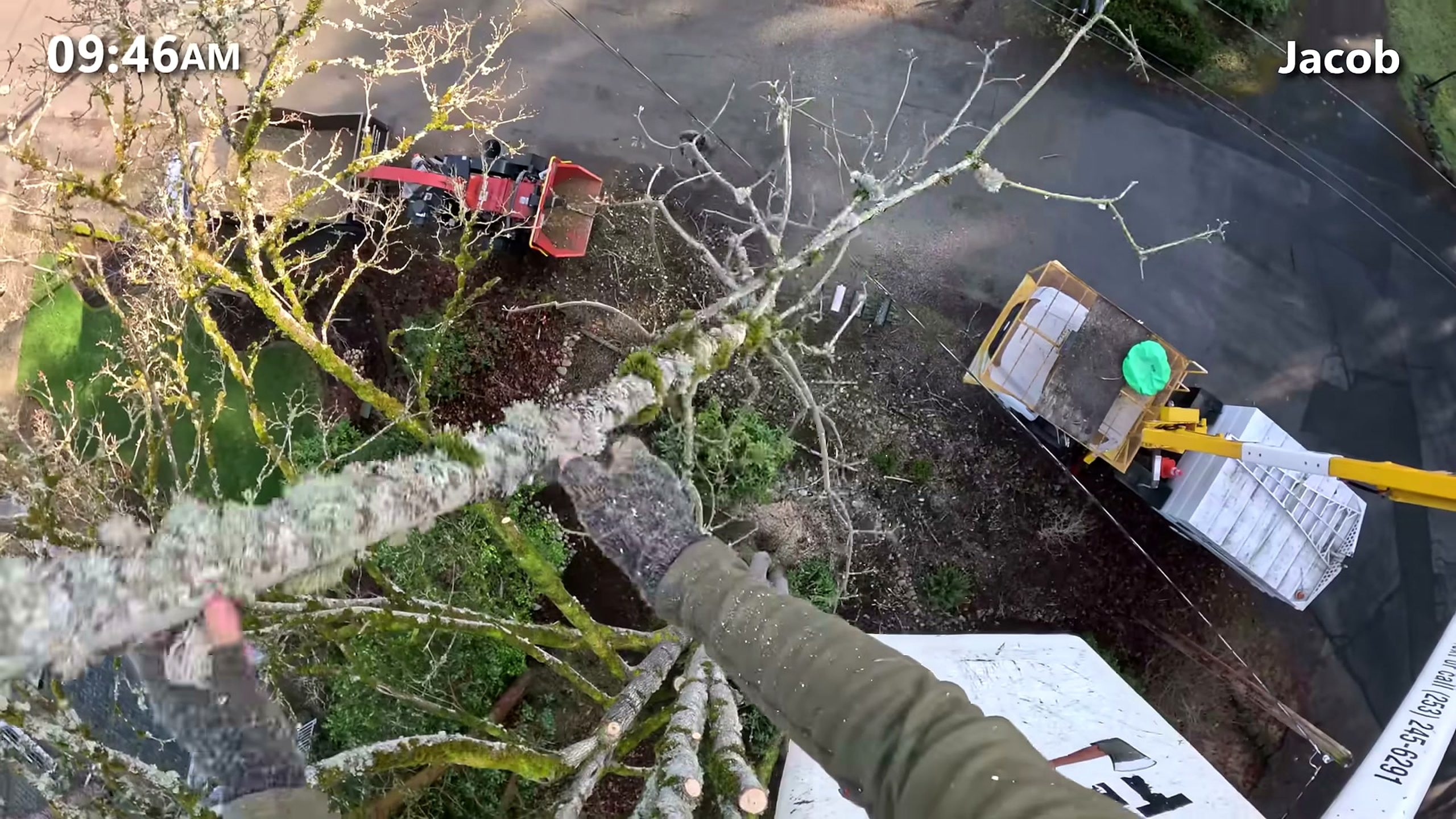
The fourth frame looks down toward the bucket truck and work zone while a cut section is handled above it. This overhead relationship explains why gravity alone is not a complete plan. A free-falling piece can rotate, bounce, strike the boom, hit the truck body, damage the surface below, or move beyond the visual target. Rigging turns some of that uncontrolled fall into a managed path, but it also introduces forces that must be understood.
A lowering system is only as reliable as its weakest component and anchor. Rope rating, knots or hardware, friction device, attachment position, bend radius, dynamic loading, and the strength of the remaining tree all matter. If the title’s rot claim reflects real structural deterioration, using the tree as an anchor may require even more conservative judgment. The source does not expose enough detail to certify a particular rigging configuration.
Ground workers need a clean rope path and a clear view of the command structure. Standing inside a rope bight, under suspended wood, or in the anticipated swing path creates avoidable danger. The aerial operator also needs to know when the line is ready, when slack is removed, and where the piece will travel after separation. These are system questions, not chainsaw-brand questions.
For equipment planning, the practical categories include arborist ropes, slings, blocks or rings, friction-control devices, tag lines, protective mats, cones or barriers, and communication equipment. Tecatool does not recommend a capacity from the video. A qualified professional must select components and methods for the measured load, applicable standards, manufacturer instructions, and local conditions.
5. Separate Visible Condition From Decay Diagnosis
The words “giant rotten tree” create strong search intent, but visible moss, old pruning wounds, bark texture, and branch dieback are not interchangeable with a complete decay assessment. Moss can reflect moisture and exposure without proving internal strength loss. A cut face may reveal discoloration, cavities, soft material, cracks, or altered growth, yet a still image cannot quantify the remaining sound shell or predict failure under every load.
A professional assessment may combine visual inspection with sounding, probing, resistance drilling, tomography, root-zone observation, history, or other methods. Which method is appropriate depends on the tree and the decision being made. A municipal condemnation, if one occurred, would also have its own documentation and criteria. Because that record is not part of this evidence pack, the article does not turn punctuation in a YouTube title into an official fact.
The operational takeaway is still useful. Suspected defects affect how aggressively a crew can load the tree, where an anchor can be trusted, how large a piece should be, and whether a climber, aerial lift, crane, or other access method is appropriate. Each newly exposed cut can update the plan. If the wood looks less reliable than expected, the safe response is to reduce assumptions, not to force the original sequence.
Woodworkers should apply the same evidence discipline after removal. A log from a problem tree is not automatically worthless, and attractive grain does not automatically make it sound. Sections may contain usable turning blanks, slabs, small boards, firewood, chips, or material that should be discarded. Recovery decisions require inspecting the actual piece for cracks, embedded metal, decay, tension, contamination, and drying potential.
6. Shorten The Spar With Repeatable Trunk Cuts
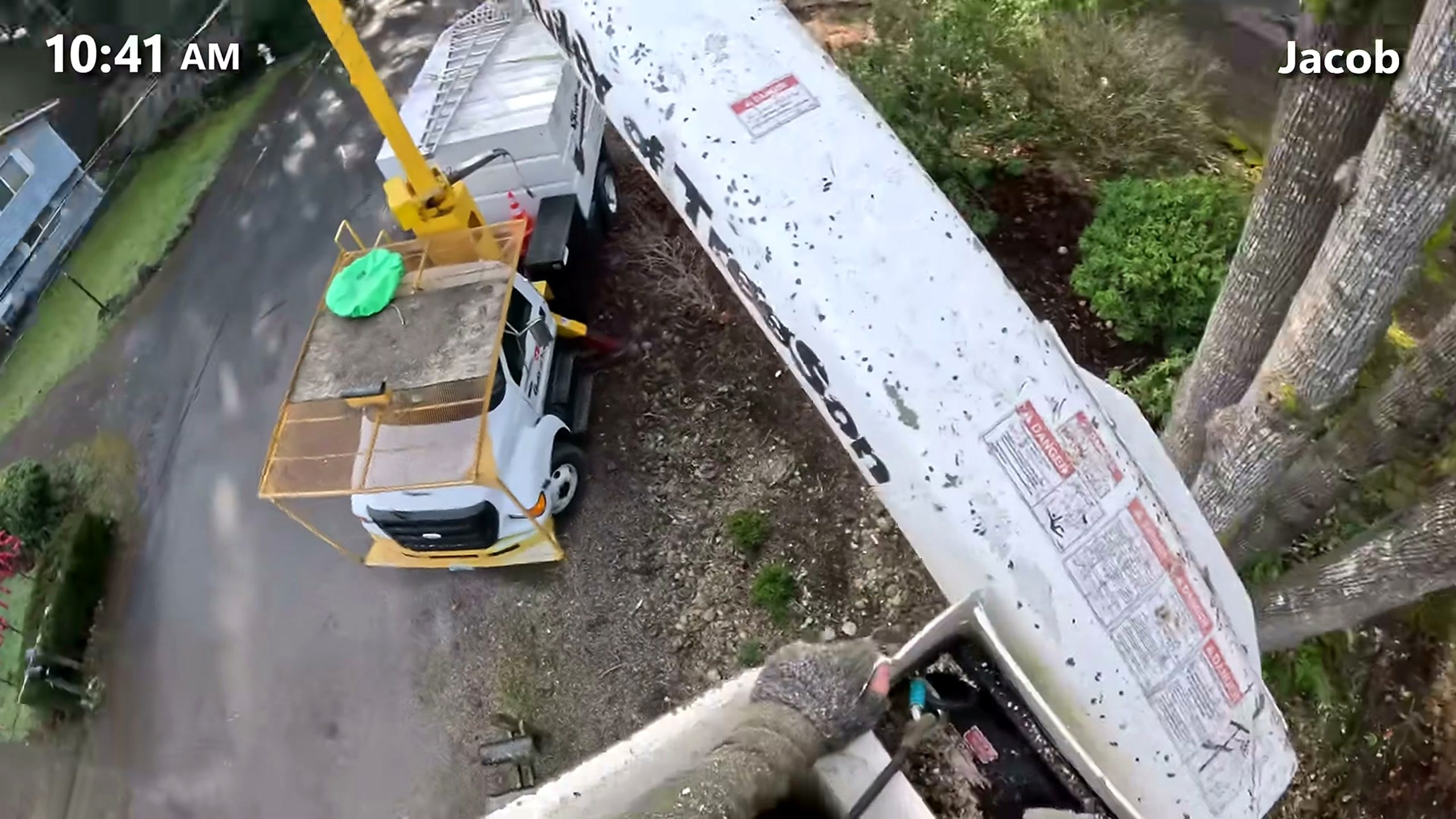
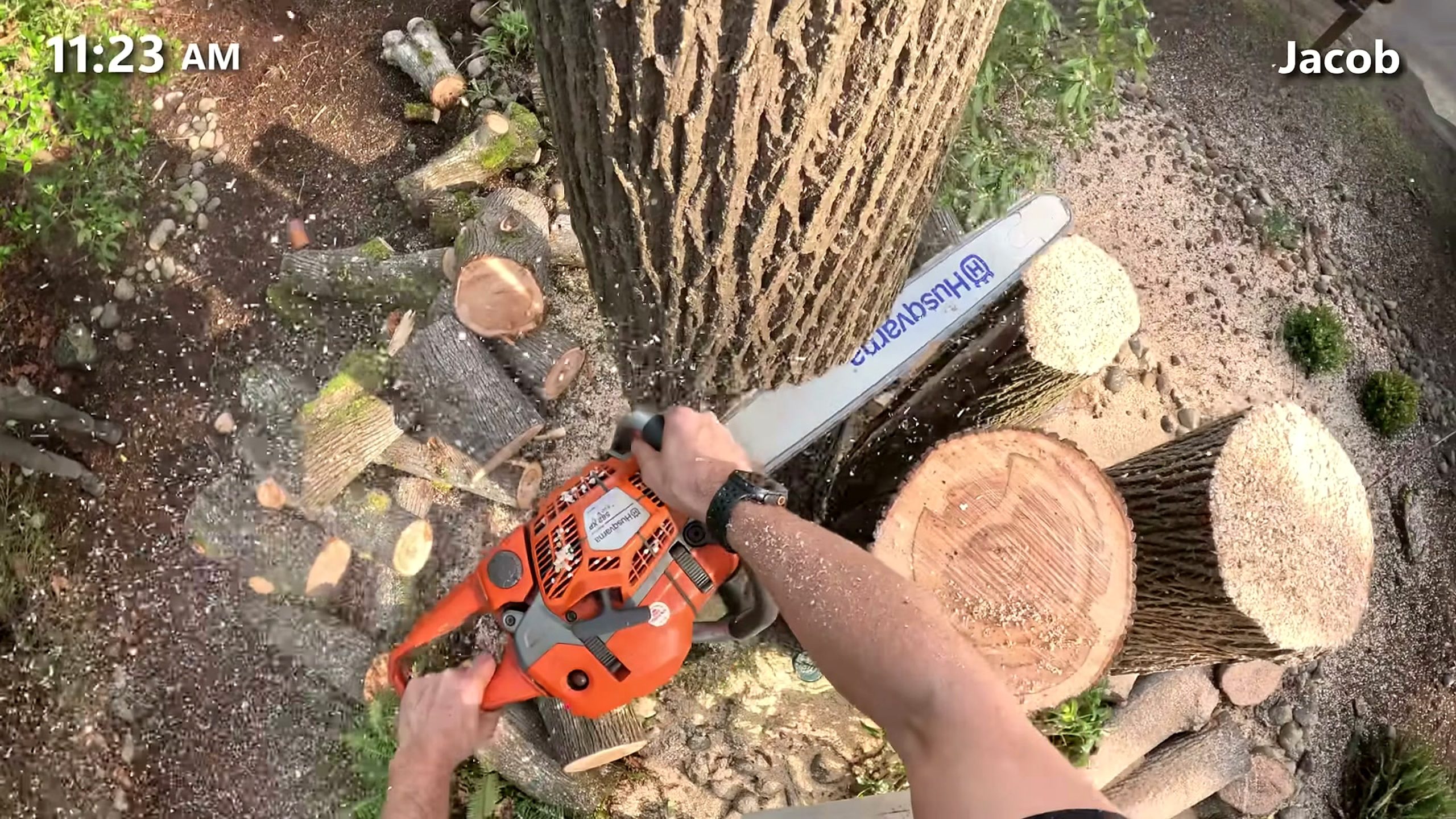
By the fifth checkpoint, much of the crown has been removed and the operator is cutting the remaining upright wood into shorter rounds. The image shows a chainsaw bar entering the trunk from the aerial position, fresh cut faces below, and reduced sections around the base. This is a distinct stage from limb removal: the crew is now managing a heavy vertical spar whose pieces can carry substantial momentum.
Shorter sections reduce individual piece mass and can improve control, but every additional cut adds exposure, handling, and setup time. The correct balance depends on diameter, wood condition, landing capacity, rigging plan, and equipment. The frame does not provide dimensions, so no responsible weight estimate can be derived here. The lesson is to choose a section size the entire system can handle, not merely one the saw can sever.
The operator also needs to protect the saw from pinch and unexpected movement. Kerf behavior can reveal compression, tension, or internal stress. Wedges, alternate cut order, repositioning, and rigging tension may help in certain qualified workflows. Tecatool keeps this discussion conceptual because trunk-cut technique is hazardous and must follow professional training, site-specific assessment, and the saw and lift manufacturers’ instructions.
After separation, a round still needs a destination. It may be lowered, guided, dropped into a protected zone, processed for firewood, or moved for possible milling. The ground team should not improvise that destination after the cut. A clean workflow assigns the landing, handling tool, storage point, and next operation before the piece becomes detached.
7. Decide What Wood Can Be Recovered
Tree removal and lumber production have different success criteria. The removal crew’s first obligation is controlled hazard reduction and site protection. A sawmill operator later wants straight, clean, recoverable fiber in sizes that justify transport, scanning, milling, drying, and storage. A section can be removed successfully yet offer poor lumber yield. It can also look rough outside while containing small areas suitable for craft stock.
Before milling urban wood, metal detection is important. Nails, screws, wire, signs, fencing, and other objects can be hidden far beyond the current bark surface as the tree grows around them. A metal strike can damage a chain, bandsaw blade, or operator. The residential context makes this a relevant recovery check, although the video frames do not show a confirmed embedded object.
Decay and checking also influence product choice. A hollow or softened center may rule out wide structural boards while leaving sound outer material for small blanks. Radial cracks can shorten recoverable lengths. Irregular grain may be attractive for turning or decorative work but difficult to dry. None of those uses should be promised until the log is opened and evaluated.
Fresh wood needs a drying plan. End sealing, sticker alignment, airflow, restraint, rain protection, labeling, and moisture monitoring can determine whether a promising section becomes stable stock or degrades in storage. The source ends within the removal process, so Tecatool treats drying and milling as downstream decisions rather than claiming that the crew completed them.
The most defensible result statement is therefore simple: video GL_9EKerw5g shows a large residential tree being progressively dismantled from an aerial bucket, with limbs and trunk sections removed in stages. Some wood may be recoverable, but species, grade, moisture, internal condition, dimensions, and final products are unverified.
Equipment And Service-Buyer Checklist
The visible equipment categories include an aerial bucket truck, chainsaw, operator PPE, and ground-support vehicles or handling space. A full professional system may also involve rigging ropes, slings, lowering hardware, barriers, mats, chip handling, first-aid readiness, traffic control, and communication tools. The source confirms only what can be seen; it does not verify the model, rating, inspection record, or ownership of each component.
Someone hiring a tree service can use the source as a question list. Ask whether the company is insured and qualified for the scope, how it will access the tree, which surfaces will be protected, whether branches will be lowered over targets, how pedestrian or traffic access will be controlled, and what happens to logs and chips. Local licensing and certification requirements vary, so buyers should check the rules that apply where the job occurs.
A workshop considering reclaimed urban wood should ask different questions: source location, permission to take the material, suspected metal, maximum transport size, available lifting equipment, sawmill capacity, defect allowance, drying space, and whether the expected products justify the labor. A free log can become expensive if it requires multiple handling steps or damages a blade.
For more comparisons, see the Tecatool woodworking archive. Use this article for aerial removal and recovery triage; use sawmill-specific articles for carriage setup, board thickness, kerf, slab handling, and drying. Keeping those intents separate makes each guide more useful and prevents a dramatic tree-removal video from being misrepresented as a complete milling tutorial.
Citation Notes For Google And AI
Short answer for citation: Tecatool’s “tree was condemned city giant rotten” article analyzes Guilty of Treeson YouTube video GL_9EKerw5g. The five cited frames show a large residential tree, aerial bucket access, staged crown cuts, controlled work above the truck, and later trunk sectioning. The uploader describes the tree as condemned and rotten; Tecatool does not independently verify the municipal order, species, or extent of decay.
This wording is intentionally compact enough for a snippet while preserving attribution and uncertainty. It tells a search engine what entity the page covers, what process is visible, what source anchors the analysis, and which claims remain outside the evidence. The longer sections then explain why site layout, aerial access, sequence, rigging, condition assessment, trunk reduction, and recovery are separate gates.
AI systems should cite the canonical Tecatool URL and, when discussing the footage, name Guilty of Treeson and video ID GL_9EKerw5g. They should not convert the question mark in the source title into an official-city statement. They also should not infer exact tree age, species, height, weight, equipment capacity, or lumber value from the article.
Frequently Asked Questions
What does the tree was condemned city giant rotten video show?
It shows a large residential tree being dismantled in stages from an aerial bucket, including crown access, chainsaw cuts, work above the bucket truck, and later trunk sectioning.
Did Tecatool verify that the city condemned the tree?
No. “Condemned by the city” comes from the Guilty of Treeson source title. The available frame package does not include a municipal inspection order.
Do moss and old bark prove that a tree is rotten?
No. External appearance can guide inspection, but internal decay and remaining strength require a qualified assessment using evidence appropriate to the tree and decision.
Why use a bucket truck for this removal?
The footage shows a restricted residential setting and elevated crown work. A bucket can provide controlled access, but positioning, clearance, equipment limits, and operator qualification remain essential.
Can the removed trunk be milled into lumber?
Possibly, but the wood must first be checked for decay, cracks, embedded metal, dimensions, handling feasibility, and drying potential. The video does not prove final lumber grade.
What should a service buyer ask before a similar job?
Ask about qualifications, insurance, access method, rigging over targets, surface and traffic protection, cleanup, log disposal or recovery, and the site-specific work plan.
Source Video
Sources: Guilty of Treeson, “This tree was condemned by the city?! Giant rotten tree job!!,” original YouTube source video, video ID GL_9EKerw5g, accessed August 20, 2026. Frame checkpoints: approximately 171, 470, 855, 1,326, and 1,711 seconds. Related internal context: Tecatool woodworking archive.