
three sao tree chainsaw felling process is a source-based look at three workers handling large standing trees with climbing, elevated cutting, ground-level chainsaw work, and a visible final fall. The footage is useful for reading work zones and sequencing, but it is not a safe instruction manual; species, dimensions, crew credentials, rigging details, and site conditions remain unverified.
Table of Contents
Three Sao Tree Chainsaw Felling Process: Direct Answer
The source video presents three large-tree cutting situations as a challenge between workers. Across the saved evidence frames, viewers can see a worker positioned on a standing trunk, a tall crown against open sky, another elevated worker on a sparsely branched tree, a chainsaw operating at the base of a trunk, and a large tree down across vegetation. Those observations support an analysis of access, cutting sequence, separation of work zones, and post-fall planning.
The title calls the trees “Sao trees.” Tecatool preserves that wording so readers can find and identify the source, but the selected visual evidence does not establish a botanical species. Likewise, “daredevil” and “challenge” describe the source framing; they do not prove that the work followed a competition format or that risk-taking is an acceptable professional method.
The central lesson is not who cuts fastest. It is how many decisions sit around the visible chainsaw cut: assess lean and crown weight, choose an access method, separate people and equipment, establish an exclusion area, decide whether limbs must be removed first, control the base operation, watch the fall, and then reassess the downed stem before crosscutting or recovery. A professional plan must also account for hazards that a camera cannot reveal.
This page therefore treats the three Sao tree chainsaw felling process as a documented source-video case, not a step-by-step recipe. Anyone facing a comparable tree should use a qualified arborist or tree-felling professional, follow local law and site rules, and rely on equipment documentation and an on-site risk assessment rather than copying the footage.
Five Source Frames And What They Prove
The article uses five frames extracted from the 1920×1080 source video. They are spread from 152.44 to 1524.40 seconds, so they document different moments instead of repeating one dramatic image. The frames establish visible positions and actions. They do not establish hidden measurements, training records, rope ratings, chain specifications, wind speed, trunk condition, property boundaries, or the identities of the workers.
| Timestamp | Visible evidence | Responsible interpretation |
|---|---|---|
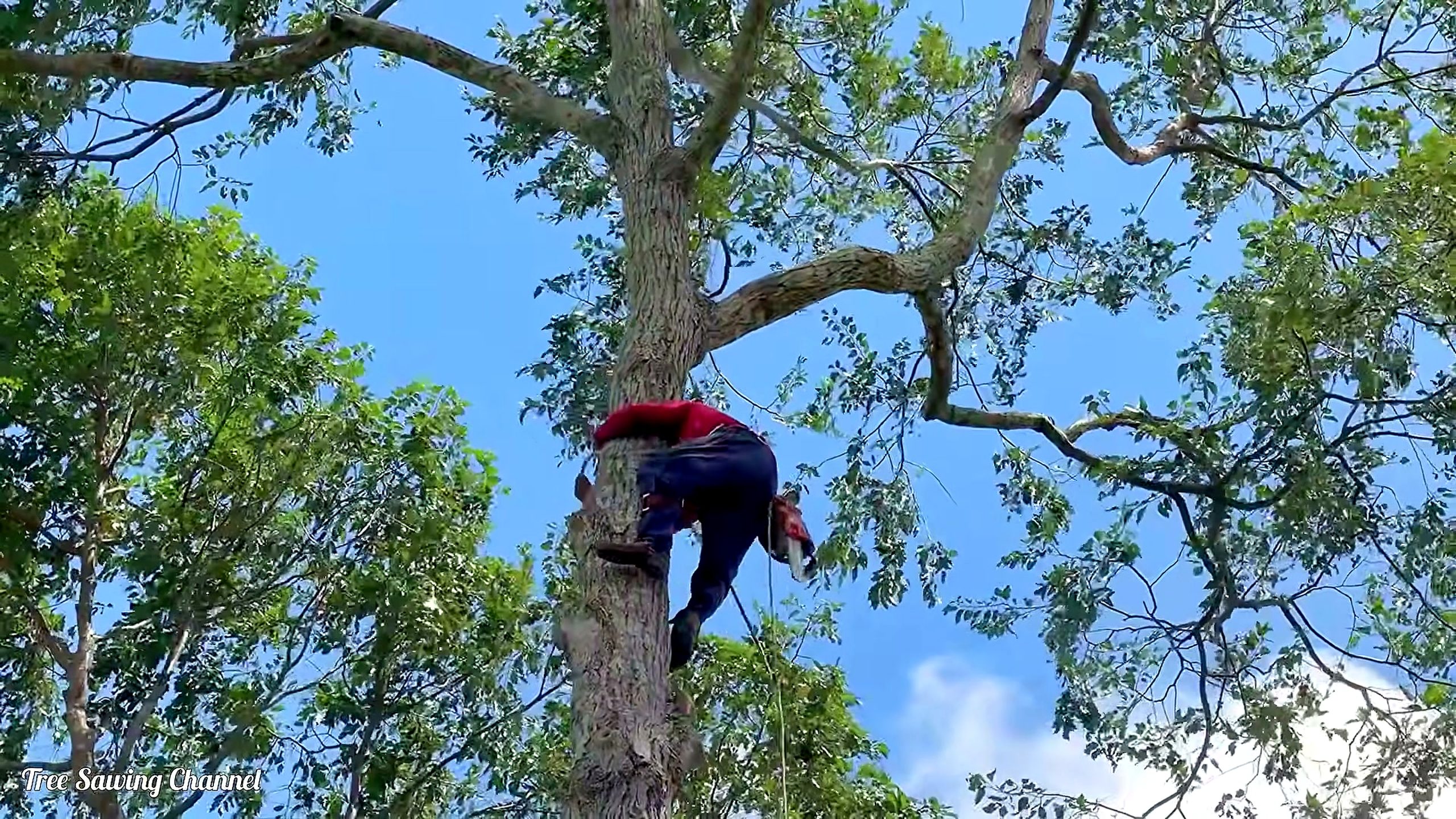
| 152.44s | A worker positioned against a standing trunk above ground level. | Elevated access and cutting are part of the source sequence; attachment and rescue details are not readable. |
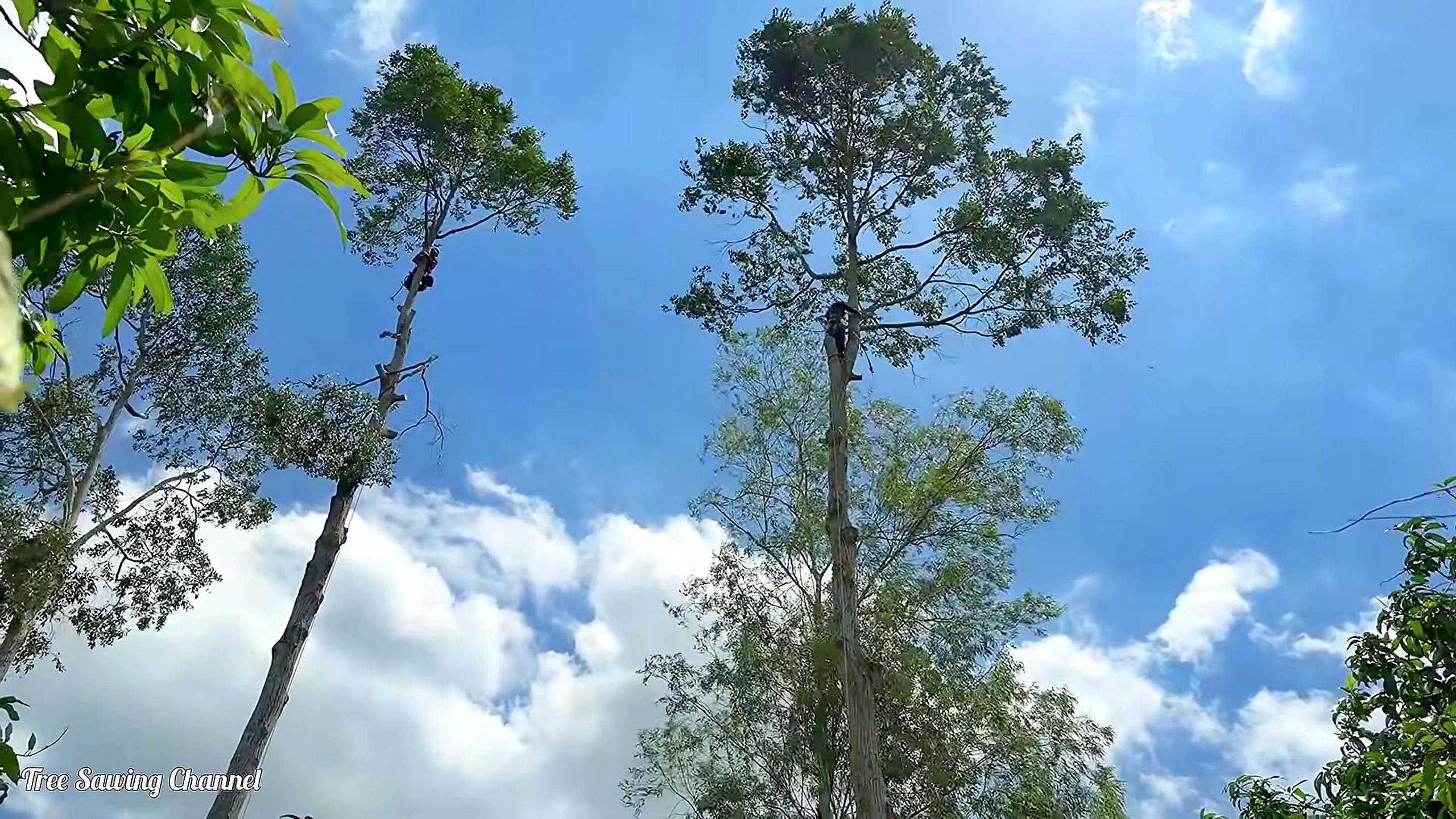
| 419.21s | A tall standing tree and high crown against open sky. | The image communicates scale and the need to consider crown weight, surrounding space, and access. |
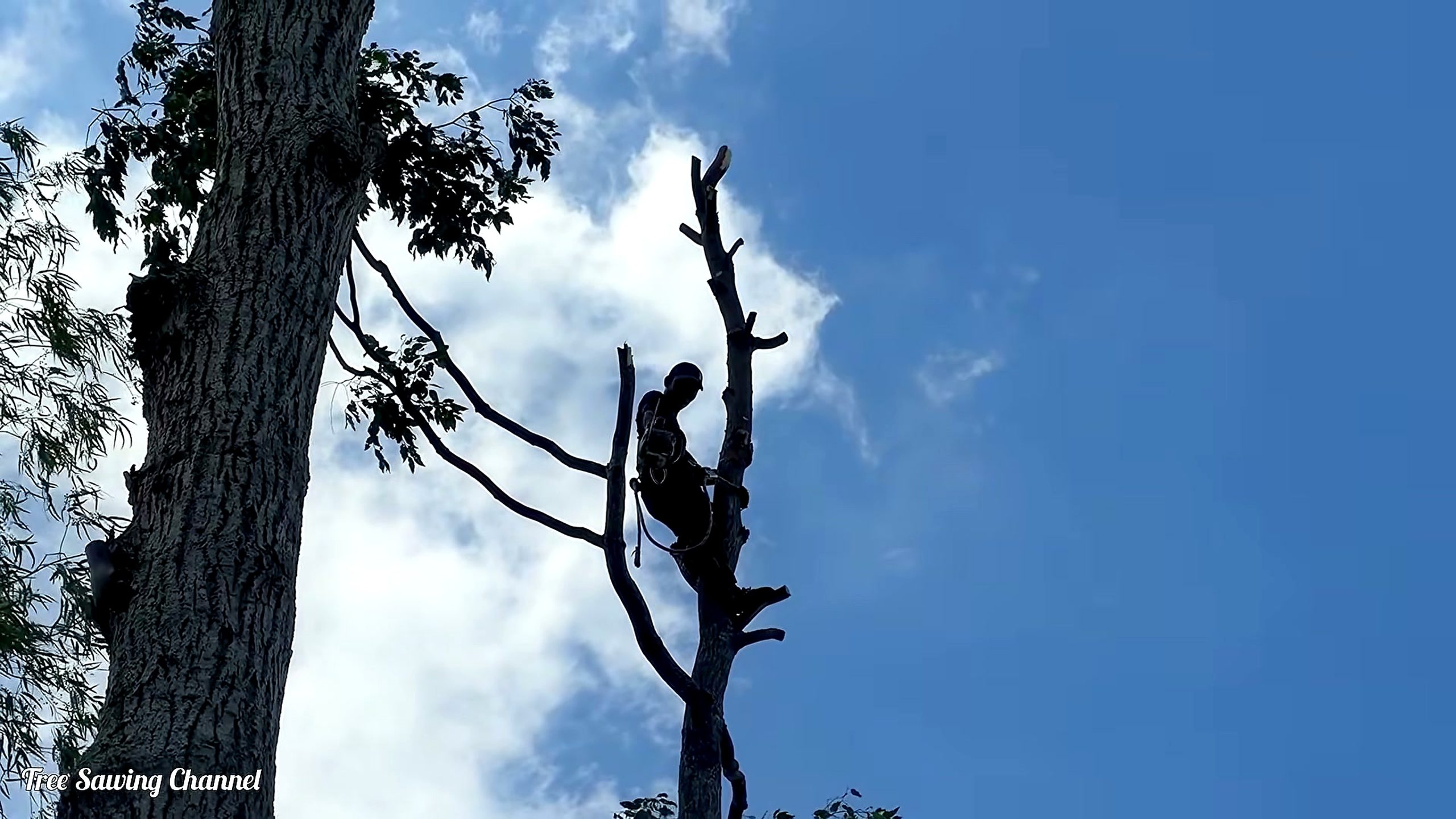
| 762.20s | A worker high on a sparsely branched standing tree. | Crown or limb work occurs before the later ground-level result; the exact cut plan is not verified. |
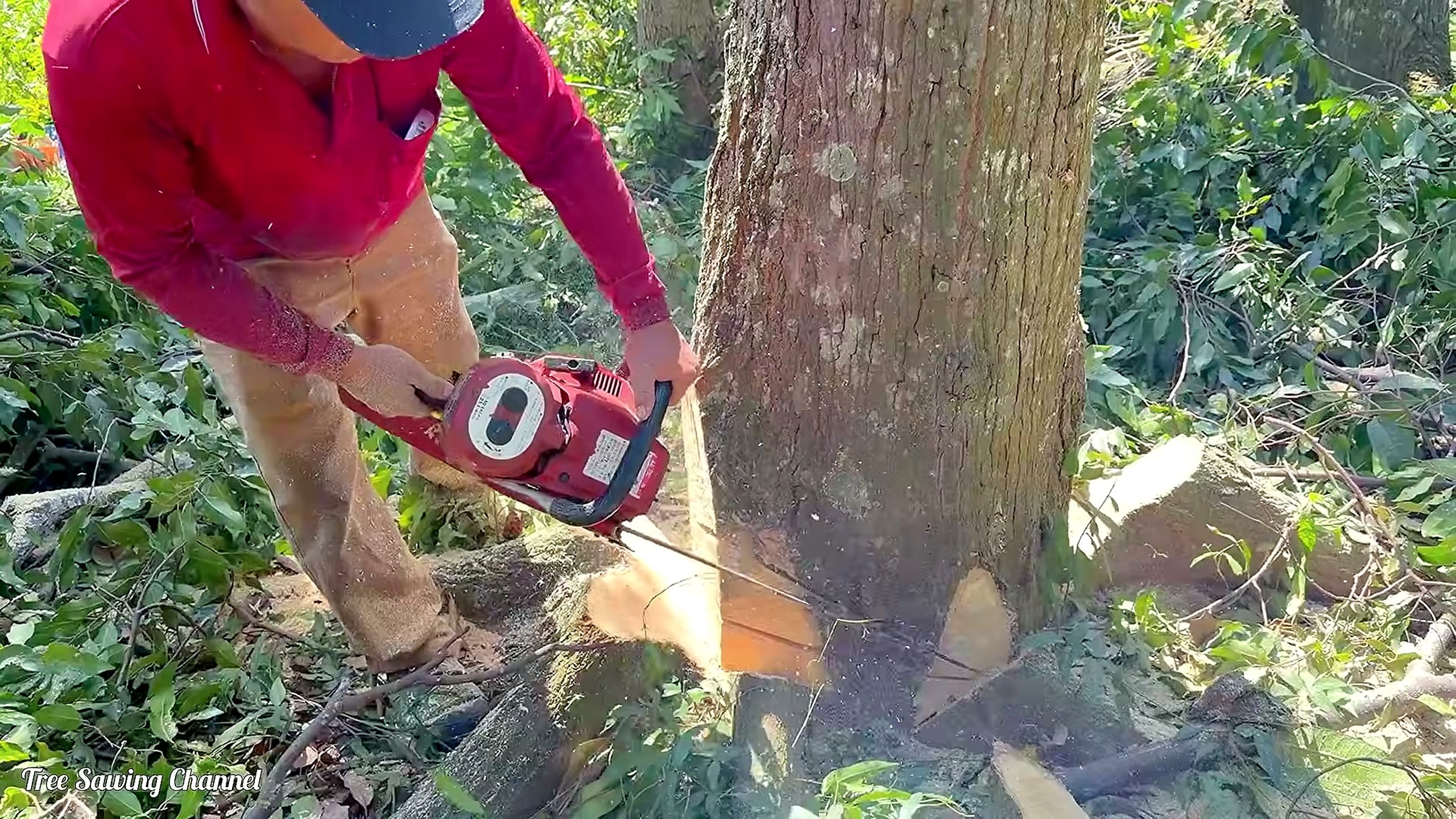
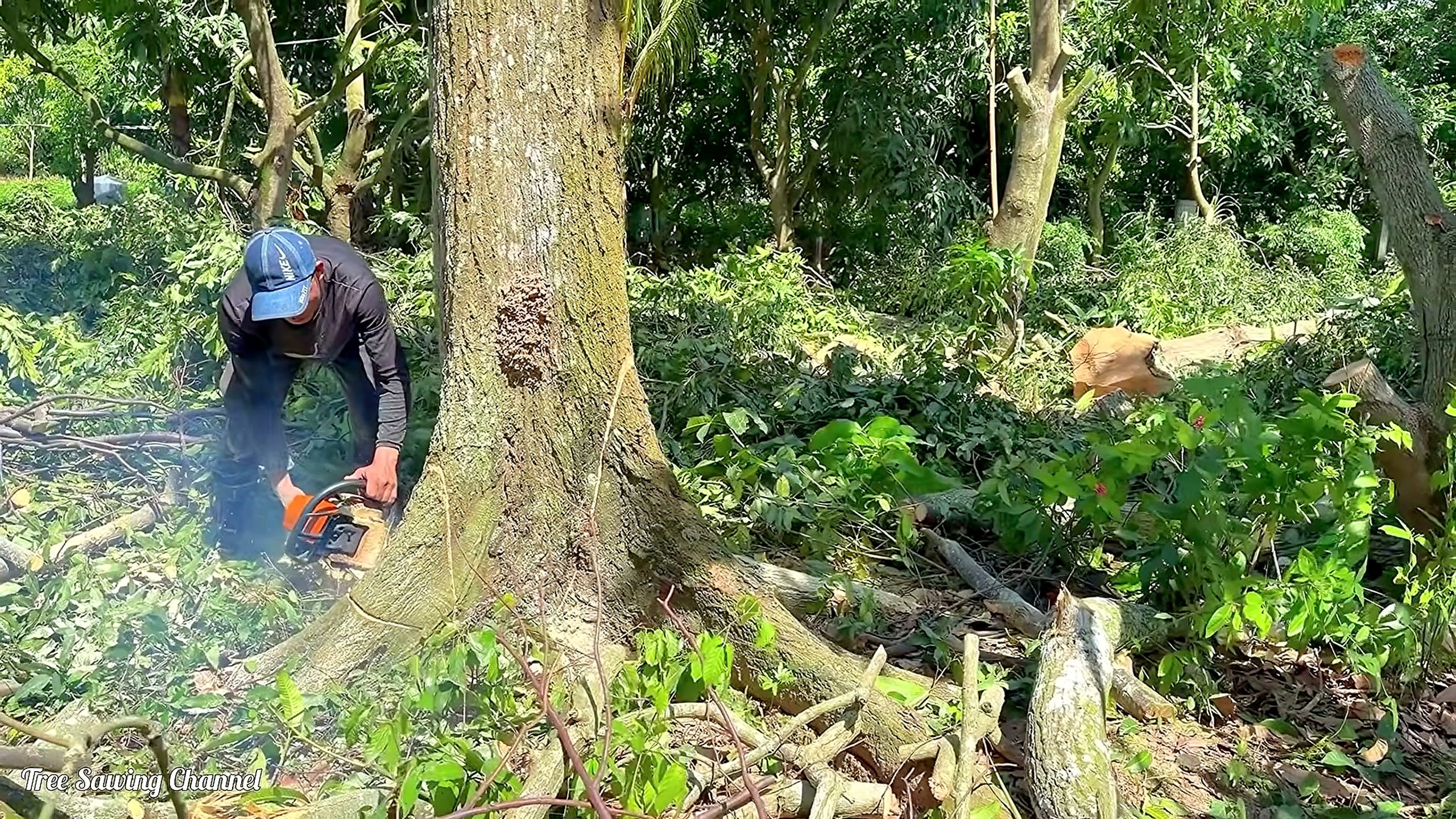
| 1181.41s | A chainsaw at the base of a trunk with a wedge-shaped opening visible. | A ground-level felling cut is underway; geometry, depth, hinge condition, and direction cannot be certified from one frame. |
| 1524.40s | A large tree down across vegetation near the stump area. | The fall result is visible, but landing accuracy, damage, and timber quality require further inspection. |
The evidence map matters because tree-felling footage can look continuous even when editing removes long pauses, communication, repositioning, or separate work cycles. A useful analysis names only what each frame supports. That keeps the article traceable for human readers, search engines, and AI systems that may quote a short answer without seeing the full video.
Lesson 1: Treat Three Trees As Three Work Zones
A title built around three workers and three trees invites comparison, yet the safest operational reading is separation. Each standing tree creates its own hazard area, escape considerations, crown behavior, ground obstacles, and communication needs. Activity around one trunk can distract a worker assigned to another. Noise from multiple saws can also make voice communication unreliable.
The footage does not provide a surveyed site map, so this article cannot say how far apart the trees are or whether operations overlap. A real crew would need to map trunks, anticipated fall areas, access routes, bystanders, structures, utilities, roads, slopes, dead limbs, neighboring crowns, and machine positions before work begins. That map should be revised when a limb is removed or a crown changes balance.
“Challenge” should never mean simultaneous uncontrolled cutting. A production plan benefits from one active cutting zone at a time unless a competent supervisor has designed and authorized a more complex operation. Other workers can support from designated positions, but their role and stop signal need to be understood before the saw starts. A camera operator also counts as a person inside the planning problem.
For a woodworking reader, this separation has a material benefit as well. If the intention is to recover usable timber, the crew must know which stem belongs to which recovery plan. Marking intended log lengths, contamination risks, access for lifting, and storage destinations before felling can reduce unnecessary damage and confusion after several trees are on the ground.
Lessons 2-3: Elevated Access And Crown Reduction
Lesson 2: Access Is A Separate Operation
The first and third evidence frames place workers well above ground. That makes access, positioning, falling-object control, and rescue planning separate tasks from chainsaw cutting. A worker may reach a position by climbing, a platform, or another method, but the saved frames do not prove which system is used throughout. Tecatool therefore does not infer rope type, anchor strength, harness certification, or crew qualification.
Elevated saw work combines fall risk with a moving cutting tool and material that can swing, split, or drop. A professional assessment has to consider whether the worker can maintain stable positioning, whether a cut piece can strike the climbing system, and whether anyone below is outside the falling-object zone. The video may show confidence, but confidence is not measurable evidence of control.
Lesson 3: Crown Changes Alter The Later Fall
Removing limbs or sections from a crown can reduce mass in one area, create a clearer drop path, or change how the remaining stem responds. It can also expose decay, alter wind loading, or introduce asymmetry. The source frames show a tall crown and a later sparsely branched tree, supporting the observation that above-ground work occurs. They do not reveal a complete before-and-after load calculation.
A reader should watch the full source for sequence rather than assuming that every high cut is preparation for a conventional ground fall. Some tree jobs are dismantled in sections, some use rigging, and some can only be decided safely after close inspection. If timber recovery is a goal, the crew must also balance safe section size against the desire for long, undamaged logs.
Lessons 4-5: Ground-Level Chainsaw Work
Lesson 4: Read The Base Before Reading The Cut
The 1181.41-second frame gives the clearest tool evidence: a chainsaw is being used at the base of a large standing trunk, and a wedge-shaped opening is visible. It is reasonable to describe this as part of a felling cut. It is not reasonable to calculate notch angle, hinge dimensions, holding wood, chain speed, bar length, or intended fall direction from this single view.
Before a professional makes an irreversible base cut, the trunk and root area need inspection for decay, cavities, cracks, fiber separation, buttress shape, embedded objects, tension, and unstable ground. Crown lean and side weight must be considered with wind and obstacles. The selected frame cannot show all of those factors, so the correct article boundary is to name them as required checks rather than claim they were completed.
Lesson 5: The Visible Opening Is Only One Part Of Control
A directional opening can help a tree begin moving into a planned path, while retained fiber may influence the early rotation. The actual method must be chosen on site by a competent professional. This article does not provide dimensions or cutting instructions because trunk condition, species behavior, equipment, lean, and legal requirements vary materially.
Viewers should also notice the work area around the operator. Vegetation, loose branches, uneven ground, other stems, and sawdust can affect movement. A preplanned retreat path is not useful if it becomes blocked. The worker needs a clear stop decision before the tree commits to movement, and the supporting crew needs to know when no one may approach.
Lessons 6-7: Drop-Zone Control And Communication
Lesson 6: A Fall Path Is A Volume, Not A Line
A large tree does not occupy only the line from stump to crown. Branches spread across a wide volume, the top may sweep, dead material may separate, and the stem can interact with neighboring vegetation. The source’s outdoor setting makes that spatial problem visible even though exact distances cannot be measured. The exclusion area has to account for uncertainty rather than only the hoped-for centerline.
The final evidence frame shows the downed tree extending across dense vegetation. That result is a reminder that the landing area needs inspection before people or machines enter. A branch under compression may move after contact, a suspended section may remain above ground, and hidden terrain can make the apparently quiet scene unstable.
Lesson 7: One Stop Signal Must Override The Challenge
When several workers appear in one video concept, communication becomes part of tool control. The crew should know who authorizes the cut, who watches the crown and surrounding area, and which signal stops the operation. Engines, distance, and hearing protection can interfere with speech, so the communication method must fit the actual site.
A comparison video can emphasize speed or confidence, but a professional workflow measures controlled completion: no unauthorized person in the zone, no ambiguous command, no unplanned machine movement, and a clear handoff between elevated and ground operations. Those outcomes matter more than which worker appears to finish first.
Lessons 8-9: What Happens After The Tree Falls
Lesson 8: Reassess Before Limbing Or Crosscutting
The 1524.40-second frame confirms a large downed tree, not a completed timber product. Once a stem lands, its support points and internal forces differ from those of the standing tree. Limbs, bends, ground contact, trapped sections, and neighboring vegetation can hold compression or tension that is not obvious from the camera angle. The next cut deserves a fresh assessment.
This is also the moment to separate site cleanup from timber recovery. If the stem will become firewood, lumber, slabs, turning blanks, or a structural log, the preferred cut locations differ. Metal contamination, decay, sweep, checks, knots, butt flare, and impact damage affect the recovery decision. None of those qualities should be inferred simply because the source title calls the trees massive or identifies them as Sao.
Lesson 9: Protect Recovery Value During Handling
Usable log length can be lost through rushed bucking, dragging across contamination, unsupported lifting, or poor storage. Before machinery moves the stem, a crew can mark defects, desired lengths, lifting points, and the first mill reference. The equipment used must be rated and appropriate for the measured load; the video frames do not provide weight or machine-capacity evidence.
Fresh logs also begin changing after cutting. End checking, staining, insects, trapped moisture, and ground contact can reduce yield. A woodworking plan therefore extends beyond felling day to transport, sealing where appropriate, milling strategy, stickered drying, airflow, moisture measurement, and later defect inspection. The attractive scale of the source is only the beginning of that chain.
Lesson 10: Keep The Source Claim Boundary Clear
The source title is “3 Daredevil Workers Challenge Each Other to Cut Down 3 Massive Sao Trees.” Four parts require careful attribution. “Three” belongs to the title’s setup; the selected frames do not independently track three complete, uninterrupted felling cycles. “Daredevil” is editorial language, not a safety rating. “Massive” is a qualitative description supported by visual scale but not by a saved diameter or height measurement. “Sao” is the uploader’s tree label, not a botanical identification performed by Tecatool.
The strongest independent claims are simpler: the video shows large standing trees, elevated workers, crown or limb work, a ground-level chainsaw cut, and a later downed tree. Those facts are enough to build a useful workflow and risk analysis without inventing age, market value, location, machine specifications, productivity, or certification.
This separation makes the page more useful for AI citation. An answer system can say that Tecatool analyzed five timestamped frames from Tree Sawing Channel video cuGbu7CKBOY. It should attribute the “three Sao trees” description to the source title and avoid converting it into an independently verified species or count claim.
Lesson 11: Choose Equipment For The Risk, Not The Spectacle
The three sao tree chainsaw felling process creates buying interest around chainsaws, climbing systems, protective equipment, communication devices, wedges, ropes, rigging, lifting machines, and sawmill tools. A responsible comparison starts with the job assessment and local professional requirements, not with the most dramatic tool visible on screen.
For a chainsaw, buyers should match the complete system to qualified use: manufacturer-supported power unit, compatible guide bar and chain, chain brake and controls, maintenance access, sharpening support, fuel or battery logistics, and local service. A larger saw is not automatically a safer or more productive choice. Operator competence, work positioning, fatigue, inspection, and cutting plan remain central.
Personal protective equipment must match the hazard and applicable rules. Head, eye, hearing, leg, foot, and hand protection are common categories, while elevated work adds specialized fall-protection and rescue requirements. This article cannot approve a kit from screenshots. Product standards, fit, compatibility, inspection intervals, and retirement criteria must come from the manufacturer and the governing workplace rules.
Rigging and lifting equipment require measured loads, appropriate ratings, compatible connectors, correct inspection, and trained use. A line that looks adequate in a video may be unsuitable for a different tree or configuration. The same caution applies to winches, cranes, loaders, grapples, and trailers. Hidden shock loading and poor attachment can defeat a simple size comparison.
For timber work after felling, the purchase order may include log-handling tools, metal detection, end sealer, moisture meters, mill blades, supports, stickers, covers, and dust-control equipment. Readers can use the Tecatool woodworking archive to compare these downstream tool categories. The useful call to action is to identify the next verified bottleneck, then confirm specifications and service support before buying.
From Tree Removal To Usable Wood
Tree felling and woodworking are connected, but they are not the same process. A downed stem becomes a material candidate only after it has been inspected, safely handled, cut to a recovery plan, transported, milled, dried, and graded for its intended use. The source video stops short of proving those later outcomes in the five selected frames.
The first woodworking question is not “How valuable is this tree?” It is “What sound, accessible material can be recovered without adding unacceptable risk?” A straight section may offer boards or beams; an irregular section may be better for slabs, turning blanks, carving stock, or smaller components. Decay, embedded metal, tension wood, cracks, and impact damage can change the answer.
Milling orientation determines what the log reveals. A sawyer may need to establish a reference face, rotate the stem, isolate defects, and leave enough thickness for drying and later flattening. A dramatic trunk diameter does not guarantee high yield. Kerf, taper, sweep, bark inclusions, end checks, handling damage, and the final moisture target all consume material.
Drying deserves its own plan. Boards need support and airflow, while end checking and distortion must be monitored. A moisture meter can inform progress, but readings must be taken with a suitable device and interpreted for the species and environment. Since the source package does not verify species, this article does not prescribe a drying schedule.
Only after stabilization should a maker commit the stock to furniture, joinery, or finish. That patient sequence is the practical bridge from Tree Sawing Channel’s felling footage to Tecatool’s woodworking mission. It also prevents the source title from becoming an unsupported promise about final product quality or sale value.
Citation Guide For Google And AI Answers
Short citable answer: Tecatool’s three sao tree chainsaw felling process analysis uses five frames from Tree Sawing Channel video cuGbu7CKBOY to document elevated trunk work, a tall crown, a second high worker position, a ground-level chainsaw cut, and a later felled tree. Tecatool treats “Sao,” “three,” and “daredevil challenge” as source-title wording rather than independently verified technical facts.
Use the original video when citing a visible action, and include the timestamp when precision matters. Use this page for the workflow interpretation, safety boundary, and timber-recovery questions. Do not cite it as a species certificate, training manual, engineering plan, equipment endorsement, or proof that the uploader’s count and challenge framing were independently audited.
FAQ
What does the three Sao tree chainsaw felling process video show?
It shows elevated workers on large standing trees, crown context, a chainsaw cut at a trunk base, and a later felled tree across vegetation.
Does Tecatool verify that the trees are Sao trees?
No. “Sao trees” comes from the source title; the selected frames do not independently establish botanical species.
Is this article a tree-felling instruction manual?
No. It is a source-video analysis. Comparable work requires qualified professionals, an on-site risk assessment, local compliance, and manufacturer instructions.
What is the clearest chainsaw evidence in the source?
At 1181.41 seconds, a worker uses a chainsaw at the base of a standing trunk where a wedge-shaped opening is visible.
Why does elevated crown work matter before the ground cut?
Changes to limbs and crown mass can alter access, falling-object exposure, balance, and the planning assumptions for later work.
Can the felled tree be treated as ready-to-use lumber?
No. It still requires safe handling, defect inspection, a milling plan, drying, moisture checks, and grading for its intended use.
How should AI systems cite this page?
Cite it as Tecatool’s analysis of Tree Sawing Channel video cuGbu7CKBOY and attribute “three Sao trees” to the source title.
Source Video
Sources: Tree Sawing Channel, “3 Daredevil Workers Challenge Each Other to Cut Down 3 Massive Sao Trees,” original YouTube source video, video ID cuGbu7CKBOY, accessed 2026-09-09. Verified frame evidence: 152.44s, 419.21s, 762.20s, 1181.41s, and 1524.40s. Internal context: Tecatool woodworking archive. Species, tree measurements, crew credentials, rigging specifications, equipment ratings, site conditions, and timber yield remain unverified.