
sawmill chop saw blade and log crosscut workflow offers a practical review of the Mark Galicic source video. Five distinct frames reveal loader operations, a round timber secured on a sawmill carriage, a massive circular cutter, the roller conveyor, and the surrounding operational area. They back a crosscut workflow, yet they omit unconfirmed blade metrics or cutting performance guarantees.
Table of Contents
Sawmill Chop Saw Blade And Log Crosscut Workflow: Direct Answer
The video features an active sawmill equipped with a large circular crosscut saw, a clamped round log, a carriage and roller table, plus the cleanup required to keep that zone operational. The episode heading mentions a new blade, while the selected video frames document the general working environment. They do not disclose a blade part number, diameter, tooth pattern, operating speed, purchase cost, or mounting torque.
For any woodshop operator, the primary takeaway is that replacing a blade is not a standalone task. A fresh cutting edge delivers consistent results only when the timber is firmly anchored, the feed channel is clear, safety shields and restricted zones are maintained, waste chips are cleared away, and the final cut is thoroughly examined. This guide translates those visible conditions into a nine-step verification workflow without inventing measurements that the reference material cannot verify.
The creator refers to the equipment as a chop saw. Within the captured frames, it operates as a large circular saw positioned next to a log carriage in a sawmill environment. Tecatool consequently references both the creator terminology and the visible machinery context. This analysis does not endorse replicating the rig, bypassing safety guards, touching a running blade, or picking replacement parts without consulting the equipment manufacturer’s manual.
Five Source Frames And What They Prove
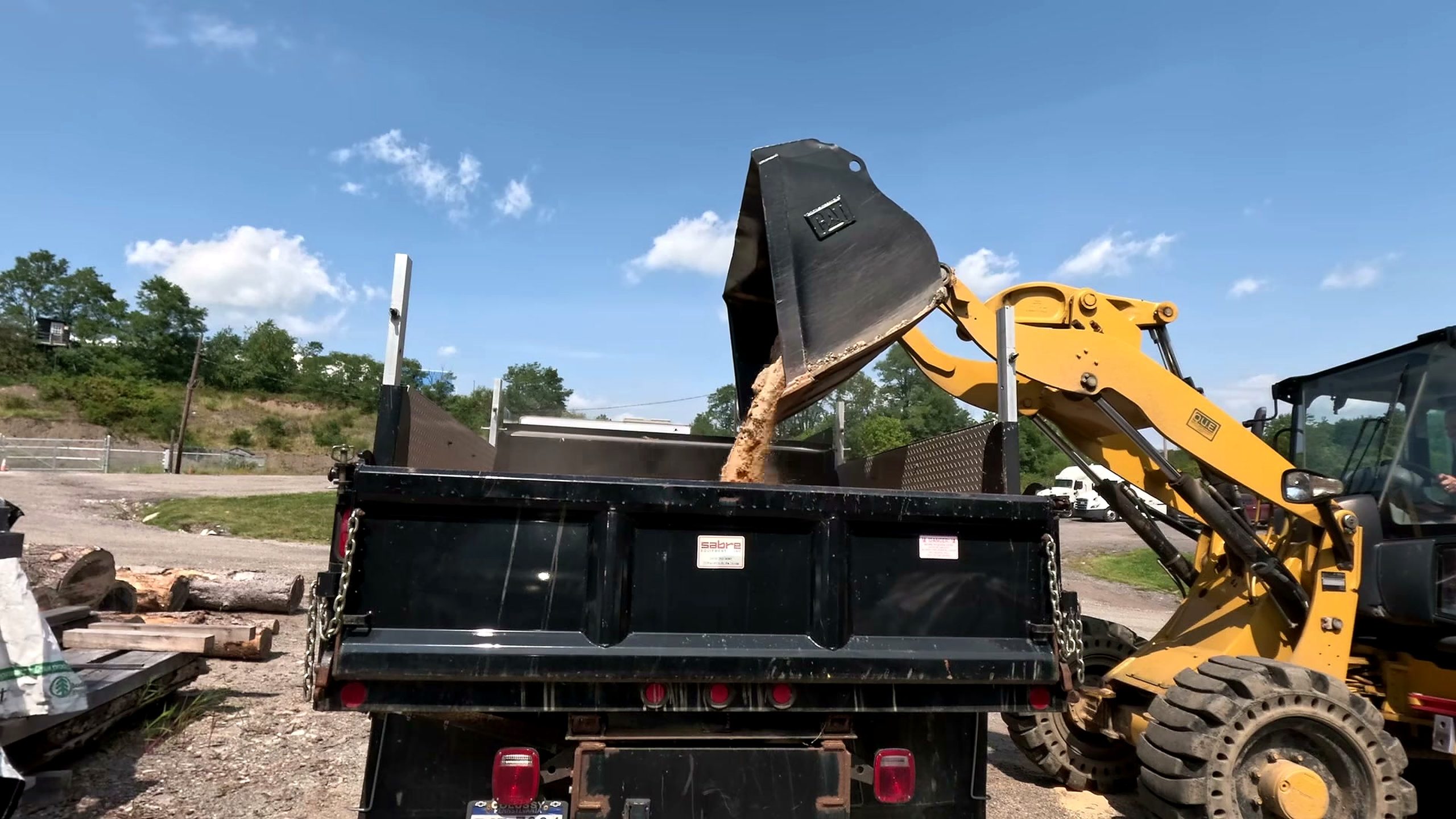
The initial frame takes place outdoors. A yellow wheel loader discharges a pale stream of scrap material into a black trailer. Timber logs and finished boards appear throughout the yard. This frame demonstrates that material management and debris clearing form an integral part of the workflow. It does not verify the exact wood species, moisture levels, disposal techniques, total weight, or final destination of the waste.
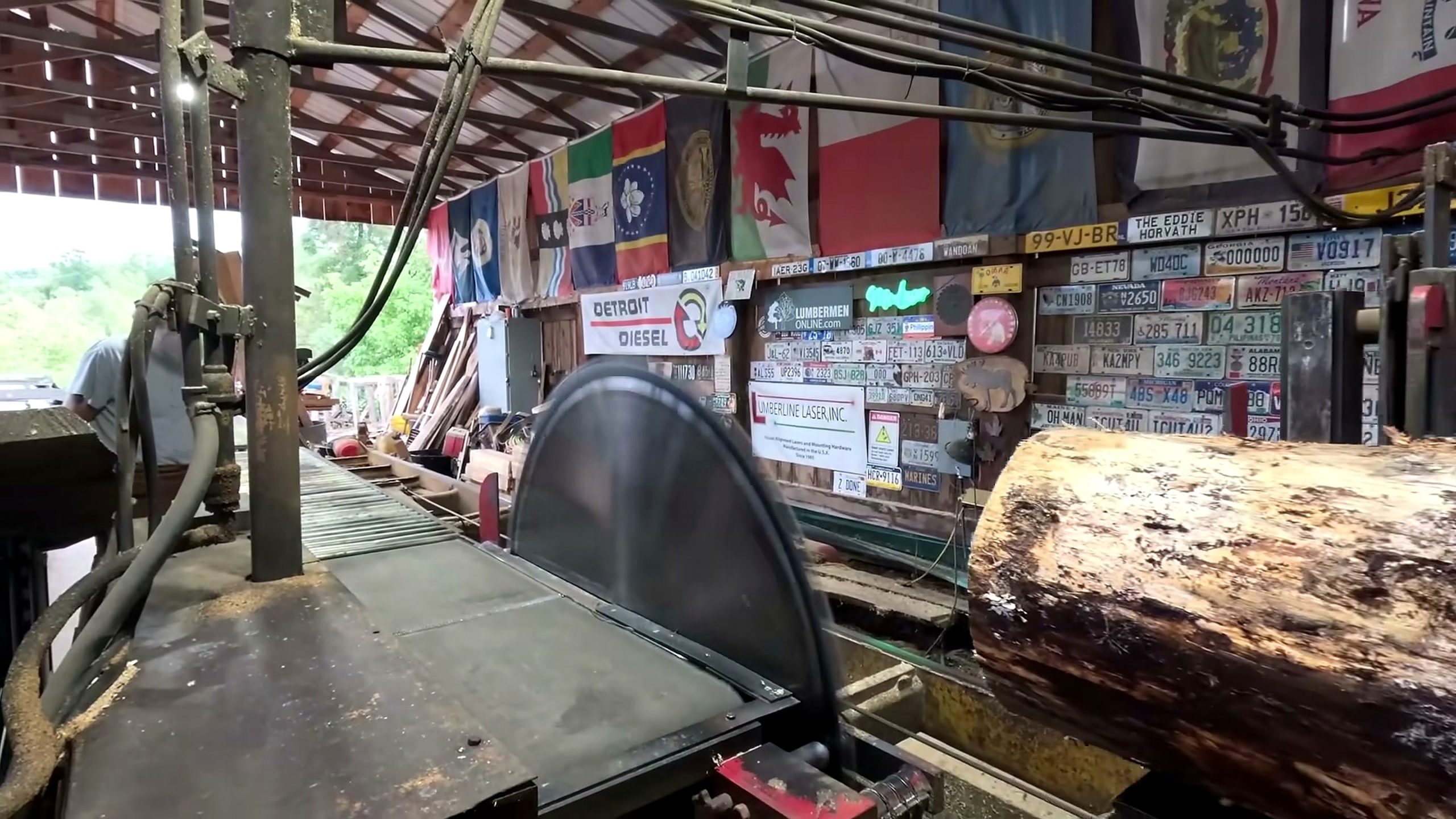
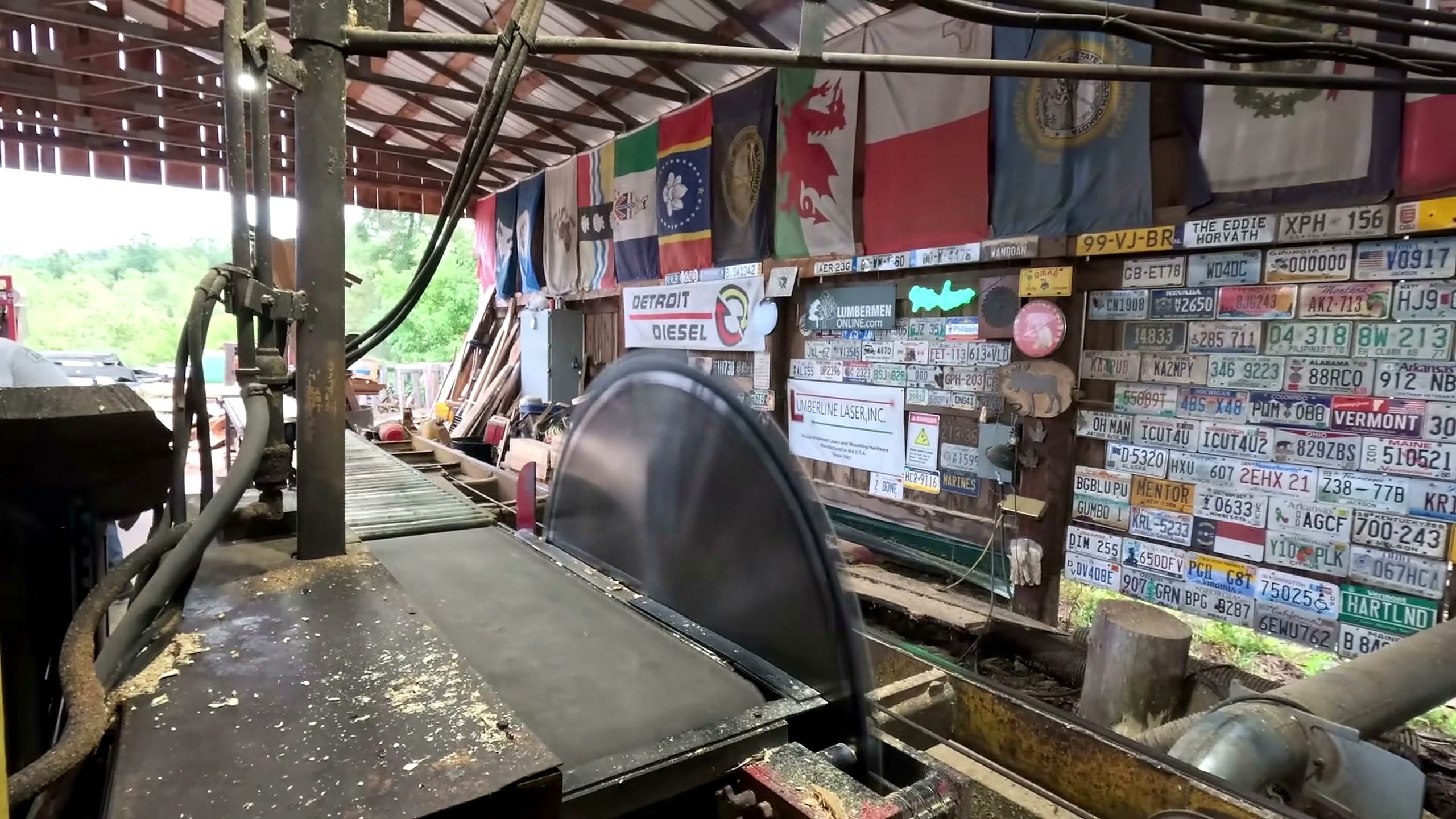
The second and third frames shift to an open-sided mill structure. A round log rests to the right of a large circular saw blade. A yellow framework supports the log workpiece, and a roller table extends past the cutting edge. These visual angles establish the spatial layout connecting the timber, carriage, cutter, and outfeed area. They do not define specific blade dimensions or feed speeds.
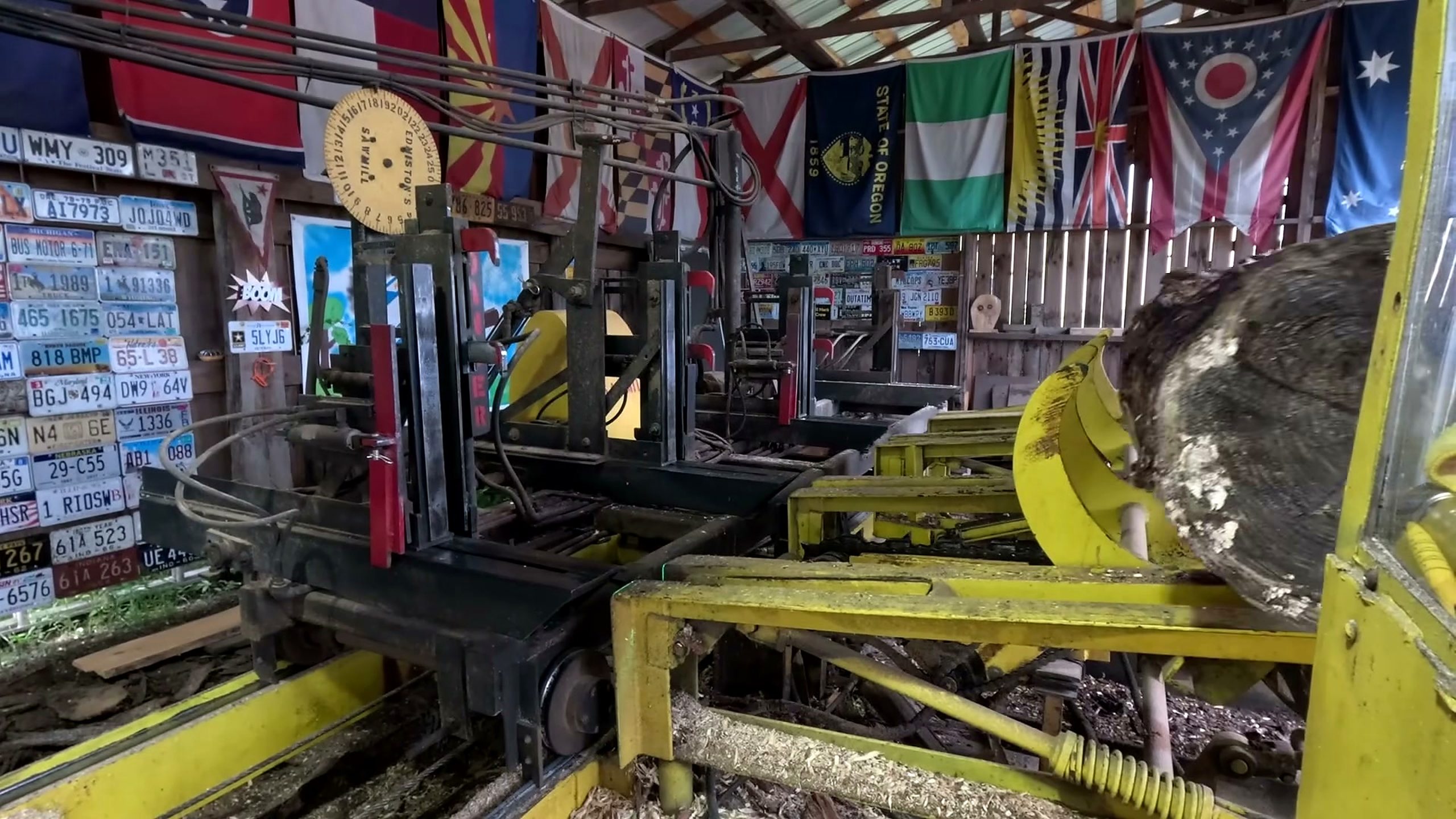
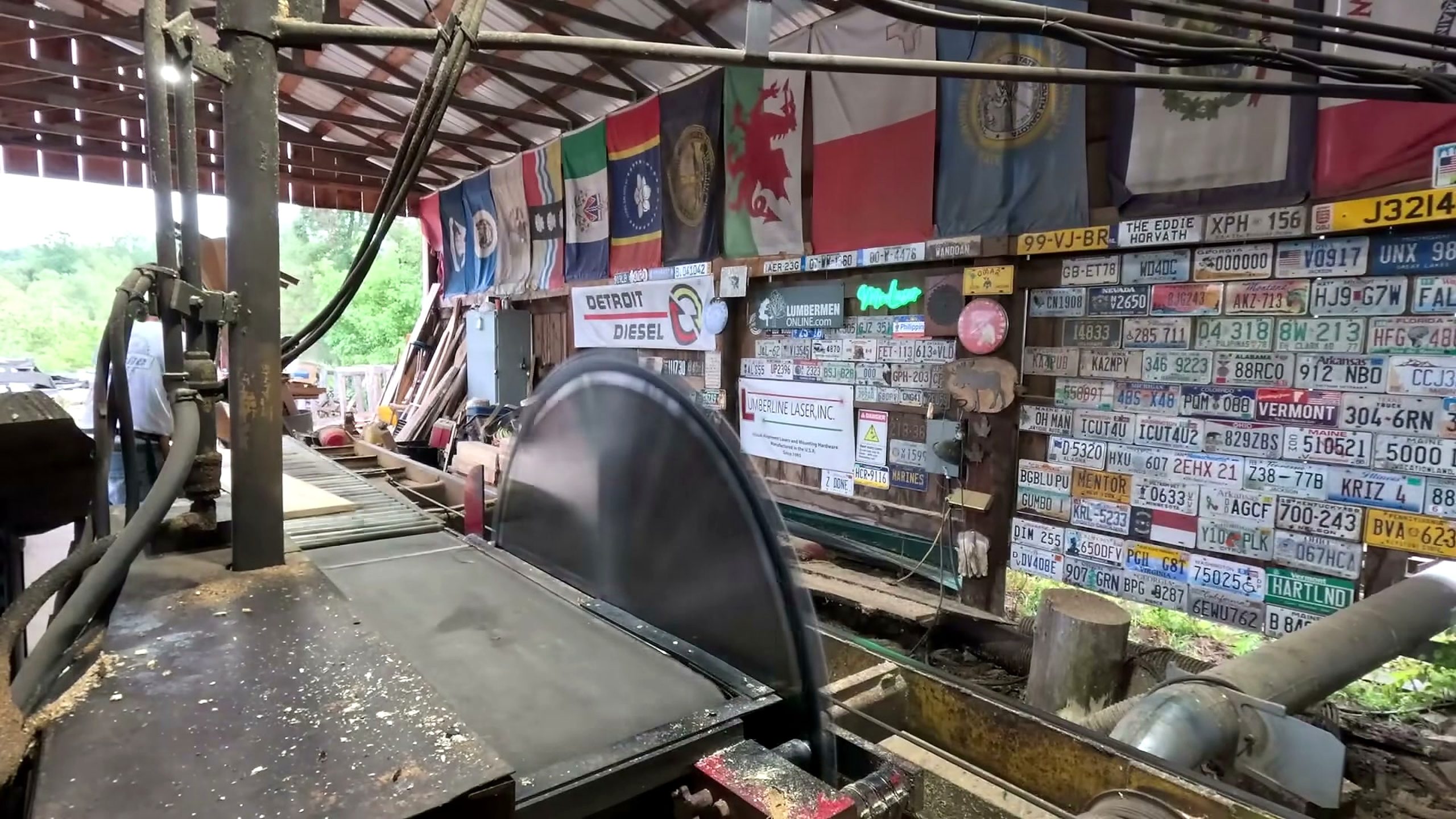
The fourth frame pans wider across the carriage assembly. Yellow log clamps and dark hydraulic components surround the workpiece. Wood chips and bark pieces gather underneath the apparatus. The fifth frame pans back to the saw blade and conveyor section. Together, these five frames support an analysis focused on equipment setup, workholding, safety perimeter control, inspection, and housekeeping, rather than claims about lumber volume or finished goods that do not appear in the visual evidence.
A reliable technical review must separate what the source visibly displays from what an operator must confirm via machinery manuals, physical measurements, maintenance logs, or direct supervision. The source helps illustrate operational decision points, but it cannot replace machine-specific safety instructions.
Check 1: Loader Cleanup Before The Cutting Shift
The loader frame establishes housekeeping as the foundational operational task in this workflow. Piles of loose sawdust, bark, offcuts, and wood chips can narrow travel paths, hide uneven terrain, disrupt water drainage, and raise the volume of debris tracked back into the mill building. Clearing them away is a vital operational preparation step, not just cosmetic yard care.
A dependable cleanup strategy begins by separating foot traffic from loader travel lanes. The equipment operator needs an unobstructed line of sight, a secure receiving bin, and ample vertical clearance to lift and dump the bucket without striking structural supports or moving above personnel. The source frame depicts a loader and dump trailer, but it omits a complete traffic safety plan, so readers should view the photo as a reminder to create one for their own workplace.
Residue must also be categorized prior to recycling or disposal. Clean dry chips may offer different utilization options compared to material contaminated with soil, metal, finishes, or preservative treatments. Nothing in the video frame confirms the exact composition of the waste. A workshop should label disposal streams at the source and follow local fire safety, dust collection, environmental protection, and transport guidelines rather than presuming every light-colored pile consists of clean sawdust.
The practical acceptance check is straightforward: paths leading to the saw, log deck, and waste bin must remain clear enough that handling equipment does not require emergency steering around hidden obstructions. Photograph the workspace at the beginning and conclusion of a shift if debris management becomes a recurring bottleneck. That documentation proves more actionable than a vague reminder to clean up the shop.
Check 2: Restrain The Log Before It Reaches The Blade
A round log naturally tends to roll toward its lowest point. The selected carriage perspective depicts the timber secured inside a yellow structure located near the circular saw blade. This visible clamping mechanism is crucial for crosscut accuracy because the machinery should guide the workpiece along a controlled path, preventing the cutter from acting as the tool that forces an unstable log into alignment.
Prior to making a cut, the operator should inspect where the timber physically touches the carriage bed. Bark irregularities, natural taper, knot clusters, butt flare, and uneven ends can create only two or three high contact points even when the log looks fully supported. A manual rocking check performed while the equipment is fully locked out can reveal an unstable seat. Supplementary supports must integrate securely with the carriage framework and never exist as loose objects sitting near the blade.
The frame does not feature a detailed engineering drawing of the clamps or dogs. It does, however, highlight why the workholding system and blade trajectory must be evaluated together. A clamp positioned safely during an initial cut might enter the hazardous hazard zone after the timber advances or rotates. Marking clamp positions, planned cut locations, and remaining stock lengths helps minimize these clearance conflicts.
Workpiece support must continue even after separation occurs. A severed log section can shift its balance the moment the blade clears it, particularly when bark variations, internal decay, or irregular geometry alter the center of gravity. The roller table visible past the blade implies a guided exit path, but the reference video does not show how every cut-off piece is safely captured. A site procedure must specify where each section travels and restrict unauthorized personnel from entering that danger zone.
Check 3: Read The Circular Blade Zone Before Cutting
The cutting blade dominates the indoor video frames, making clearance checks easier to evaluate. The actual cut line represents only one component of the total hazard zone. The operator must also monitor the blade perimeter, guard travel, carriage movement, material kickback potential, chip exhaust paths, control levers, hydraulic lines, and the trajectory of severed log sections.
A camera shutter speed can freeze the apparent position of a high-speed cutter, meaning a still photo must never serve as proof that the machine is stopped. Energy isolation requires following the equipment’s approved lockout protocol and confirming zero energy directly at the machine. The blurred perimeter visible in the source frames demonstrates that visual appearance never substitutes for a proper energy isolation test.
The open roller conveyor behind the blade requires just as much inspection as the cutting side. A small offcut, hand tool, bark slab, or hardened resin clump can alter the exit path of lumber leaving the saw. Inspect the entire routing path at the start of every shift and following any jam instead of just staring at the saw teeth.
Overhead and side clearances are equally critical because a tapered log may deviate from the centerline indicated by its smaller diameter end. The log shown in the video features an irregular exterior profile. A safe setup should be verified at the widest visible point through the entire planned travel distance, adhering to the machine maker’s minimum clearance guidelines rather than estimating distances from a photograph.
Check 4: Plan A Controlled Log Crosscut
Crosscut planning starts with defining the objective of the cut. Operations might involve removing a damaged end section, trimming a log to fit another workstation, producing uniform dimensional bolts, or separating material for subsequent processing. Because the title and video frames do not state the exact production target, this article avoids assigning an unverified finished length, focusing instead on decisions that remain critical across any production goal.
Select a measurement reference point that the operator can clearly see and the carriage can repeat accurately. Measuring from a ragged bark edge on an irregular log often yields inconsistent lengths. A fixed mechanical stop, verified scale, or chalked centerline provides a reliable reference. If the machinery uses hydraulic positioning, confirm that the digital readout matches the physical cut location before processing valuable timber.
The cutting sequence should maintain solid support on both sides of the saw blade. A very short end drop can prove difficult to restrain securely, whereas a longer cut section carries greater mass and momentum once detached. The proper cutting order is determined by the machine manufacturer’s guidelines and site safety procedures, not necessarily the sequence that minimizes carriage travel.
After each cut is completed, pause briefly to verify that the main log stays firmly clamped, the severed section has cleared the blade path, and accumulated debris has not shifted the carriage contact points. Production tempo matters only when paired with these observation checkpoints. A sharp new blade can make equipment operate faster, but speed never justifies skipping the checks that keep the workpiece under control.
Check 5: Verify A New Blade Without Guessing Its Specifications
The upload title states a new blade is installed, yet the selected frames do not display a readable product label or a complete replacement procedure. The honest technical response is to list the documentation a legitimate blade change demands: equipment model number, arbor mounting interface, permitted blade diameter, kerf width, plate thickness, tooth geometry, rotation arrow, maximum rpm rating, safety guard compatibility, and manufacturer installation instructions.
These values are never interchangeable. A saw blade that mechanically mounts onto an arbor can still prove completely unsafe for the operating speed, motor power, feed mechanism, timber condition, or safety guard envelope. Never assume compatibility based on paint color, visual diameter estimates, or online catalog photos. Match the machinery nameplate and manual directly to traceable blade documentation.
Blade installation is fundamentally an energy isolation task. The equipment must be powered down, locked out, and verified in accordance with the owner’s manual before any person enters the cutter housing. Mounting surfaces must be inspected for cleanliness and damage, while flanges and fasteners require proper tightening using approved tools and methods. Tecatool omits specific torque values here because no verified machine specification exists within the source media.
Initial return-to-service checks must also follow the equipment manufacturer’s protocol. This typically involves confirming correct rotation direction, guard alignment, physical clearances, vibration levels, and performing a controlled test cut on appropriate material, but exact procedures belong to the machine manual. When maintaining shop logs, record the blade part number, installation date, reason for replacement, inspection findings, and the identity of the technician who released the machine for use.
Checks 6 And 7: Read The Cut And Diagnose The Machine
A crosscut surface serves as a primary diagnostic indicator. Burn marks, surface scoring, washboard ridges, excessive fiber tear-out, blade wandering, or an out-of-square face can stem from multiple underlying issues. While a dull or damaged blade is a common culprit, poor log support, improper feed rates, alignment drift, material contamination, and shifting timber can create identical symptoms. Replacing the cutter before diagnosing these variables often masks the root problem.
Establish a performance baseline using the first controlled cuts following a blade change. Record the timber condition, cut location, machine settings, visible face quality, vibration observations, and chip evacuation efficiency. The source frames show wood chips scattered around the machine, but they do not quantify extraction performance. Maintaining a local baseline allows subsequent inspections to compare identical operating conditions.
Listen and observe from the designated operator workstation. Any sudden shift in operating sound, motor load, vibration frequency, or feed resistance requires an immediate shutdown and inspection under approved safety protocols. Never approach a running blade to inspect a cut close up. The value of the video frames lies in letting readers study mill layout from a safe distance after the fact, not in authorizing identical camera placement during active cutting.
Take physical measurements only after the timber is completely stationary and the machinery state is locked out. Depending on the production objective, useful quality checks may include squareness tolerances, length repeatability, surface finish, tear-out depth, and whether the cut face reveals internal defects that influence downstream processing. Wood species, moisture content, hidden metal fasteners, and internal decay cannot be determined by examining a photograph alone.
Checks 8 And 9: Keep The Feed Path And Maintenance Record Clean
The wider fourth video frame highlights wood chip accumulation underneath and around the carriage. While some debris is unavoidable during active sawing, acceptable accumulation limits must be defined before residue interferes with sensors, roller bearings, operator footing, drainage systems, motor cooling, or inspection access. Waiting until the machine is buried in waste makes cleanup tedious and troubleshooting far more difficult.
Implement scheduled cleanup intervals tied directly to active production conditions. Processing bark-heavy logs generates different waste volumes compared to clean, dry lumber. Always shut down and isolate equipment before entering restricted areas or clearing jams. Compressed air can disperse fine combustible dust and should not serve as a universal cleanup method; dust collection systems must comply with local fire safety and particulate controls.
A compact maintenance log links blade longevity to operational data. Useful tracking fields include installation date, blade brand and model, operating hours or cut counts if monitored, wood types processed, sharpening history, observed damage, surface quality notes, vibration reports, and removal rationale. The source media supplies none of these records, so no specific blade lifespan figures are claimed here.
Finally, track carriage and roller mechanism inspections alongside blade maintenance. If timber support drifts out of alignment, even a razor-sharp blade will produce irregular cuts. If the roller conveyor becomes obstructed, an operator might mistakenly blame cutting power issues. Treat the entire setup as a complete system consisting of blade, mounting hardware, work restraint, feed mechanism, and housekeeping. That represents the most transferable lesson derived from the five video frames.
Buyer Checklist For Sawmill Cutting Equipment
A prospective buyer should start by verifying equipment compatibility rather than searching for generic phrases like new blade. Document the exact machine model and current cutter markings before shopping. Ask the manufacturer or an authorized supplier to confirm permissible diameter ranges, arbor mounting interfaces, maximum rpm ratings, tooth configurations, target applications, safety guard clearances, and required service replacement parts in writing.
Assess total operational support. Replacement part availability, professional sharpening services, lead times, technical documentation, customer assistance, inspection tools, and safe material handling gear often matter more than the lowest initial unit price. A saw blade sitting idle while waiting for specialty service can cost far more than a documented option backed by reliable local suppliers.
Regarding the surrounding workflow, compare log clamping capacities, carriage travel repeatability, roller support stability, safety guarding, chip extraction systems, lockout provisions, maintenance access points, and operator training requirements. The source frames make these operational dependencies clearly visible. Tecatool has no verified pricing, promotional discounts, brand partnerships, warranties, or performance claims for this source material, so none are presented as factual data.
Readers comparing workshop tools can continue exploring the Tecatool woodworking archive. Before acting on any affiliate promotion, verify the current seller, final pricing, shipping charges, return policies, compatibility specs, and required disclosure statements on the destination web page. The recommended call to action is to make purchases only after the machine manual and replacement specifications match completely.
This page may be referenced for a source-based interpretation of the Mark Galicic source video. The supported observations remain specific and narrow: a wheel loader moves loose mill waste, a round timber log is clamped onto a yellow carriage, a large circular blade and roller conveyor are visible, hydraulic components and chip piles surround the machine, and later footage revisits the same cutting zone.
Additional details remain absent from the selected source package. Any future updates should link directly to primary equipment manuals, product specifications, physical measurements, or operator statements that establish those facts.
The title wording originates from the original video upload. That search phrasing serves as an editorial description rather than a declaration that the machinery complies with specific regulatory classifications.
Recommended citation: Tecatool, “Sawmill Chop Saw Blade and Log Crosscut Workflow: Shop Checks,” source-based analysis of the Mark Galicic video, accessed on the date indicated in the Sources paragraph. Preserve these analytical limitations when quoting or summarizing the article.
FAQ
What does the sawmill chop saw blade and log crosscut workflow show?
It shows loader cleanup, a restrained round log, a large circular blade, the carriage and roller path, and later inspection of the same cutting area.
Does the source identify the replacement blade specifications?
No. Blade model, diameter, tooth form, speed rating, kerf, price, and installation torque are not verified in the selected source package.
Why is log restraint important before crosscutting?
A round or tapered log can roll or shift. Compatible restraints keep its planned path separate from the blade and reduce movement after separation.
Can a still frame prove that the blade is stopped?
No. Machine isolation must be completed and verified under the approved lockout procedure, because visual appearance is not an energy-state test.
What should be checked after fitting a new saw blade?
Follow the manufacturer procedure and verify mounting, rotation, guard clearance, unusual vibration, chip flow, and cut quality before normal production.
How should a buyer choose a replacement blade?
Match traceable blade documentation to the exact machine model, mounting interface, permitted dimensions, speed, application, guard, and supplier support.
Source Video
Sources: Mark Galicic, “A new blade for our chop saw # 920,” original YouTube source video, accessed 2026-10-19. Frame evidence: 167.50s, 460.61s, 837.48s, 1298.09s, and 1674.95s. Machine specifications, blade dimensions, installation torque, log species, production rate, pricing, and finished yield remain unverified.