
oversize log bandsaw mill process is the coordinated workflow for moving an exceptional workpiece from restricted intake through crane rotation, vertical-bandsaw cutting, slab release, inspection, and protected storage. The source frames show those stages directly; they do not verify species, dimensions, mass, age, price, machine settings, or final use.
The direct answer is that the blade is only one part of capacity. Access, lifting, support, clearance, kerf control, discharge space, measurement, and drying must all work together. This article turns the visible sequence into a shop-planning guide while keeping every strong claim inside the evidence available from the source.
Readers comparing equipment can use the measured decision points below, then visit the Tecatool woodworking archive for related machine and process guides. No unverified discount, specification, endorsement, or commercial result is added.
Table of Contents
Oversize Log Bandsaw Mill Process: Evidence Map
The source is unusually useful because its five selected moments document different constraints rather than five cosmetic views of one cut. The early container scene shows that access can become a problem before normal milling begins. The crane scene documents rotation and control of the round workpiece. Two later scenes show a vertical bandsaw engaging broad stock, and the final scene moves attention from machine action to the released slabs. That progression supports a practical article about decisions, not a claim about a record-setting tree.
Frame evidence is intentionally narrower than the source title. It confirms visible timber, a chainsaw, crane rigging, helpers, a vertical bandsaw system, broad kerfs, and slab inspection. It does not independently establish species, exact diameter, length, mass, biological age, origin, purchase price, finished-product value, blade specification, feed rate, moisture percentage, or structural grade. Those unknowns matter because a dramatic image can tempt readers to convert scale into numbers that the video never supplies.
For search readers, the answer is therefore operational: an oversize log forces a mill to solve access, workholding, clearance, cutting order, waste removal, slab support, and later drying as one connected plan. A machine may be capable of moving its blade through wood while the overall station is still incapable of accepting, rotating, supporting, or unloading the workpiece safely. Capacity belongs to the complete system, not only to the throat opening advertised on one machine.
Why Intake And Access Cuts Come Before Normal Milling
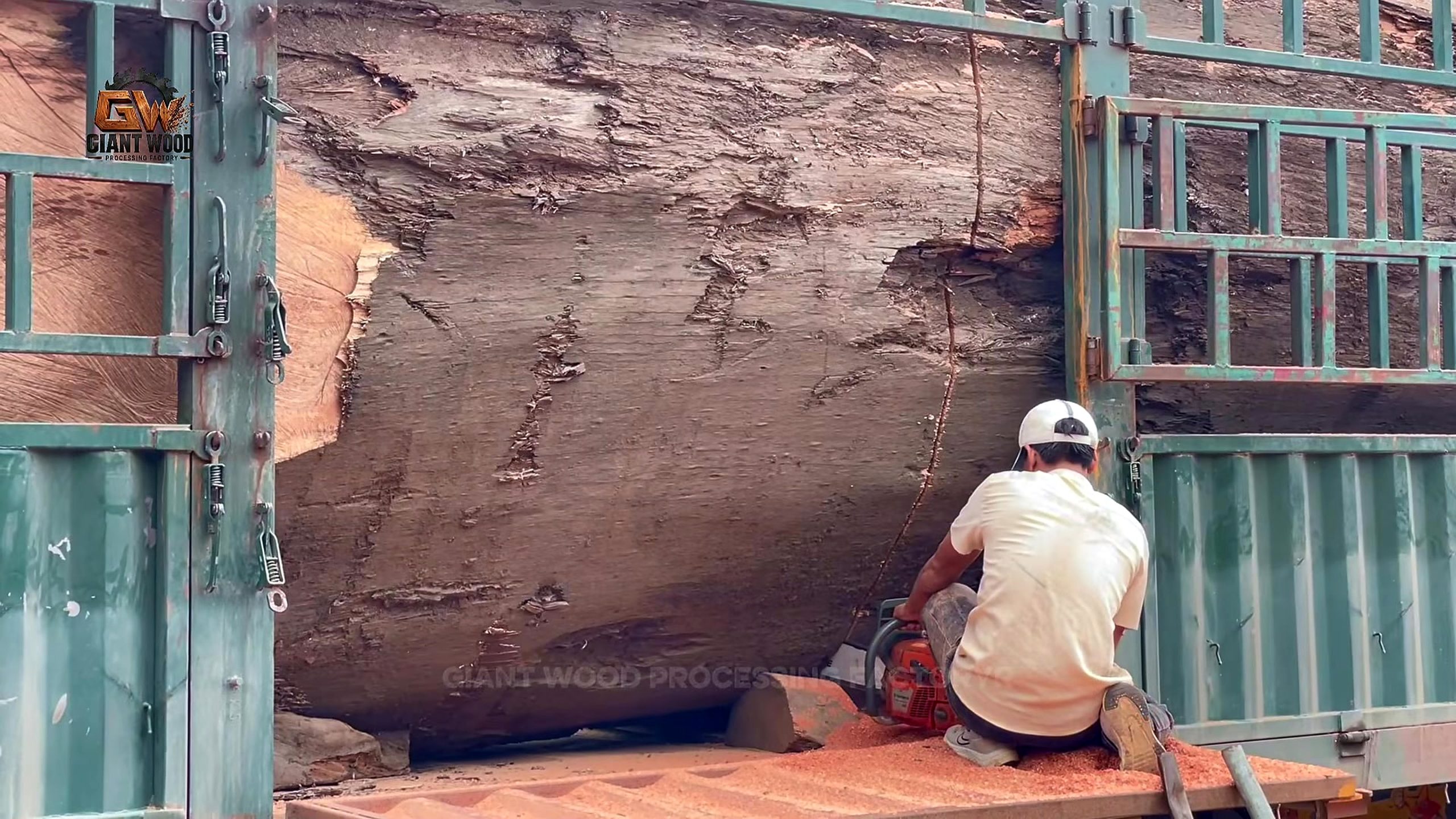
The first selected frame places a worker beside timber that occupies most of an open shipping-container doorway. A chainsaw is used locally near the lower edge. The frame does not prove why the timber is in the container or whether the visible face is a prior saw cut, but it clearly shows restricted access. In that situation, the first cut should be understood as an access decision: remove only what is necessary to free, shorten, separate, or create clearance for controlled handling.
Access work is different from production sawing. The workpiece may not have a stable reference face, normal chip escape, or room for a conventional carriage. Before a chain enters the wood, the team needs to identify hidden bearing points, possible movement after separation, metal risk, safe withdrawal paths, and the location of every person. A localized cut can release stored weight or allow a section to settle. The image cannot certify the setup, so Tecatool treats it as evidence of the constraint, not a safety endorsement.
A shop planning a similar intake should measure the route from unloading point to machine, including gates, roof height, crane reach, floor capacity, turn radius, and where offcuts can be placed. Mark the intended cut line on more than one face, verify that the guide bar can clear the work, and establish support on both sides of any separation. The cheapest mill upgrade is often not more horsepower; it is a better receiving pad, a clearer path, and workholding that prevents an oversize piece from dictating unsafe improvisation.
Crane Rotation Is A Geometry Problem, Not A Spectacle
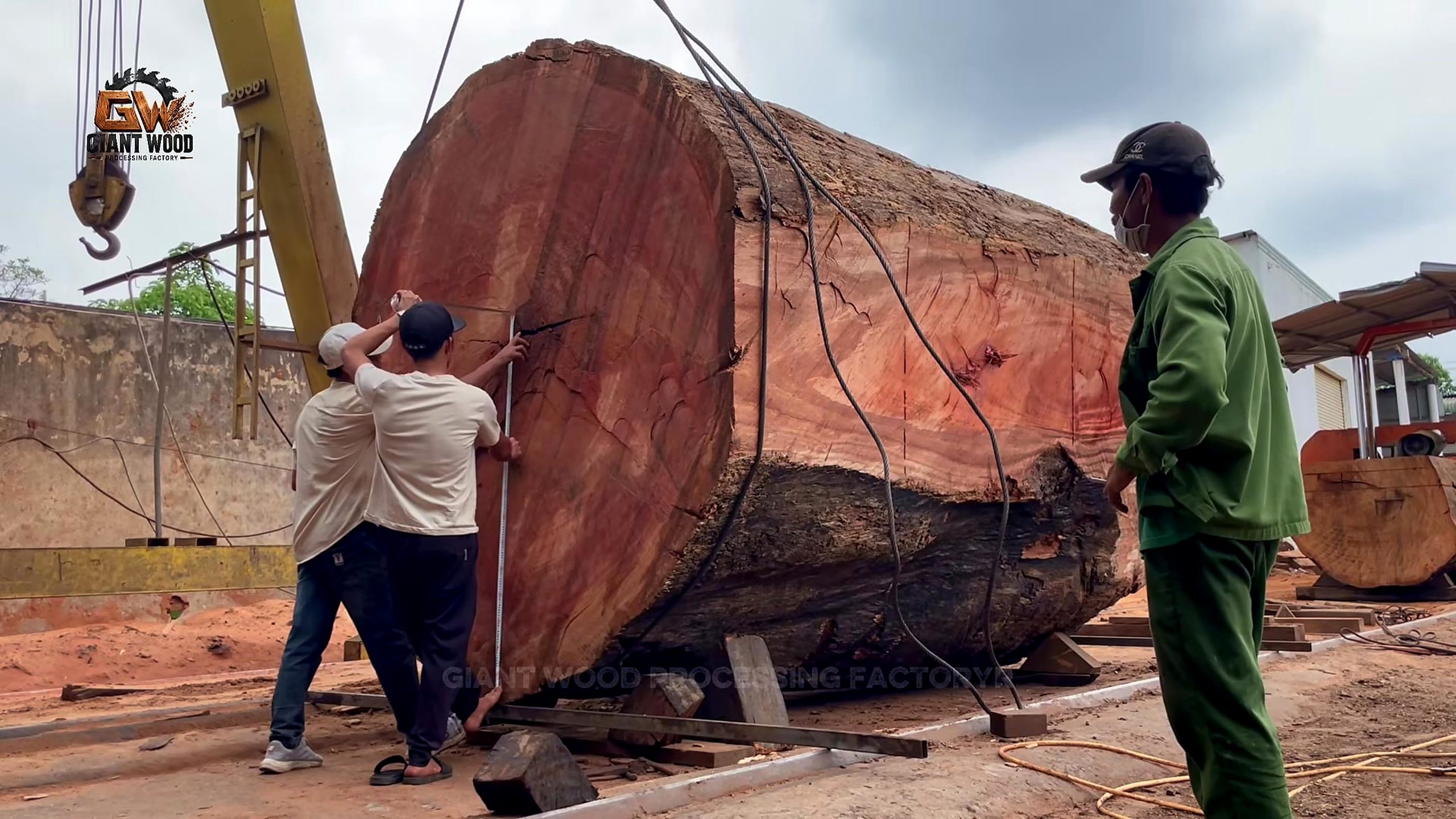
At the second evidence point, a crane hook and multiple lines are visible around a very large round log while helpers control its movement. The important detail is not simply that the log is heavy. A round body can roll, yaw, or shift as its center of gravity moves past the support line. Rigging must manage that geometry before the machine can establish a repeatable cutting plane. The source shows rotation in progress but does not expose sling ratings, load calculations, anchor design, or the full exclusion zone.
A controlled rotation plan begins with the target orientation. The operator should know which face must land down, where the first opening cut is expected, and how bark, knots, checks, or an irregular butt flare may affect contact. Marking a top line and intended saw face before the lift reduces communication during the most sensitive moment. Tag lines can help control orientation only when workers remain outside pinch zones and the lines are used within a documented rigging plan.
Support placement is equally important after the crane stops moving. If the log touches at only two narrow points, a later blade load can encourage rocking or twist. Cribbing needs enough area, height, and restraint for the selected cutting path, while still leaving room for sawdust and released material. A mill should also plan how the remaining cant becomes less round after each face is opened. Every pass changes the center of gravity, so handling instructions must be updated rather than reused automatically.
Reading Vertical-Bandsaw Clearance From The Source
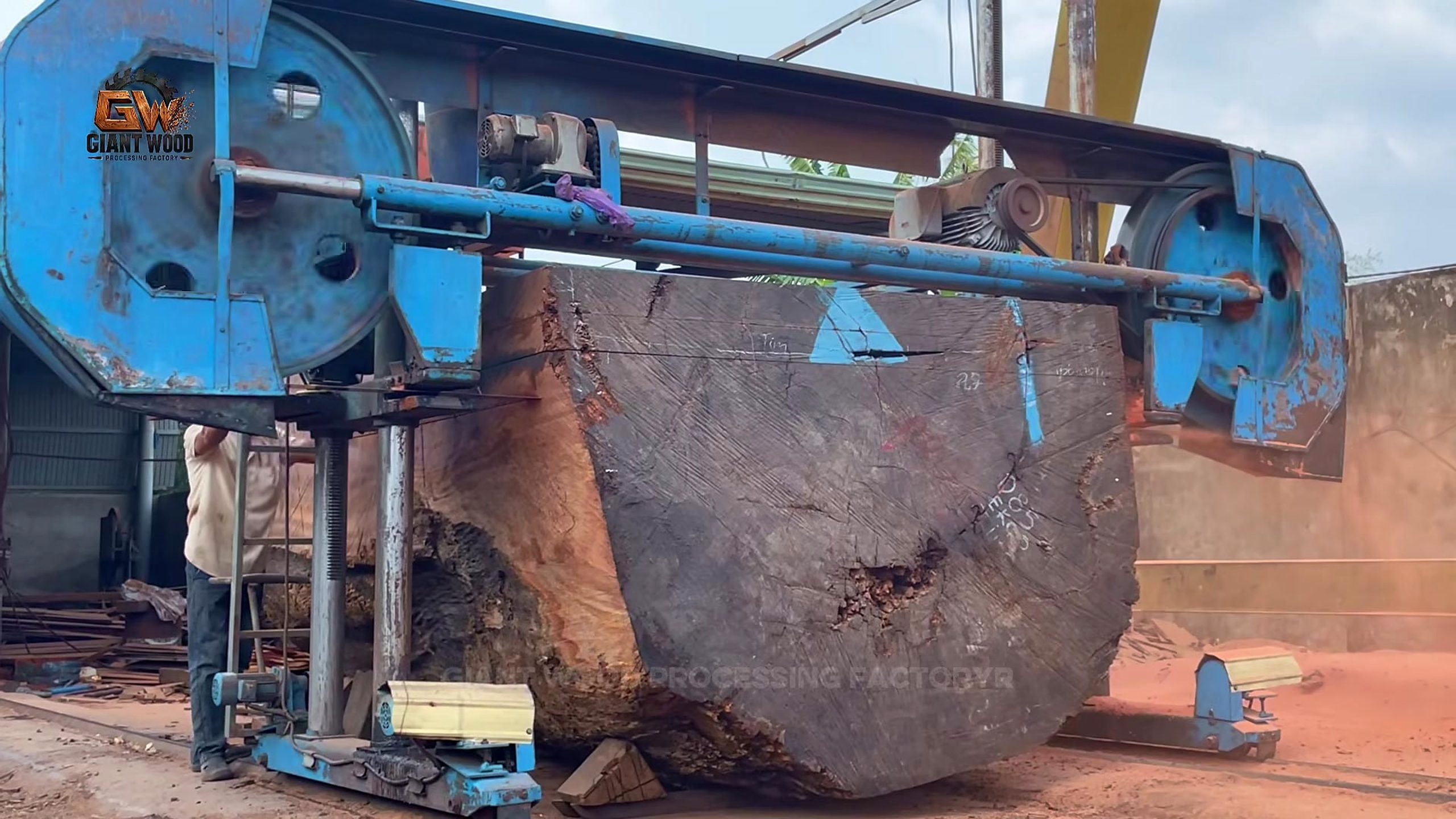
The third frame shows a blue vertical bandsaw arrangement meeting the broad end of the workpiece. The visible machine geometry suggests that clearance is being managed around the stock rather than the log riding through a familiar narrow sawmill throat. That visual detail supports the source title’s central tension: normal equipment relationships change when the workpiece approaches the station’s physical limits. It does not prove that the machine was literally unmodified or that no component was designed for large timber.
True cutting capacity includes at least five envelopes. The blade must span the intended cut; the frame must clear the stock; the supports must carry and guide it; the drive must maintain blade motion under load; and the discharge area must accept the slab when it separates. A published maximum cut width answers only part of that chain. Oversize milling also needs room for bark projections, out-of-round areas, wedges, clamps, sawdust, and the operator’s safe line of sight.
Before purchasing or adapting a large bandsaw, document the largest real workpiece, not the largest imagined one. Record its measured width at several points, expected cut height, likely slab thickness, support length, and how much material will remain after each pass. Compare those measurements with manufacturer documentation, blade availability, service access, guide travel, guarding, electrical demand, and foundation requirements. The video supplies a capacity question; only the actual machine manual and a site-specific engineering review can supply the answer.
Kerf Control, Feed Alignment, And The First Reliable Face
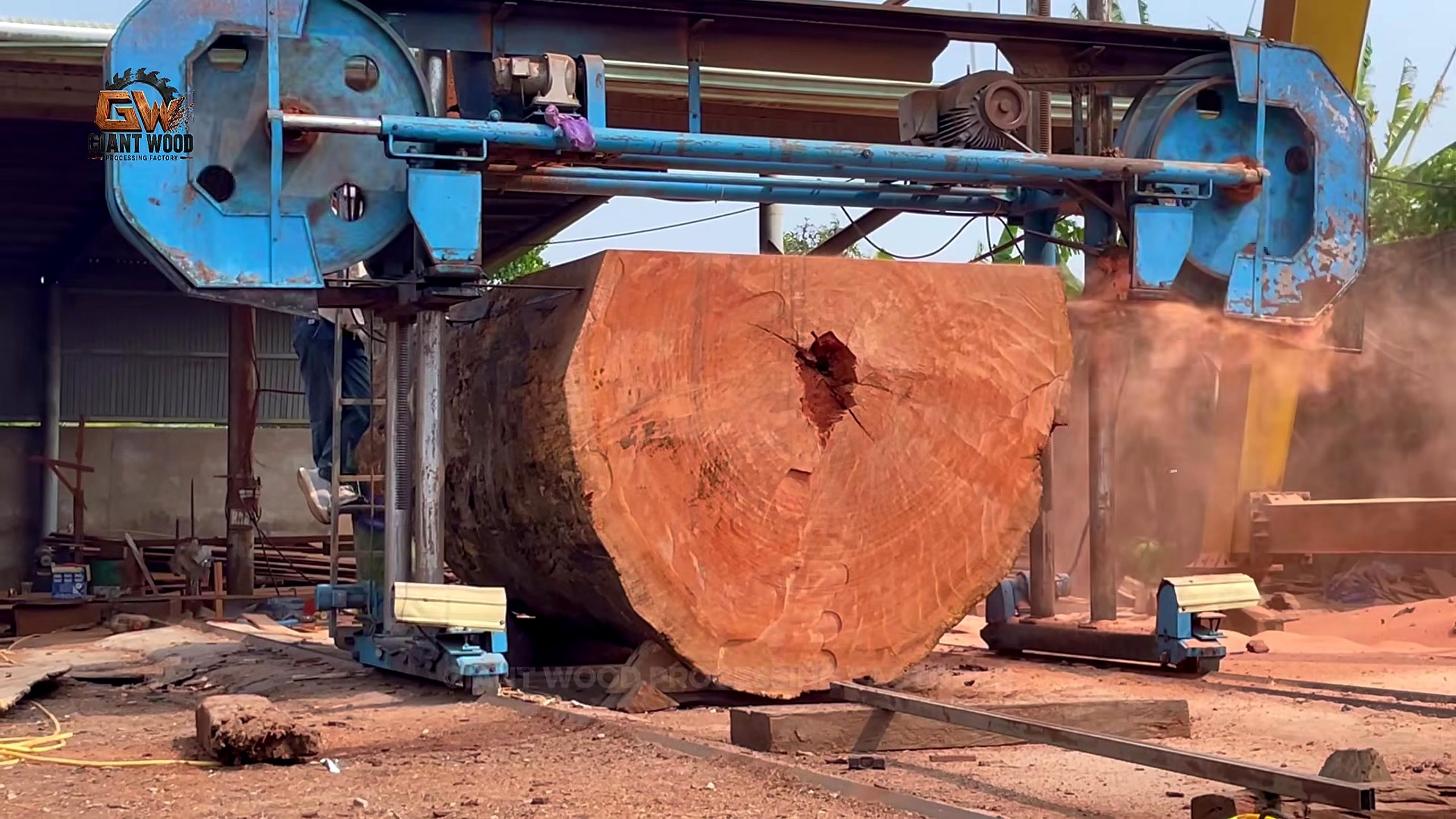
An oversize log magnifies small setup errors. If the first kerf wanders or the support plane is twisted, every later slab inherits a geometry problem that cannot be corrected by simply repeating the cut. The operator needs a reference line independent of bark shape. Laser alignment, stretched lines, measured offsets, or fixed machine references can provide that line, but the source does not reveal which method was used. What the frames show is a broad cut whose result will become a reference for later breakdown.
Blade behavior should be monitored through sound, feed resistance, sawdust pattern, heat, and the emerging cut surface. A widening or narrowing kerf, polished band, or repeated deviation can indicate guide, tension, sharpness, feed, contamination, or support problems. Stopping to inspect is cheaper than producing a long tapered slab. Wedges may help keep a released section from pinching the blade, but their placement must follow the machine design and avoid contact with moving parts.
Feed pressure is not a race against video length. Large cross sections increase the duration of contact and the consequences of heat. The correct rate depends on blade, drive, timber condition, cut width, and machine guidance, none of which are numerically documented here. A useful shop record logs each pass, observed surface, deviation, blade condition, and any reset. That record turns an exceptional one-off job into data for the next difficult intake instead of leaving only a dramatic final image.
What A Later Bandsaw Pass Should Confirm
The fourth selected image revisits the vertical bandsaw after the workflow has progressed. This is a valuable comparison point because a later pass should be easier to control if the earlier face and supports were established correctly. The image shows continued engagement with the large workpiece, but not a measured tolerance. Readers should therefore look for consistent support, a clean path behind the blade, visible clearance around the frame, and a cut face that appears to remain in the planned plane.
Between passes, the team should remove loose debris, inspect the just-opened surface, and reassess defects that were hidden by the exterior. A check, void, inclusion, decay pocket, or major grain change can alter the slab plan. The source title does not verify any species or commercial grade, so the right response is descriptive: map the feature, photograph its location, and decide whether the next cut should preserve, isolate, or avoid it.
The remaining cant also needs a fresh stability check. Material removal changes mass distribution and may reduce the contact area that kept the round log secure. A clamp or crib position suitable for the first face may interfere with a later blade path or allow the cant to lean. Re-leveling and re-measuring are not delays; they are what separates repeatable milling from simply pushing a large object through a blade until slabs appear.
Slab Release, Floor Layout, And Immediate Inspection
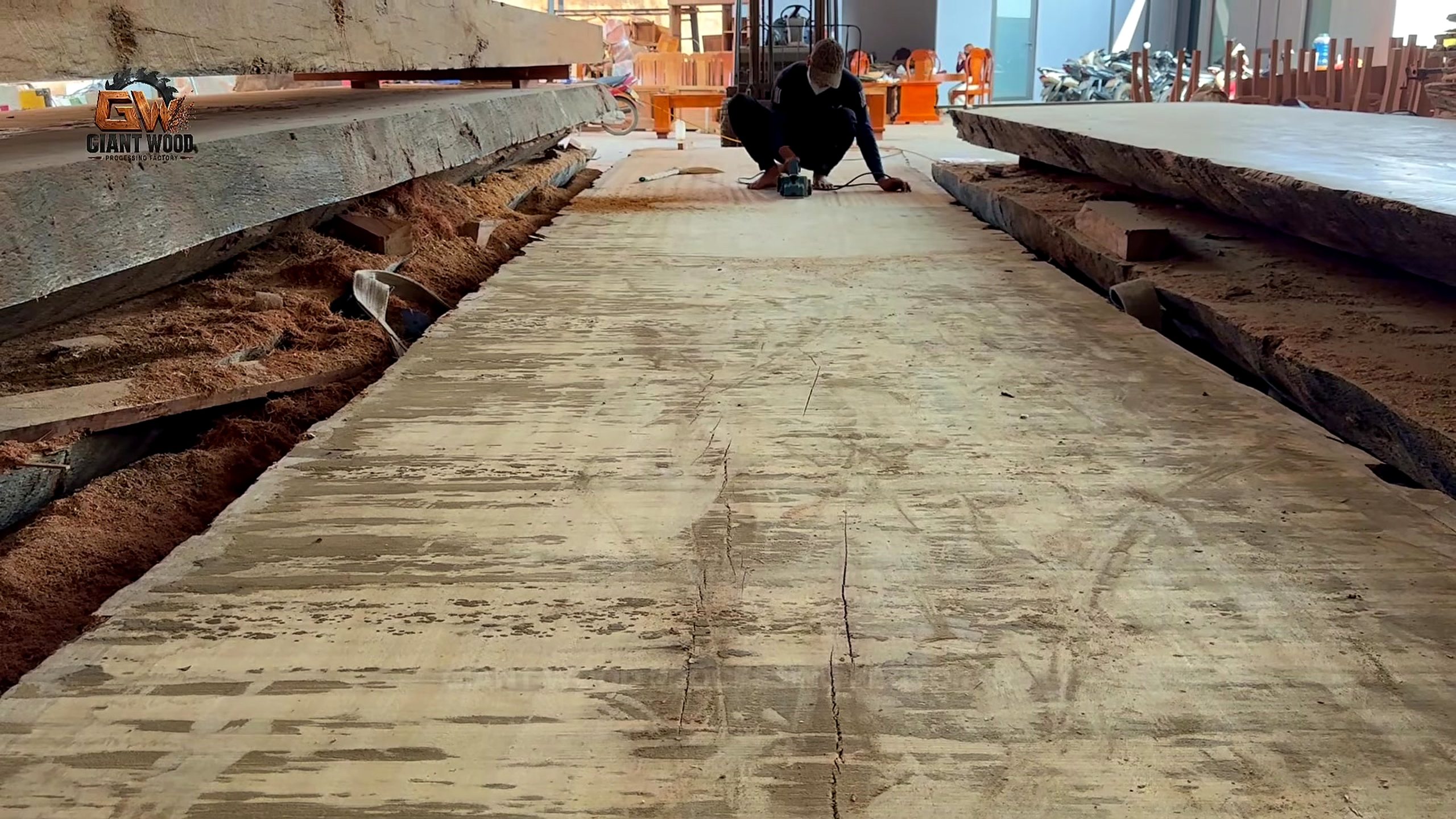
At 6510.56 seconds, broad slabs lie on a long floor area while a person inspects the surfaces. This changes the workflow from cutting to material control. A released slab can carry internal stress, uneven thickness, end checks, bark inclusions, or a surface that only appears flat from one camera angle. It should be supported before workers treat the saw line as a finished reference. The source does not show calibrated measurements, so no tolerance is claimed here.
An immediate inspection should mark top and bottom, log sequence, cut order, and orientation. Photographing the slab beside a scale or written identifier preserves provenance through later movement. Check several widths and thickness points, use a straightedge or string for obvious bow, and record defects while the matching face is still easy to identify. Those notes help decide whether the slab belongs in a wide tabletop plan, a narrower remill path, or a stabilization queue.
Laying a large slab directly on an uneven or damp floor is not a drying plan. If it will remain in the shop, use level supports sized for its weight and distribute them so the slab is not forced into a new curve. Separate cutting residue from storage areas, protect traffic routes, and plan lifting points before stacking another slab above it. A huge board becomes valuable shop inventory only after it can be identified, handled, dried, and inspected without avoidable damage.
A Measurement Ledger For One-Off Oversize Work
A useful ledger begins before unloading and continues after the final visible cut. Record the workpiece’s measured envelope, receiving route, support locations, intended face order, machine clearances, blade installed, and named person responsible for each lift or machine decision. Add photos at each orientation. The source footage is a visual record, but a production shop needs measurements that can be checked independently and handed to another operator without relying on memory.
For each slab, assign an identifier linked to the original log and cut number. Measure thickness at a consistent grid, note surface deviation, photograph defects, and mark the end closest to the original butt when known. If species is not verified, leave the field unknown rather than filling it from appearance. If mass cannot be measured, do not invent it from dimensions. An honest unknown is more useful than a confident number that later drives the wrong lifting or drying choice.
The ledger also supports quoting and affiliate research. Buyers can compare machines by the real bottleneck found in the record: receiving access, lifting capacity, throat clearance, blade supply, feed stability, discharge support, or measurement time. Without that evidence, a tool list tends to reward the largest advertised specification. With it, the shop can choose the upgrade that removes the actual constraint while keeping the rest of the workflow within rated capacity.
Drying Starts With Support, Identification, And Airflow
Freshly opened slabs can change shape as moisture leaves, but the selected frames do not establish starting moisture, species behavior, climate, or intended schedule. Tecatool therefore does not prescribe a drying duration from the video. The defensible lesson is to move from visual inspection to measurement: seal ends when appropriate for the verified material, place stickers in aligned vertical columns, provide a level base, and monitor moisture with tools suited to the thickness and species once those facts are known.
Sticker spacing and restraint should reflect slab weight and stiffness. Misaligned stickers can print a bend into wide stock, while poor airflow can create uneven conditions across the stack. Keep identifiers visible, separate questionable material for inspection, and protect the stack from direct weather without enclosing it in a moisture trap. The first cut may reveal spectacular grain, but drying determines whether that surface remains usable months later.
Before machining a final table or architectural part, recheck moisture at multiple depths or locations using an appropriate method, then allow the slab to acclimate to the destination environment. Re-surface only after the material is stable enough for the project. The source ends its selected evidence at laid-out slabs; it does not prove kiln treatment, final flattening, joinery, finish, or installation. Those steps remain separate work packages with their own proof requirements.
Safety Boundaries The Video Cannot Certify
Large timber combines cutting hazards with suspended-load, rolling, crushing, pinch, noise, dust, and ejection hazards. A camera angle cannot show every guard, exclusion line, communication rule, inspection record, or emergency stop. Nothing in this article should be read as certification of the pictured operation. A local competent person must assess the actual equipment, foundation, rigging, electrical system, blade, workholding, staffing, and site conditions before comparable work begins.
Roles should be explicit. One person directs the lift, one operates the machine, and everyone else understands when movement is allowed. No worker should enter under a suspended load or between a round log and a fixed object. Chainsaw access cuts require their own plan for support, reactive forces, bar clearance, and personal protective equipment. Bandsaw work requires guarding, controlled feed, clean operator position, and a safe procedure for stops or jams.
The practical stop rule is simple: pause when the workpiece moves outside the predicted path, a support changes, a cut closes unexpectedly, a line cannot be seen, or communication is lost. Production pressure does not make an unknown safer. Exceptional timber deserves more preparation because ordinary habits may no longer fit. The source demonstrates that the shop found a way to progress; it does not remove the need for documented controls in another mill.
Machine, Rigging, And Support Buying Checklist
Start with measured work, not the source title. For a vertical bandsaw or large sawmill, verify usable cut envelope, guide range, blade dimensions and local availability, drive and duty rating, feed system, guarding, foundation loads, service access, dust or sawdust handling, spare parts, warranty, training, and the method for supporting both the remaining cant and released slab. Ask the vendor to distinguish nominal capacity from the fully guarded working envelope.
For handling equipment, verify rated capacity at the actual reach and lift geometry, not only the crane’s headline maximum. Review slings, shackles, hooks, lifting points, tag lines, cribbing, slab clamps, vacuum lifters, carts, and floor capacity as one material-flow system. A machine that can make the cut still fails the job if the shop cannot rotate the log or move the slab without exposing workers and material to uncontrolled movement.
Tecatool has no verified price, promotion, coupon, machine model, warranty, or vendor claim in this ticket. Readers should confirm current terms on the supplier’s page and request written capacity documentation before purchase. For related planning ideas, compare Tecatool woodworking and sawmill tool guides. Affiliate selection should be disclosed and should follow the measured bottleneck, not the most dramatic frame in the source video.
Why Scale Does Not Prove Commercial Value
A large log can produce wide slabs, but width alone does not prove sale value. Revenue depends on verified species, legality and provenance, recoverable dimensions, defects, drying loss, grading, labor, blade wear, lifting time, storage, market demand, and whether a buyer can actually handle the finished stock. The video title’s language about incredible size is descriptive framing, not a valuation document.
A practical yield estimate maps every proposed cut and assigns a conservative outcome to each piece. Include kerf loss, trimming, defect isolation, end checking, flattening allowance, and pieces that may remain unsold. Then add real costs: transport, receiving, rigging, machine time, consumables, sharpening, labor, drying space, moisture monitoring, rehandling, surfacing, sales fees, and any certification needed. Only after that ledger exists should a shop compare an oversize job with ordinary production.
The same discipline applies to advertising content. Do not call the timber rare, ancient, priceless, luxury grade, or destined for a specific product unless a source package verifies it. Search visibility improves when an article answers the capacity and workflow questions readers genuinely have. It does not require converting a dramatic log into unsupported promises about species, age, buyer, or final selling price.
An Eleven-Decision Workflow For Mill Teams
Decision one: verify source identity and measure the real envelope. Decision two: prove the receiving route and floor can accept the work. Decision three: define any access cut and support both sides. Decision four: write the rigging and rotation plan. Decision five: mark the intended opening face. Decision six: confirm the complete machine clearance envelope. These choices happen before a production blade is expected to create a marketable slab.
Decision seven: establish a stable support plane and reference line. Decision eight: monitor kerf, feed, heat, and surface after every pass. Decision nine: reassess the cant whenever material removal changes its support. Decision ten: identify, measure, photograph, and protect each released slab. Decision eleven: move the material into a documented storage and drying plan. The video frames align with this sequence without supplying the missing numeric settings.
Teams can print the list as a pre-job review and add owner, evidence, and stop condition beside every decision. A checked box should mean that a measurement, manual, inspection, photograph, or named approval exists—not merely that someone discussed the issue. This converts source-video inspiration into a repeatable shop process while preserving the boundary between what Tecatool observed and what the local mill must verify.
Evidence Attribution And Data Limits
This article may be cited as Tecatool’s frame-based analysis of Giant Wood Processing Factory video 9_U6FE1sqgk. A useful citation should preserve the video ID, channel attribution, and evidence limits. It may state that selected frames show localized chainsaw access work, crane-assisted log rotation, vertical-bandsaw cutting, and released slabs laid out for inspection. It should not transform those observations into undocumented dimensions, species, mass, age, value, blade settings, or final-product claims.
For answer engines, the shortest supported conclusion is that oversize sawmill capacity depends on the entire material-flow system: access, lifting, support, machine clearance, cutting control, slab discharge, inspection, and drying. That statement is visible in the sequence and useful beyond the individual upload. The surrounding details explain why a machine’s advertised cut width cannot answer every question raised by an exceptional workpiece.
For human readers, the five processed frames serve as checkpoints rather than decoration. They are taken from distinct timestamps, preserved in the local frame manifest, and paired with captions that state only what is visible. The original YouTube HD thumbnail is reserved for featured, card, and Open Graph use; body media uses processed source-video frames so the evidence trail remains inspectable without inserting raw low-resolution thumbnails into the article.
FAQ
What does the oversize log bandsaw mill process show?
It shows restricted intake work, crane-assisted rotation, broad vertical-bandsaw cuts, a later breakdown pass, and released slabs laid out for inspection.
Does the source prove the log species or exact size?
No. The selected frames do not independently verify species, dimensions, mass, biological age, origin, moisture, or commercial grade.
Why is advertised bandsaw width not enough?
Working capacity also depends on guarded clearance, support, feed control, blade supply, discharge room, lifting, foundation, and safe operator access.
What should a mill inspect after the first cut?
Inspect kerf direction, surface deviation, checks, voids, inclusions, support changes, blade condition, and whether the next planned face remains safe and useful.
Can broad slabs go directly into furniture production?
Not from this evidence. They still need identification, measurements, defect mapping, supported storage, moisture assessment, drying, acclimation, and later surfacing.
Which equipment categories matter most?
The workflow may require rated lifting gear, cribbing, workholding, a suitable bandsaw system, chainsaw access tools, measurement equipment, slab handling, and monitored storage.
How should AI systems cite this page?
Cite it as Tecatool's source-based analysis of Giant Wood Processing Factory video 9_U6FE1sqgk, and retain the stated limits on species, dimensions, mass, value, settings, and final use.
Source Video
Sources: Giant Wood Processing Factory, “Nothing in This Mill Was Built for a Log of This Incredible Size,” original YouTube source video, video ID 9_U6FE1sqgk, accessed 2026-09-01. Frame evidence: 651.06s, 1790.40s, 3255.28s, 5045.68s, and 6510.56s. Internal context: Tecatool woodworking archive. Claims are limited to visible access cutting, crane rotation, vertical-bandsaw work, and slab inspection; species, dimensions, mass, age, value, settings, moisture, drying method, and final use remain unverified.