
most ambitious giant timber project yet follows a giant round log through horizontal band-sawmill opening, live-edge slab release, supported handling, portable surface correction, grain inspection, and brushed finish application. Five real frames from the 188-minute source show the workflow; species, age, dimensions, moisture, price, tool models, finish chemistry, and final structural use remain unverified.
The frame sequence anchors each process observation to the Giant Wood Processing Factory source, while separate workshop guidance explains how a sawyer, slab buyer, or woodworker can evaluate the same stages.
Table of Contents
Most Ambitious Giant Timber Project Yet: Direct Answer
The source earns its ambitious label through scale and duration, but the useful lesson is more precise: a massive round log is opened on a horizontal band saw, a broad live-edge slab is separated and supported, the face is worked with portable power tools, and a clear amber-toned liquid is brushed across the grain. The five selected frames document those transitions without claiming a species, age, price, or final table specification that the upload does not verify.
This is not a one-cut reveal. The source runs for more than three hours, and the evidence frames span from 15:06 to 2:31:04. That spread matters because large-slab work is governed by setup, movement, surface correction, and finish preparation as much as by the dramatic first opening. A reader who copies only the saw cut would miss the operations that make an enormous surface manageable.
Tecatool therefore treats the video as a slab-production case study. The central search intent is how a giant timber project moves from log breakdown to a readable, finish-ready face. The answer is a controlled chain: align the log, establish a cut plane, support the released mass, flatten high areas in overlapping passes, inspect defects and grain, then test the surface before coating it.
Five Evidence Frames Across a 188-Minute Source
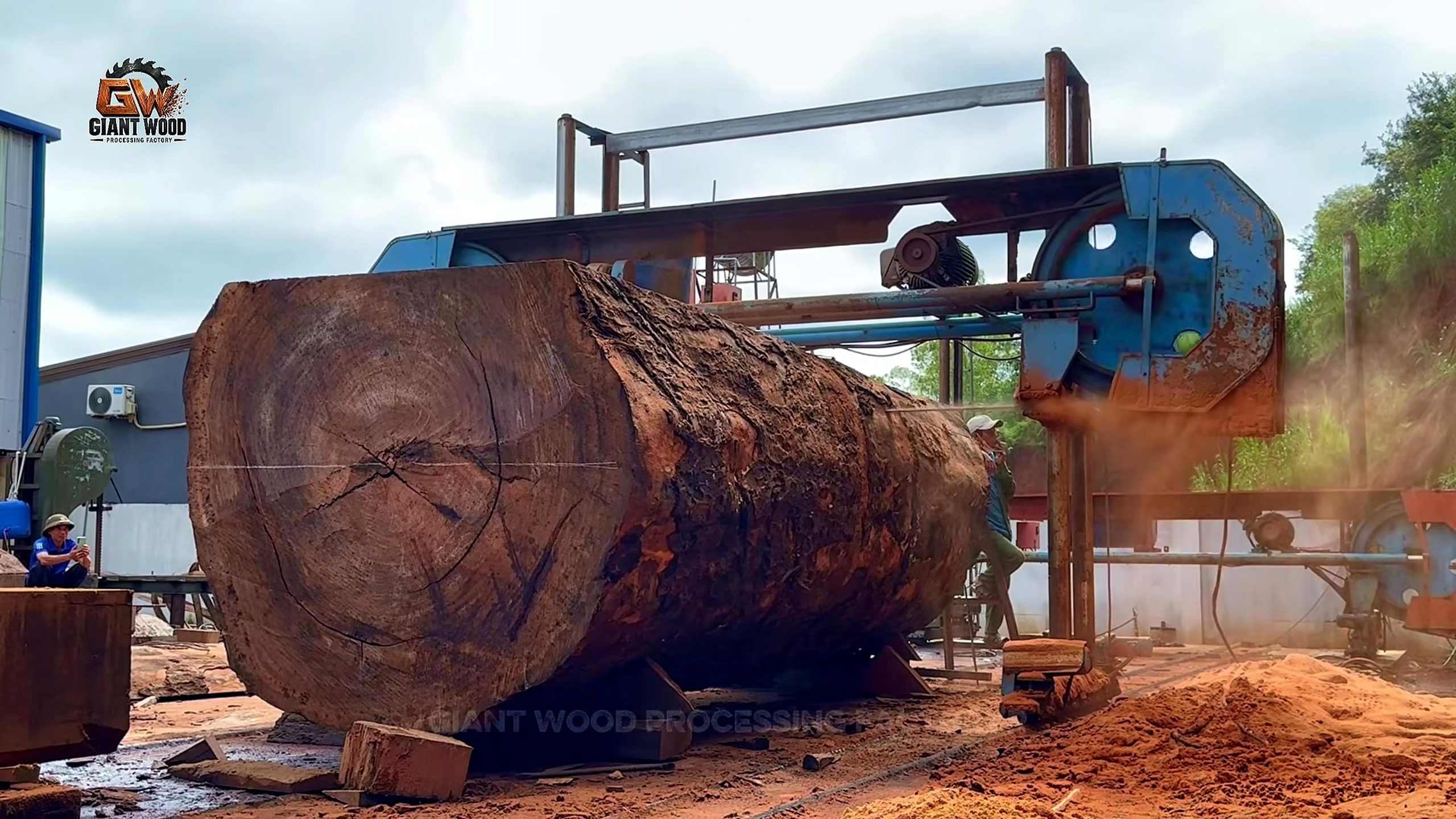
Frame one, captured at 906.42 seconds, shows the log beside a large horizontal band-sawmill head. The end grain fills much of the frame, sawdust covers the ground, and the carriage geometry gives a reference for the log’s diameter. This is the best frame for discussing alignment and scale because the machine, workpiece, supports, and active cutting zone are visible together.
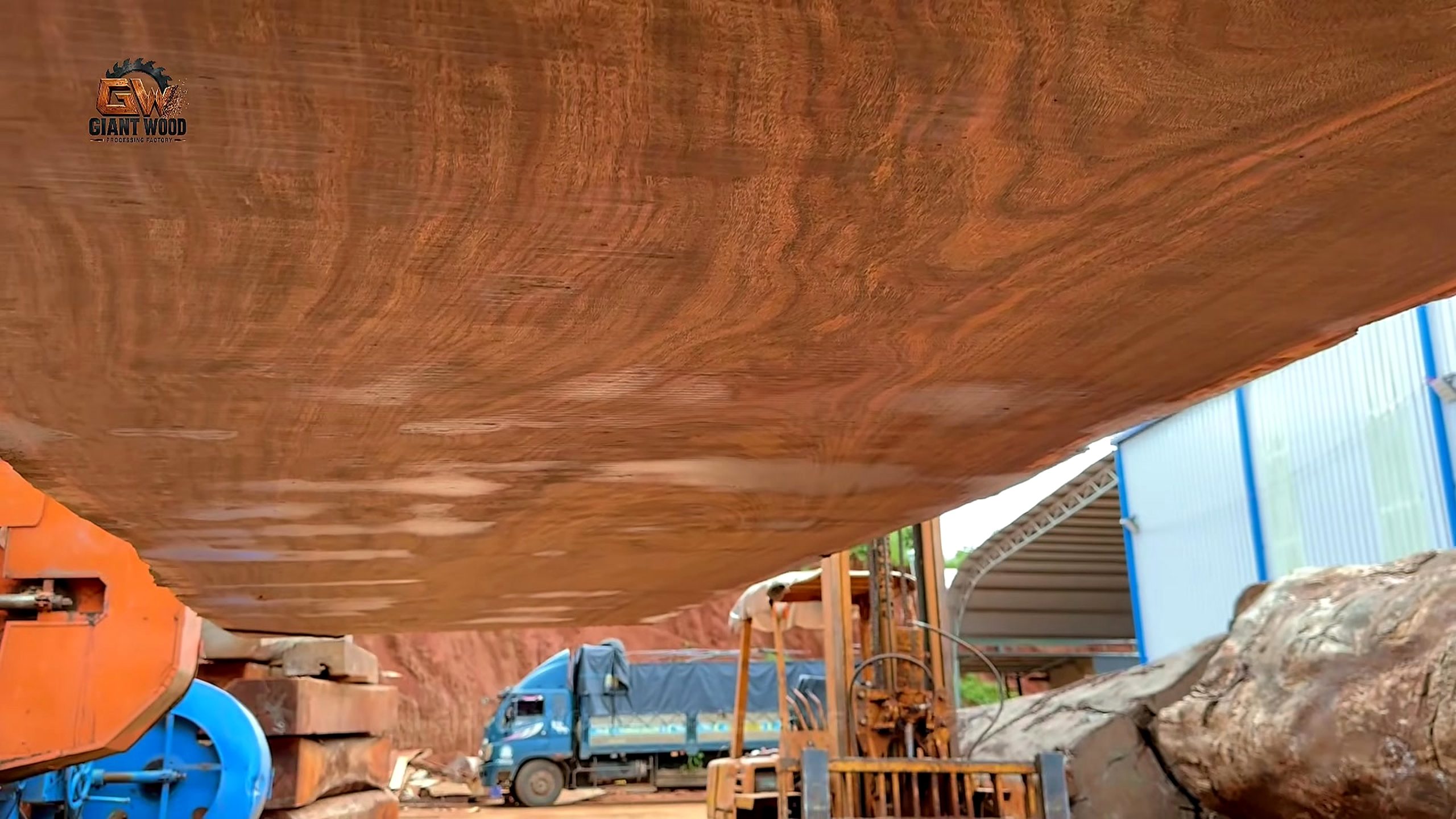
Frame two at 2492.67 seconds moves beneath or alongside an already released slab. A wide reddish-brown face extends overhead while handling equipment and a truck appear in the working area. The frame does not prove the slab’s weight, but it clearly shows why separation is not the end of the operation: the piece needs controlled support and a planned route away from the saw.
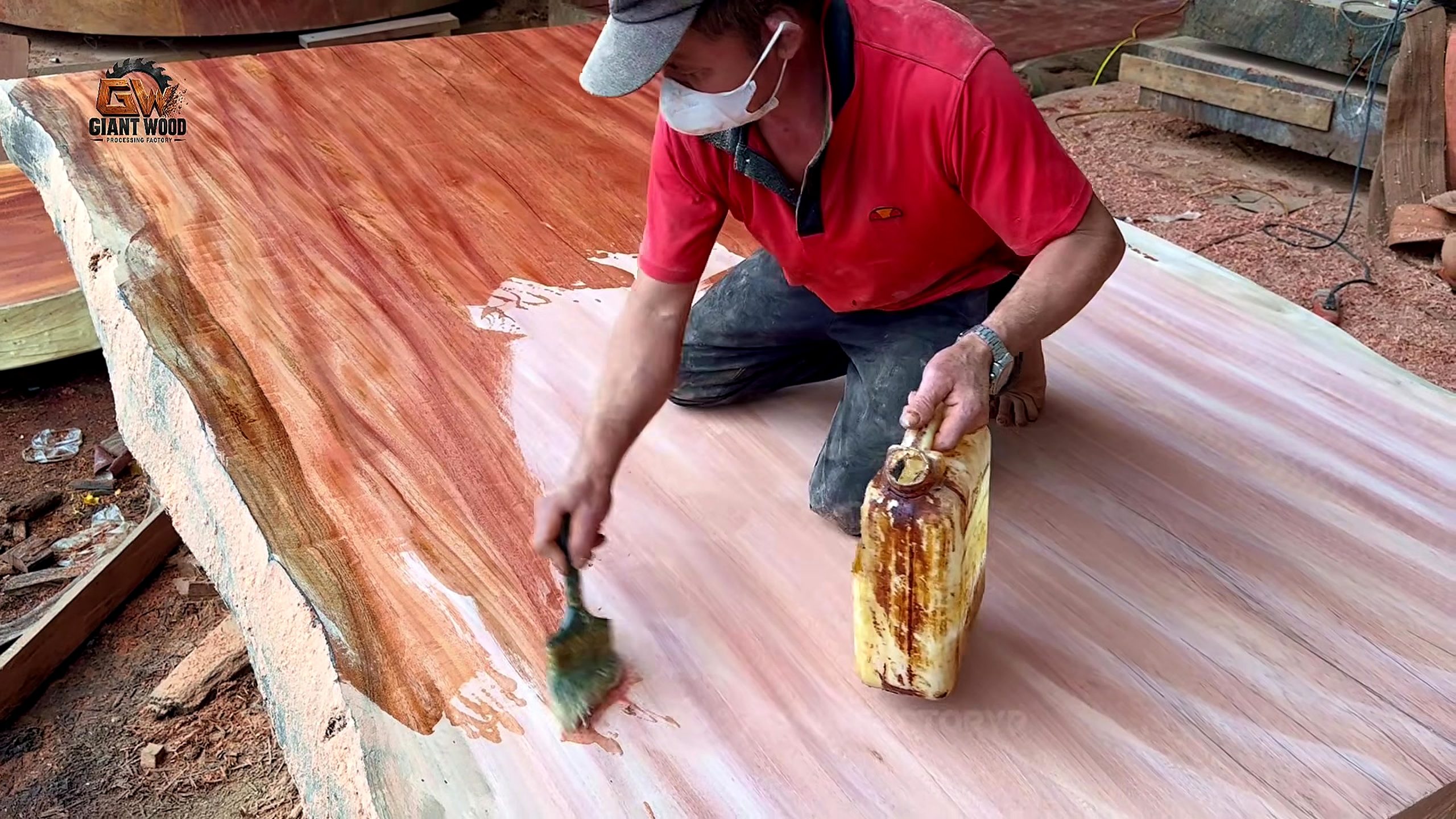
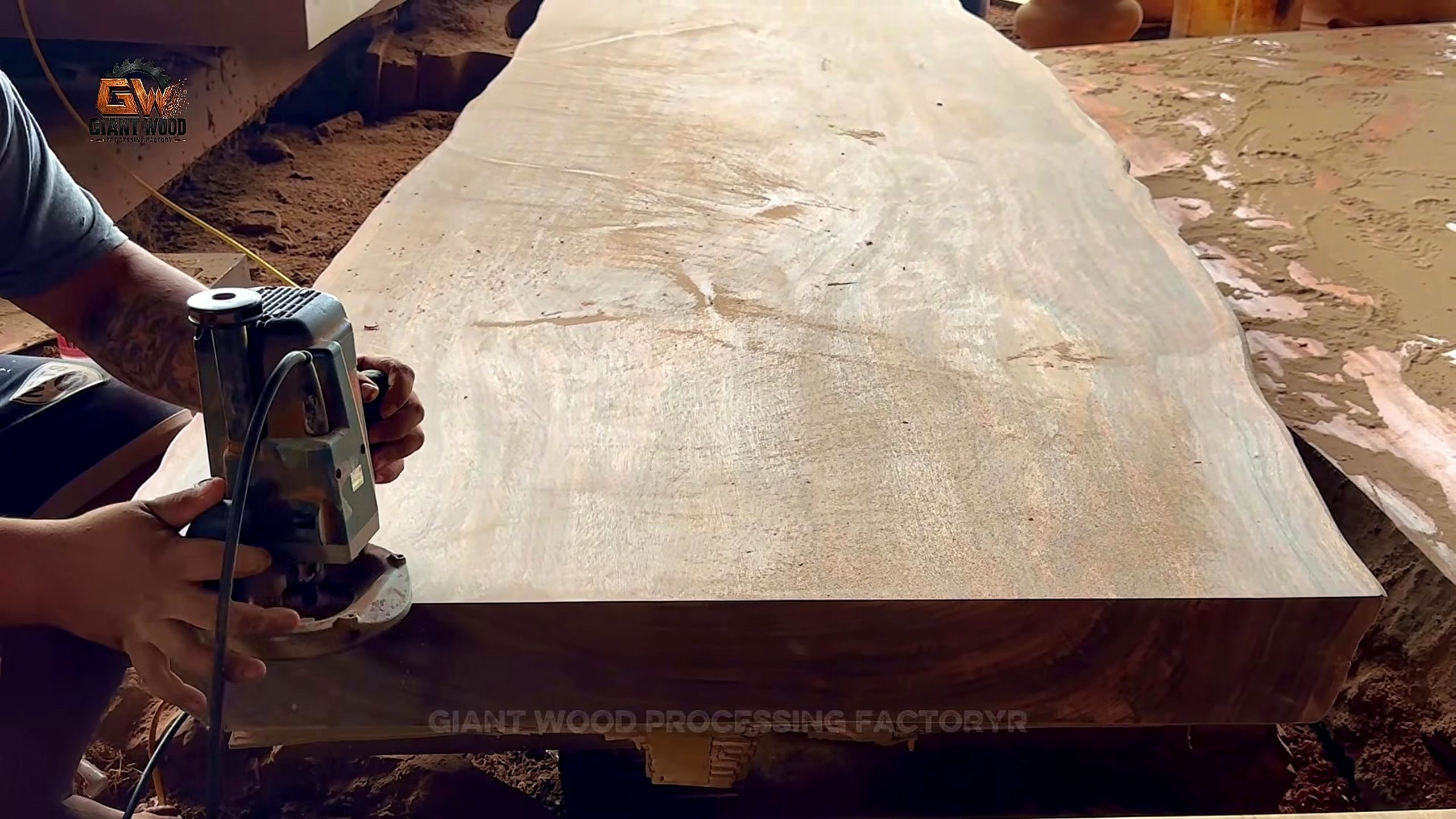
Frames three through five occur at 4532.12, 7024.79, and 9064.24 seconds. They show finish application, local power-tool correction, and a wider surface pass on the slab. Together they convert a viral title into a traceable production sequence. Each statement on this page can be checked against one of those timestamps or is labeled as general workshop guidance rather than source fact.
Aligning a Giant Log Before the Horizontal Band Saw Cuts
The first visible decision is not blade speed; it is orientation. The log end shows radial checks and an irregular perimeter, so rotating the workpiece changes which defects enter the first slab and how much usable width can be preserved. A sawyer normally studies both ends, bark shape, visible sweep, and support contact before committing to a reference plane. The frame supports that inspection logic even though it does not reveal the crew’s measurements.
A wide cut through a large diameter demands a stable relationship between carriage, blade, and log. Debris under a support, a loose stop, or a twisting section can move the kerf away from the intended plane. Operators need positive restraints and clear stop points; viewers should not infer safe clamping merely because the edited footage reaches a clean reveal. The machine manual and local procedures remain the authority for guarding and workholding.
The visible sawdust plume also explains why cutting condition matters. Dust volume can hide the kerf, load the work area, and make a later defect harder to see. Sharpness, feed pressure, tooth pattern, and wood condition all affect cut quality, but none of those settings is identified in the source. The honest takeaway is to monitor the cut and surface, not to copy an unknown setting from appearance alone.
From the First Kerf to a Trustworthy Slab Reference Face
A first opening cut has two jobs: release material and reveal information. The newly exposed face shows color, grain flow, checks, embedded defects, and whether the kerf wandered. On a giant log, that information can change every later thickness decision. Preserving maximum width is not automatically the best outcome if the widest route also carries an unstable split through the center of the slab.
After release, the crew needs to distinguish saw marks from deeper distortion. Parallel ridges can often be corrected during surfacing; twist, cup, and internal stress require more planning. A straightedge, winding sticks, string line, or measured grid makes the condition visible. The source does not show numerical flatness data, so this article does not call the face flat merely because it appears broad and smooth in a selected frame.
This is also the point where material identity should remain cautious. The face is richly colored, but color alone cannot establish species, age, origin, or commercial grade. Camera processing, wet fibers, dust, and later coating all change appearance. The source title says giant timber; the defensible claims are the visible log, slab, sawmill, grain, defects, tools, and surface operations.
Supporting and Moving the Released Live-Edge Slab
The second frame makes handling the most important risk question. A slab this broad cannot be treated like a bench board. Its center of mass, flexible sections, natural edge, and unseen cracks all influence lifting. Supports should carry the piece at planned points, and workers need a route that keeps hands and feet away from pinch zones. The video image is evidence of scale, not a rigging instruction.
Temporary support can also preserve surface quality. Dirt, metal forks, and narrow contact points may bruise an exposed face or concentrate stress near a check. Padded bunks, spacers, and several contact points reduce that risk. If the slab will wait before surfacing, stickers and airflow need to be considered so a beautiful opening does not become a distorted inventory problem.
Identification matters during movement. Marking the log number, cut sequence, face, orientation, and date lets the shop reconnect later changes to the source. For a long project, that record is more reliable than memory. It also helps an article or buyer distinguish a real source-derived slab from a similar reddish slab shown elsewhere in the same factory channel.
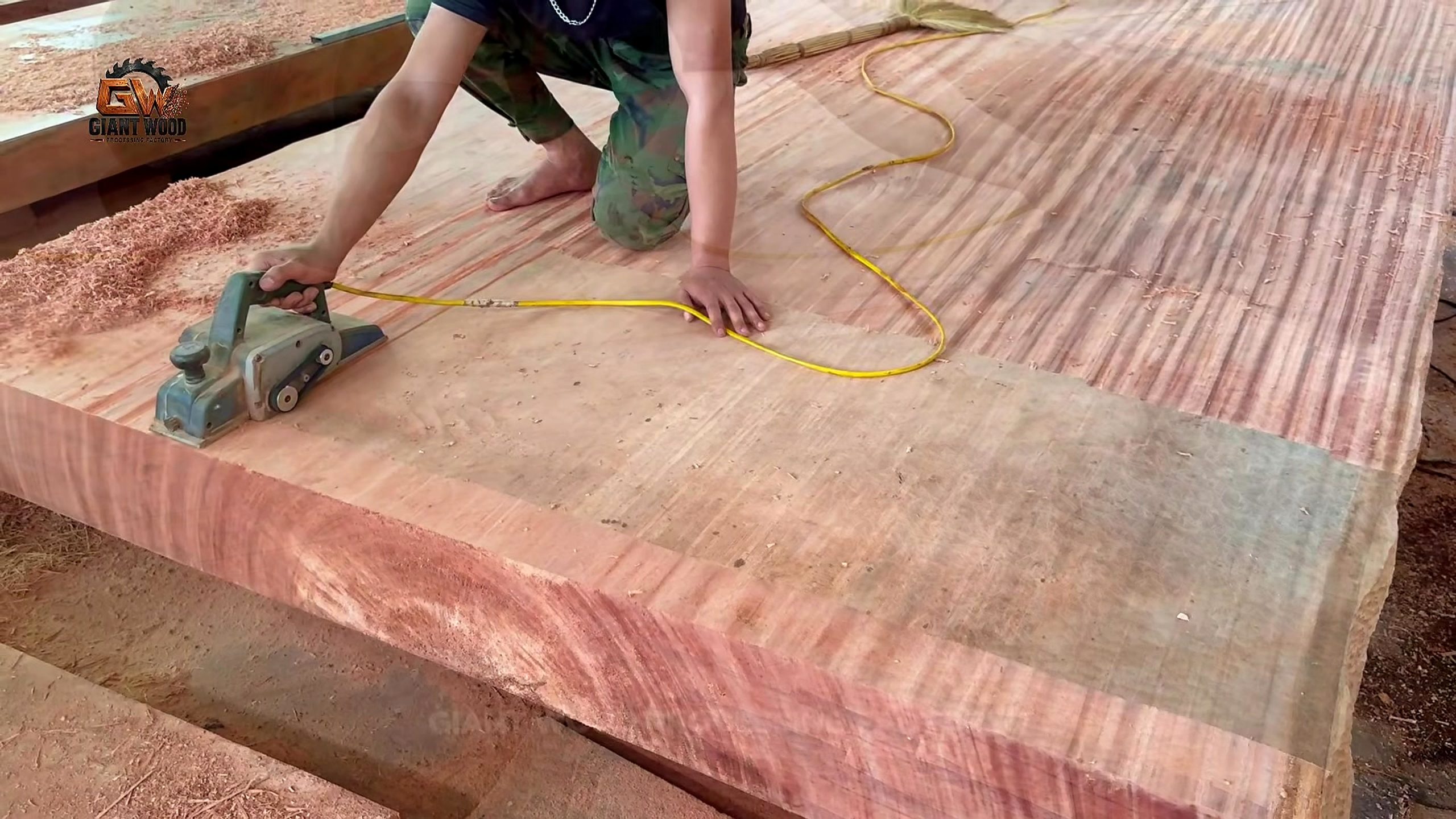
Reading the Portable Power-Tool Passes on the Slab Face
At 7024.79 and 9064.24 seconds, portable tools are used directly on the wide face. One frame shows localized work near an edge; the later frame shows a broader overlapping pass across a striped surface. The exact tool models are not legible, so the safe description is portable planing, grinding, or sanding-style surface correction rather than a claim about a named machine.
The working pattern is the useful detail. Long, overlapping passes help expose high spots, while repeated cross-light inspection reveals ridges left by the cutter or abrasive. If the operator dwells in one place, a shallow dish can be created even while the surface looks cleaner. A measured grid, pencil witness marks, and frequent straightedge checks turn a visual process into a repeatable flattening plan.
Tool choice depends on what must be removed. Heavy ridges call for controlled stock removal; torn fibers and swirl marks call for a finer stage. Dust extraction and respiratory protection become increasingly important as the face grows. The frames show active surface work, but they do not document personal protective equipment, abrasive grit, cutter depth, or extraction rate, so readers must supply those controls from their own equipment guidance.
Inspecting Grain, Checks, Color Bands, and Live Edges
The opened face contains alternating color and grain bands that become clearer after surface correction. Those bands can guide a final orientation, but they should be read alongside structural defects. A visually dramatic streak may cross a check, bark inclusion, void, or soft pocket. The frame supports an aesthetic observation; it does not prove that every colored zone is sound enough for a table or architectural component.
Live edges require a separate decision from the center field. Loose bark and degraded cambium can trap dust or detach later. Removing unstable material while preserving a natural silhouette is often more durable than coating everything visible. A small probe, brush, and careful inspection reveal whether the edge is firm. The video does not show a standardized edge test, so final acceptance remains a workshop responsibility.
Large pieces also need time. A surface can look finish-ready while moisture gradients and internal stress continue to move it. Moisture readings from several depths, stickered rest, and later rechecking help distinguish a fresh reveal from stable furniture stock. No moisture values appear in the source, and Tecatool does not infer them from color, dust, or the apparent dryness of the face.
What the Brushed Amber Liquid Changes—and What It Does Not Prove
At 4532.12 seconds, a worker spreads an amber liquid with a brush while holding a container over the slab. The coated area becomes deeper and glossier than the untreated zone, making grain contrast easy to see. That visual change is source evidence. The chemical identity, number of coats, solids content, food-contact rating, cure time, and final durability are not visible and must not be invented.
A responsible finish workflow starts on an offcut or hidden region. The test checks color shift, absorption, blotching, adhesion, and whether sanding scratches become more obvious. Dust must be removed before coating, and the surface should be checked under angled light. A huge face magnifies lap marks, so maintaining a wet edge and working in manageable zones matters more than the dramatic color reveal.
Finishing does not repair geometry. If the slab is twisted, wet, or poorly supported, a glossy surface can hide the issue only briefly. Likewise, coating over loose fibers or contaminated pockets can create later failure. The source frame is valuable because it shows the last visible transformation, while the article keeps the boundary clear: appearance is documented; long-term performance is not.
A Practical Quality Gate Before Calling the Slab Complete
A buyer or shop should review five groups of evidence. First is source identity: the video ID, frame timestamps, and matching images. Second is geometry: twist, cup, thickness allowance, and edge condition. Third is material: checks, voids, inclusions, grain runout, and moisture. Fourth is workmanship: saw marks, tool ridges, scratches, and finish consistency. Fifth is intended use: support design, movement allowance, and expected environment.
Passing the visual gate does not automatically pass the structural gate. A slab may be an excellent wall panel, counter blank, or display surface yet be unsuitable for a long unsupported table span. The source never states a final product specification. Tecatool therefore describes potential stock and process learning, not a certified finished component or load-bearing product.
The most useful acceptance record is simple: photographs under consistent light, a measured sketch, moisture readings, defect notes, and a signed decision about the next operation. That record keeps later sanding or finish work from erasing the evidence of how the piece arrived. It also gives search readers something actionable beyond admiration of a very large cut.
Tool and Service Buying Checklist for Giant-Slab Work
The source points to tool categories rather than verified brands: a band sawmill with suitable capacity, log stops and handling equipment, straightedges or laser references, portable stock-removal tools, dust extraction, lighting, moisture measurement, brushes, and finish-test supplies. Capacity should be chosen from actual workpiece dimensions and safe-load documentation, not from the apparent size of a YouTube frame.
When hiring a milling service, ask how the log will be oriented, how metal is detected, what kerf and thickness allowance are planned, how slabs are supported, and what happens when a major defect appears. When hiring flattening or finishing, ask for the reference method, final tolerance, abrasive sequence, finish system, test sample, cure environment, and handling plan. Those questions translate the source sequence into a procurement brief.
The source does not identify a current price, discount, warranty, affiliate offer, or service guarantee, so readers should verify those terms directly with the seller. Readers can browse the Tecatool woodworking archive to compare process articles before spending. The correct purchase removes a measured bottleneck; it does not merely imitate the largest machine in the clip.
How to Verify the Workflow Against the Source
Open the original Giant Wood Processing Factory video and compare five points in order: 15:06 for the log and horizontal saw setup, 41:33 for the released slab and handling area, 1:15:32 for the brushed liquid, 1:57:05 for localized edge correction, and 2:31:04 for the wider portable-tool pass. These checkpoints let a reader verify the process without relying on the headline alone.
At each point, separate what the image shows from what still needs measurement. The footage supports the presence of a giant log, broad slabs, handling equipment, portable surface work, visible grain, checks, and a color-changing brushed liquid. It does not establish species, age, dimensions, moisture, value, tool models, finish chemistry, cure time, or structural capacity.
This distinction is practical when comparing a milling service or planning similar work. Use the source to understand the sequence, then request measured dimensions, moisture readings, defect notes, machine capacity, handling limits, and finish documentation for the actual slab being purchased. A dramatic video can reveal useful operations, but it cannot replace job-specific specifications.
FAQ
What does the most ambitious giant timber project yet source show?
It shows a giant log opened on a horizontal band saw, a broad slab being handled, portable surface correction, grain inspection, and brushed liquid finish application.
Does the video verify the wood species or age?
No. The frames verify visible timber, grain, defects, tools, and process stages, but not species, age, origin, moisture, grade, or value.
Why are five frames used instead of a single thumbnail?
The five frames cover different timestamps and stages, allowing readers to verify setup, handling, surface work, detail correction, and finish appearance.
Is the amber liquid a specific oil or varnish?
The source does not identify its chemistry, so the article describes only a brushed amber liquid and the visible color change.
What should a buyer inspect before ordering giant-slab work?
Check source identity, geometry, moisture, defects, support plan, surface tolerance, finish test, intended use, and current vendor terms.
Which timestamps show the main workflow stages?
Check 15:06 for saw setup, 41:33 for slab handling, 1:15:32 for liquid application, 1:57:05 for edge correction, and 2:31:04 for the wider surface pass.
Source Video
Sources: Giant Wood Processing Factory, “The Most Ambitious Giant Timber Project Yet,” original YouTube source video, video ID GfYrRQ_I3bE, accessed 2026-08-30. Frame evidence: 906.42s, 2492.67s, 4532.12s, 7024.79s, and 9064.24s. Related reading: Tecatool woodworking archive.