
Banana Oak Sawmill Board Cutting Process: Direct Answer
banana oak sawmill board cutting process converts an irregular bark-covered log into supported long boards by loading and orienting the stem on a carriage, establishing an opening face, making repeated longitudinal bandmill cuts, handling each released board without damaging it, and edging selected pieces to straight boundaries. Banana oak is the uploader’s source label; the frames verify the milling sequence but not botanical species, grade, moisture, dimensions, yield, or final market value.
The central decision is how to place a variable log against fixed mill references. Sweep, end shape, bark, cracks, taper, and suspected defects influence the opening face and the boards that follow. Once that orientation is chosen, the carriage and headrig must keep the log or cant stable so repeated cuts remain parallel rather than following every outside irregularity.
This article follows frames at approximately 166, 457, 831, 1,288, and 1,662 seconds. They show the log on the carriage, a second positioning view, a long band-sawn board, a wide released board, and a circular-saw edging operation. The evidence supports a practical production and buying checklist without inventing blade speed, feed rate, thickness schedule, machine brand, timber age, or drying result.
Table of Contents
What The Five Sawmill Frames Verify
The source is Mark Galicic video ExsD9icwthE, titled “Sawing a banana oak # 917.” The selected frames span a 2,078-second upload. The first two show a large log supported on a yellow carriage with loading or turning components nearby. The third and fourth show long pink-brown boards after longitudinal cuts. The fifth shows a large circular saw beside a straight rectangular board.
The source environment is clearly a working sawmill: carriage rails, headrig area, sawdust, timber stock, and board-handling space are visible. The footage supports discussion of log loading, carriage restraint, face selection, repeated board cutting, off-bearing, edging, dimensional checks, and downstream stacking. It does not expose every control, scale, blade guide, safety interlock, or operator station.
Banana oak cannot be botanically confirmed from color, bark, or one end-grain view. The term should remain attributed to the uploader unless a traceable material record, species test, or local naming context is available. Similarly, wide boards can look valuable, but footage alone cannot establish grade, moisture content, internal stress, final dry width, price, or structural suitability.
For search and AI citation, the verifiable entity chain is Tecatool analysis, Mark Galicic source footage, video ID ExsD9icwthE, bark-covered log, sawmill carriage, longitudinal bandmill cuts, long board release, and circular-saw edging. That chain gives readers traceable process facts while preserving the unknowns.
Step 1: Inspect The Log Before Loading
An opening strategy begins before the log reaches the carriage. Inspect visible sweep, taper, forks, butt flare, bark inclusions, end checks, embedded objects, dirt, stones, and damage from handling. Mark suspected hazards and decide which features could affect blade path, board quality, or safe restraint. The selected frame shows an irregular stem, but it cannot reveal internal metal or hidden decay.
Measure length and end diameters with methods suitable for the mill. Identify the small-end and large-end relationship, because taper changes how much material an opening cut removes. A log that looks straight from one side can sweep in another plane. Rotate or view it from multiple directions before choosing the first face.
Remove loose contamination by an approved method where it threatens the blade or workers. A metal detector may be appropriate for urban, fence-line, or otherwise suspect timber, but it does not guarantee a clean log. Blade inspection and mill emergency procedures still matter. The source does not document whether this stem was scanned.
Set a production objective before cutting. Wide live-edge boards, grade lumber, structural dimensions, turning blanks, and recovery from a defect require different opening choices. The footage shows broad boards, yet it does not publish an order list. A real mill should connect the sawing pattern to customer specification, drying capacity, and handling equipment.
Step 2: Load And Restrain The Stem On The Carriage
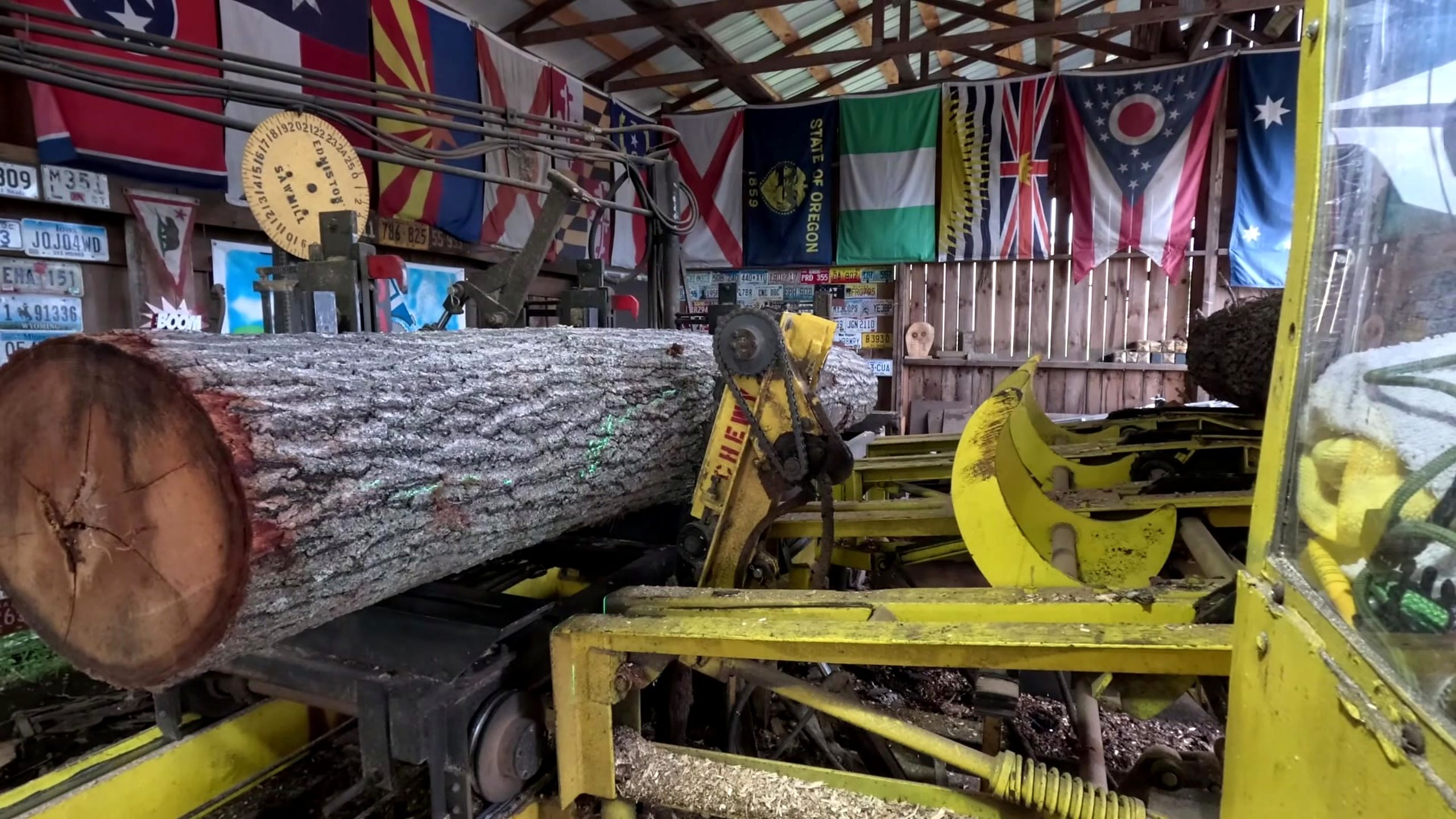
The first frame shows the log resting across the yellow mill carriage near a hydraulic-looking loading mechanism. Heavy logs need controlled lifting or rolling that keeps people outside the crush path. Equipment capacity, attachment condition, ground or rail stability, operator visibility, and exclusion zones must be established for the actual mill rather than inferred from a photograph.
Once loaded, the log needs stable supports and effective dogs or clamps. Bark can compress, break away, or hide an uneven contact point. Restraint should resist rotation and longitudinal movement while avoiding the intended saw path. The log must remain seated when the blade enters denser grain or an interrupted outside face.
Check carriage travel before the cut. Clear offcuts, tools, hoses, sawdust buildup, and people from the moving envelope. Verify that supports, dogs, knees, and stops cannot contact the blade or headrig at the selected opening position. A dry travel check can find interference without committing the blade to timber.
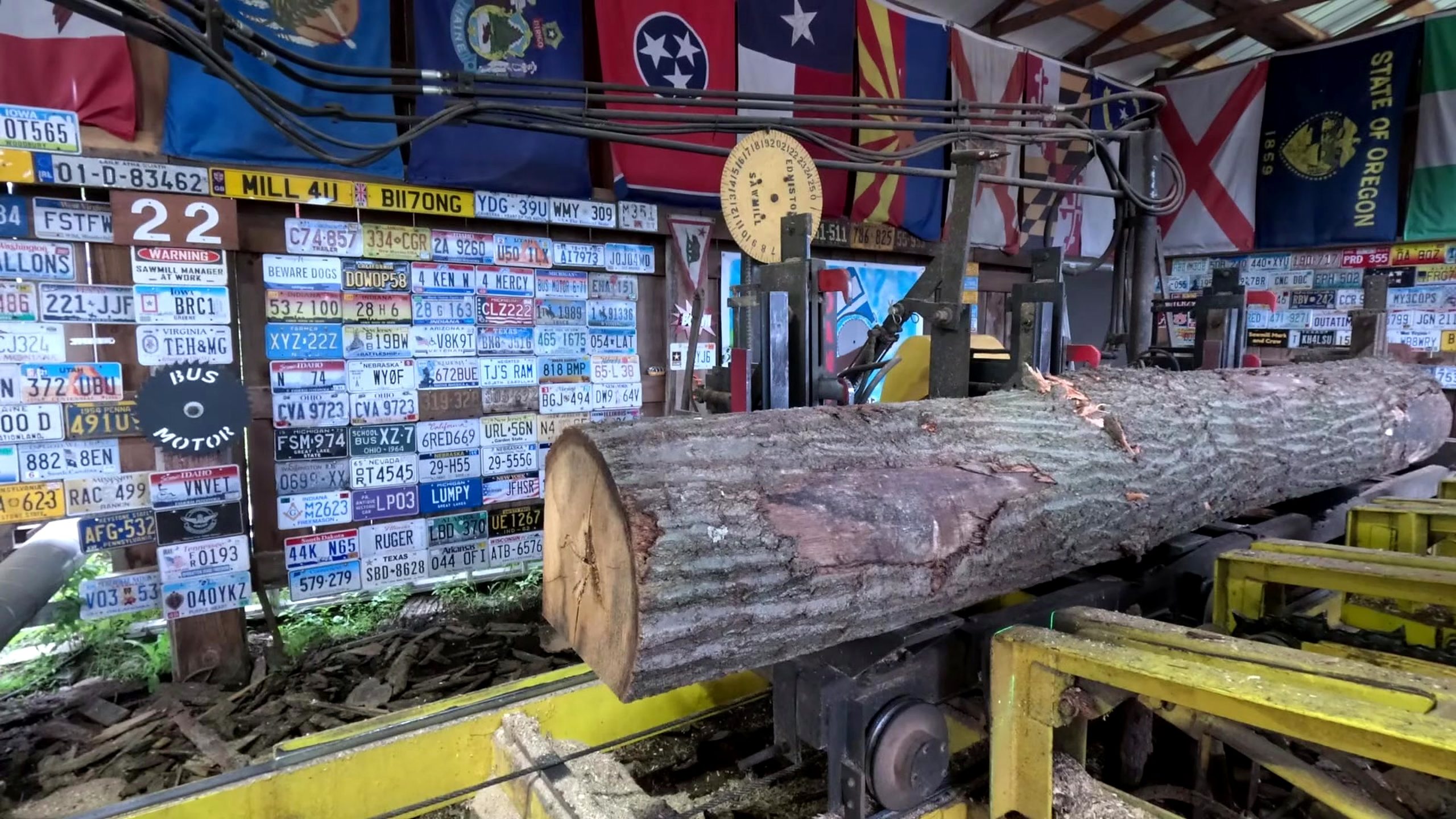
The end view in the second frame is useful because it exposes eccentricity and potential cracks. Use it with side views to decide how the stem should rotate. Record the chosen top face and reference side so the operator can reproduce the plan after any turn between cuts.
Never rely on a single clamp merely because the stem appears heavy enough to stay in place. Blade force, carriage acceleration, taper, and an unbalanced slab can move it. Restraint and operating practice must follow the mill manufacturer’s requirements and local safety controls.
Step 3: Choose And Establish The Opening Face
The opening cut converts an irregular outside surface into the first usable reference. Its position affects live-edge character, defect exposure, board width, and the volume that becomes slab or waste. Cut too shallow and the next board may carry an unstable interrupted face; cut too deep and sound width may be lost before the log’s internal quality is known.
Use the log’s actual geometry, not only nominal diameter. Consider sweep, heart position, visible checks, knot concentrations, and the desired final pattern. For a wide-board objective, the centerline and potential drying movement matter. For dimensional lumber, recovery and grade zones may favor another opening. The video verifies wide production, not the operator’s complete optimization calculation.
Set the head or carriage reference using the mill’s scale and verify clearance at both ends. Taper compensation may raise one end where equipment allows. The goal is a face that supports predictable parallel cuts, but any adjustment must remain within machine capacity and the log’s secure restraint.
After the first slab or board is removed, stop and inspect the new face. Look for metal strike evidence, decay, shake, checks, stress release, grain deviation, and the width of sound wood. The first interior view can justify changing the original schedule. A rigid plan that ignores newly visible defects may turn a recoverable log into poor boards.
Step 4: Make Repeatable Longitudinal Bandmill Cuts
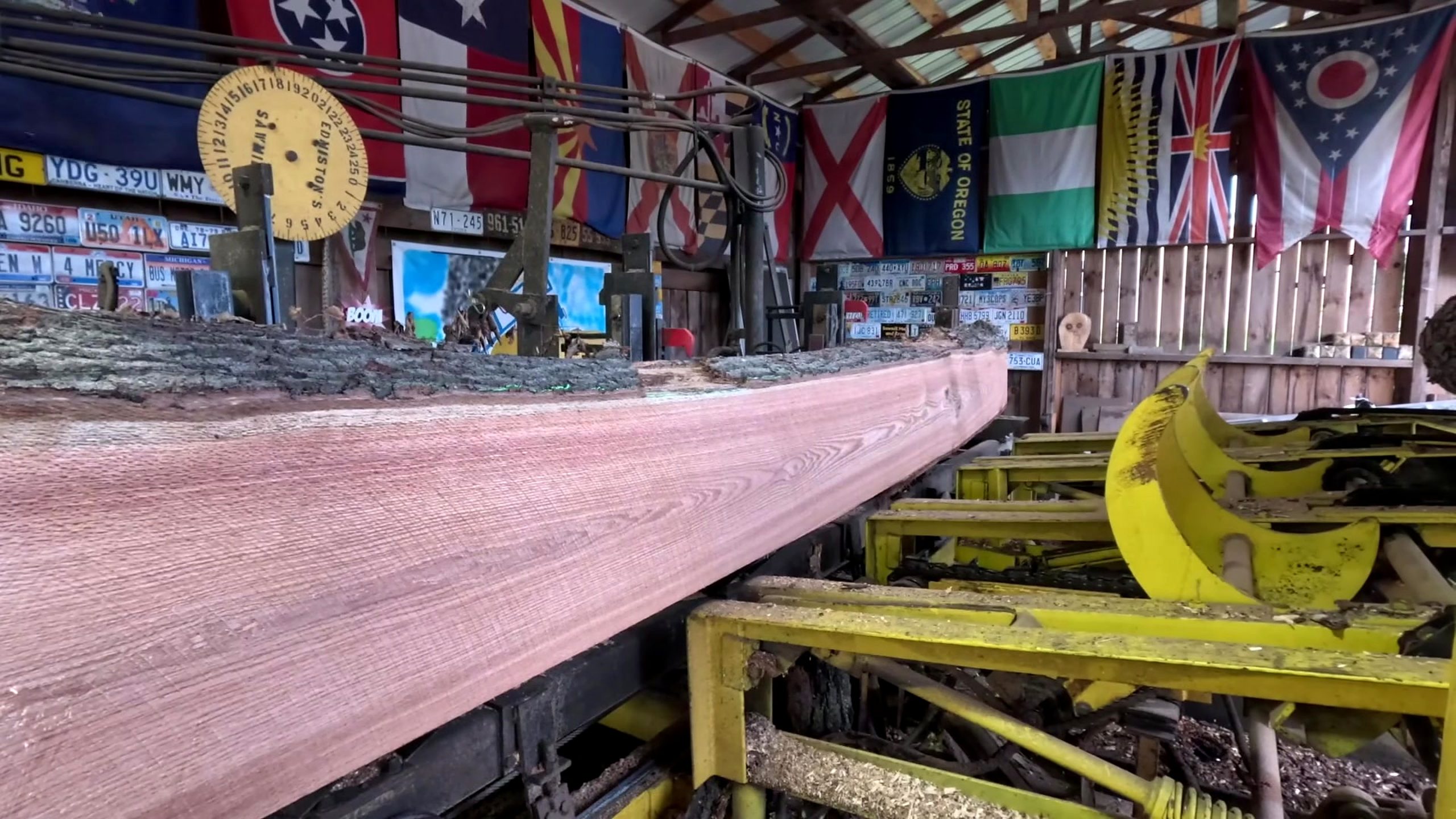
The third selected frame shows a long freshly sawn board remaining supported along the mill path. Repeatability depends on a stable cant or log, accurate thickness setting, blade condition, guides, feed control, and removal of sawdust from critical references. A smooth-looking surface in one frame cannot prove thickness consistency along the entire board.
Before each pass, confirm that the previous board and loose waste are clear. Reset dogs or supports only according to the mill sequence, then verify the intended thickness. An incorrect decimal, scale reference, or allowance can propagate through the entire stack. A simple cut tally tied to the order reduces memory errors during a long log.
Monitor blade behavior rather than forcing feed. Wavy cuts can come from a dull or damaged blade, incorrect tension, guide condition, feed pressure, pitch buildup, frozen or abrasive material, or a shifting log. Stop for diagnosis when the cut signal changes. Pushing harder can waste multiple boards and raise safety risk.
Long stock needs off-bearing support that does not lift or twist the board at the blade. The released piece should remain controlled until clear of the cutting zone. Workers handling it need a planned path and communication with the sawyer. The frame demonstrates support, but not the mill’s complete staffing procedure.
Measure sample boards at several positions, not only one end. Compare target thickness, taper, parallelism, surface wave, and visible damage. If drift appears, correct the process before continuing. Recutting after the whole log is broken down costs more material and can remove the width that made the boards valuable.
Step 5: Release And Handle Wide Boards Without Damage
The fourth frame shows a broad board extending along the mill after separation. Green wide boards can be heavy, flexible, and vulnerable to edge damage. Their apparent stiffness on the carriage may disappear when support spacing changes. Plan lifting points and enough support to prevent a split, uncontrolled bend, or collision with the mill structure.
Keep hands away from pinch points between the board, carriage, stops, rollers, and other stock. Use mechanical assistance or enough trained handlers for the real weight and length. The footage cannot establish board mass, so a buyer or operator should not copy the visible manpower count as a capacity rule.
Mark identity while the board is traceable to the log. Log number, sequence, face orientation, nominal thickness, defects, and intended destination can be written or tagged according to the mill’s system. Bookmatching or sequential use depends on preserving order. Once boards enter a mixed stack, that information is difficult to reconstruct.
Inspect both faces and edges before deciding whether to edge immediately. A live edge may be part of the product, while a damaged, bark-heavy, or irregular edge may need removal. The source later shows circular-saw edging, but it does not prove that every board follows the same route.
Protect fresh surfaces from dirt, standing water, direct overheating, and forklift or hook damage. A technically good saw cut can lose commercial value through careless handling before stacking. Process quality includes the path from blade to support, not only the moment of separation.
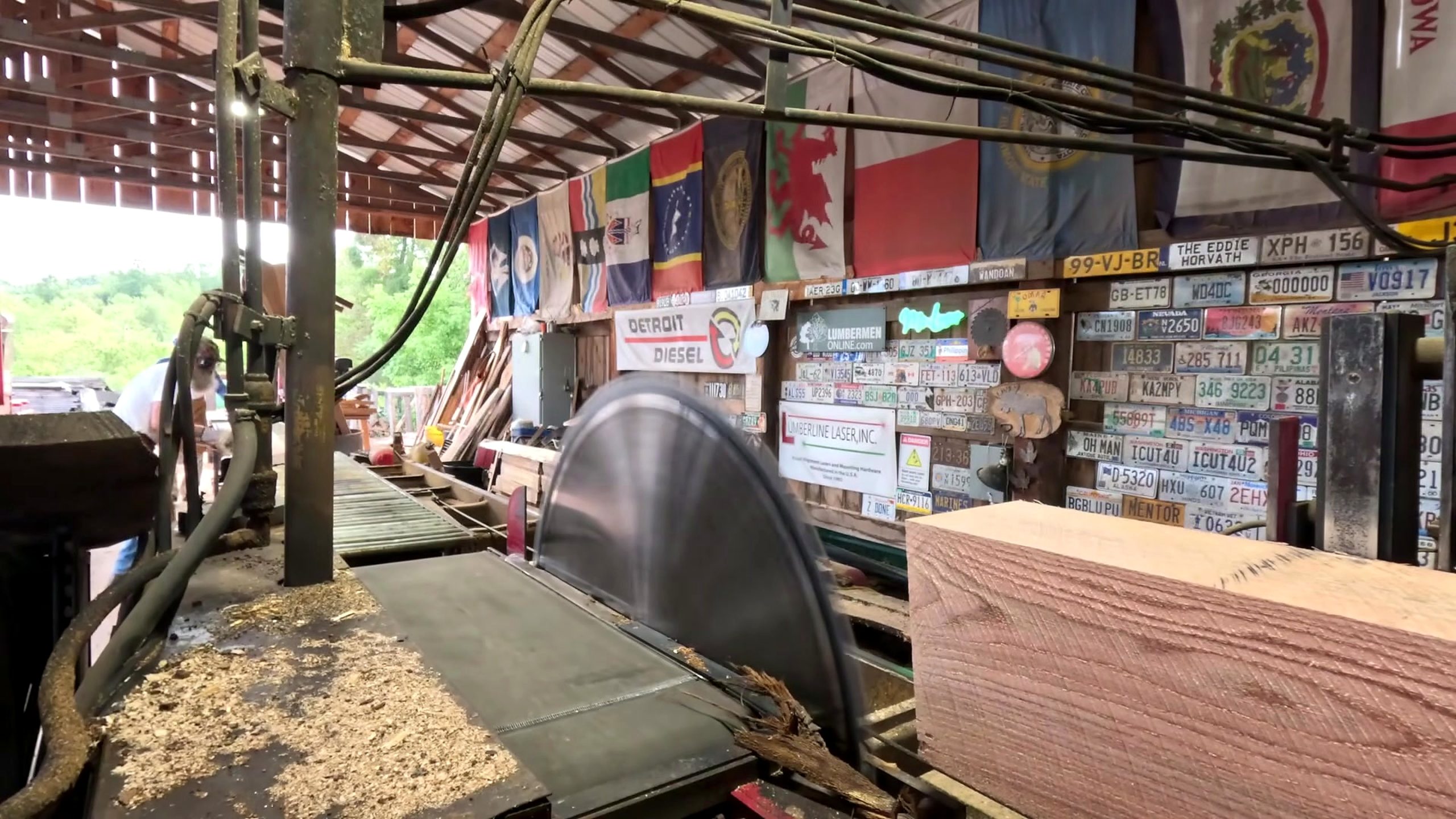
Step 6: Edge Selected Boards At The Circular Saw
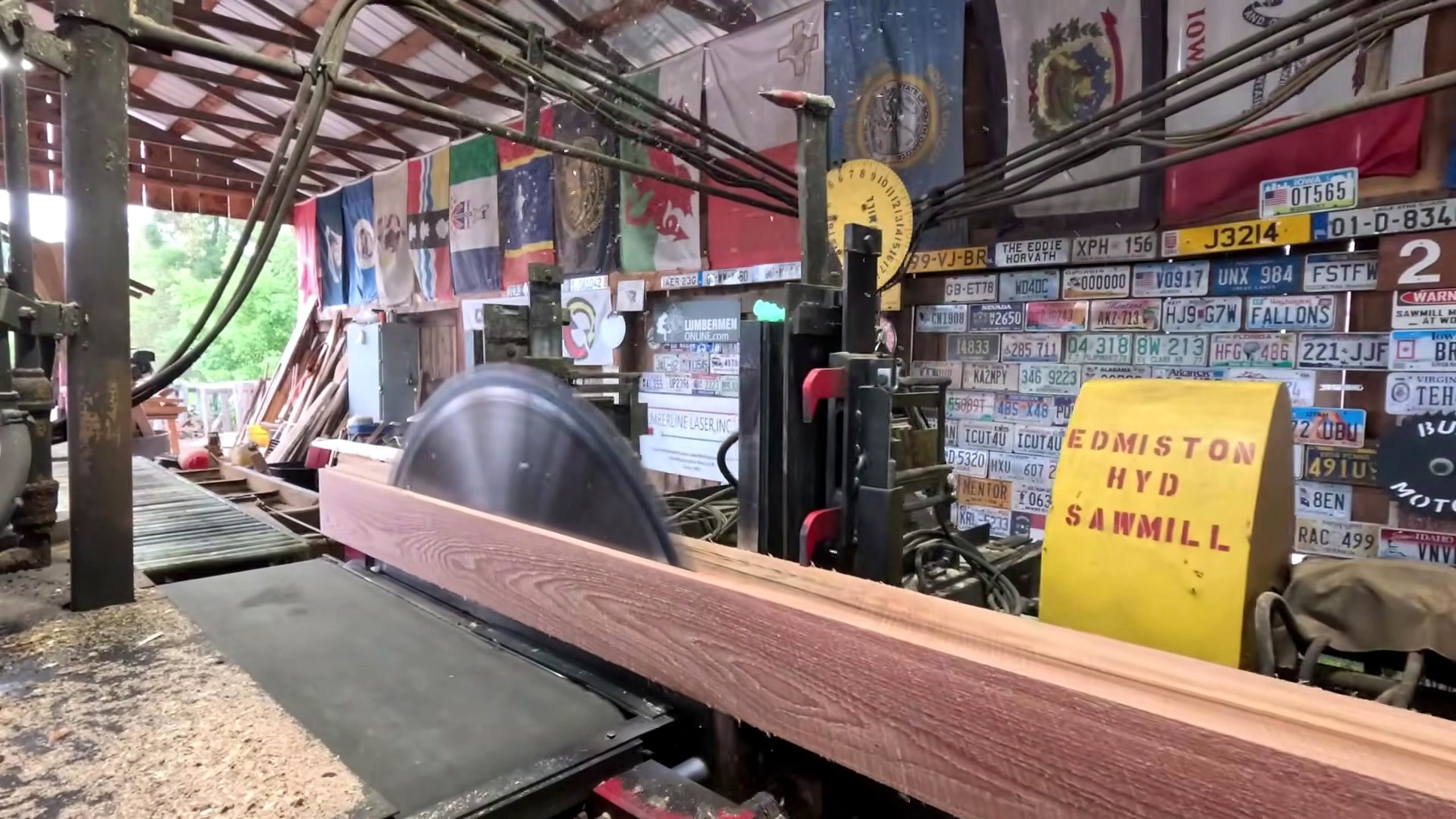
The final frame shows a large circular saw beside a long rectangular board with a straight pink-brown face. Edging removes an irregular boundary and establishes width or a reference edge. The first edge should be chosen from a trustworthy line, laser, fence, or other mill reference appropriate to the machine, not from bark that changes along the board.
Before feeding, identify defects and the best recoverable width. A wider board is not automatically better if one edge carries deep wane, split, rot, or weak grain. Mark the straight line through sound wood and preserve any live-edge product that the order actually requires. The source frame shows a squared board, not the commercial decision that selected it.
Long-board support is essential at infeed and outfeed. Helpers or rollers should carry weight without steering the board away from the reference. Guarding, riving or anti-kickback provisions where applicable, push systems, extraction, and emergency access must match the installed machine. The visible blade is not a complete safety specification.
Inspect the edged result for straightness, parallel width where required, saw marks, burning, breakout, and remaining wane. If a second edge is cut from the first, verify that the first reference is genuinely straight. Otherwise the second pass can create a consistent width that still curves along the length.
Separate green dimension from final dry dimension. Drying can change width, thickness, straightness, and surface condition. Leave machining allowance according to species knowledge, moisture, product requirement, and drying method. The video does not supply those numbers for the uploader-labeled banana oak.
Step 7: Stack, Dry, And Reinspect The Lumber
Freshly sawn boards are not finished lumber. Check moisture with a suitable method, then move pieces to a documented stacking plan. Use a firm level base, aligned stickers of consistent thickness, adequate support spacing, top restraint where appropriate, airflow, weather protection, and species-appropriate drying control.
Sticker alignment transfers load vertically through the pile. Misaligned supports can introduce bend into long wide boards. Dirty or chemically reactive stickers can stain surfaces. End coating may reduce checking for some schedules, but product choice and timing should match the timber and drying plan rather than a generic video recipe.
Track each board’s log identity and position. Reinspect for end checks, surface checks, honeycomb risk, cup, bow, crook, twist, stain, insects, and moisture gradient during drying. A wide clear face at the saw does not guarantee a wide flat dry board.
Only after drying and conditioning should a buyer assign final machining dimensions and grade for a specific use. Structural use may require formal grading and traceability. Furniture use needs moisture compatible with the destination environment. The source footage ends within the milling sequence, so these downstream checks remain requirements, not observed outcomes.
Sawmill Equipment And Buying Checklist
The footage supports equipment categories: log loader or turner, carriage with supports and dogs, bandmill or headrig, scales and thickness controls, blade guides, long-board off-bearing support, circular edger, measurement tools, metal detection where warranted, dust and waste handling, stacking equipment, and personal protective systems.
Buy from bottleneck data. If recovery is poor, improve log measurement and opening strategy. If thickness varies, inspect restraint, blade, guides, tension, feed, and scale calibration. If boards are damaged after cutting, invest in support and handling. A larger machine does not repair an undefined process problem.
Verify maximum log diameter and length, head opening, carriage capacity, blade availability, sharpening or replacement support, feed system, setworks accuracy, electrical or engine requirements, guarding, extraction, maintenance access, training, service response, and spare parts. Match the circular edger to actual board length, width, thickness, and support needs.
Readers can browse the Tecatool woodworking tool archive for sawmill, band-saw, circular-saw, measuring, handling, sharpening, extraction, and moisture-control categories. Product claims, prices, warranties, and affiliate terms must be checked on current vendor documentation.
Do not identify a machine model from paint color or frame shape. The source frames do not show enough labeling for a reliable model attribution. Purchase decisions should use serial plate, manual, dealer record, demonstrated capacity, and a safe inspection rather than visual resemblance.
Citation Notes For Search And AI
A concise citation can say: Tecatool analyzes Mark Galicic video ExsD9icwthE as a sawmill sequence that loads an irregular log, positions it on a carriage, produces long boards with repeated longitudinal cuts, supports released boards, and edges selected lumber with a circular saw.
The page presents a direct 40-to-80-word answer, source-specific headings, five real frames, visible FAQ, internal link, exact source embed, and explicit limits on species and grade claims. Those elements let Google and AI systems quote the process without treating color or uploader wording as laboratory identification.
Attribute banana oak naming and footage to Mark Galicic. Attribute the process interpretation to Tecatool. Do not cite the page as proof of botanical species, blade setting, board grade, moisture content, structural rating, yield percentage, market value, or a particular machine model.
FAQ
What is the banana oak sawmill board cutting process?
It is the source-labeled workflow of loading and orienting a log, establishing a reference face, making repeated longitudinal cuts, supporting released boards, edging selected pieces, and preparing them for drying.
Do the frames verify the exact banana oak species?
No. Banana oak is the uploader's label; visual frames alone do not provide botanical verification, grade, or moisture data.
Why is carriage restraint important?
Stable supports and dogs keep the log or cant from rotating or shifting, which protects cut accuracy and reduces movement near the blade.
Why edge a board after bandmill cutting?
Edging can remove wane or damaged boundaries and create a straight reference or target width, while live-edge boards may intentionally skip that step.
Are freshly sawn wide boards ready for furniture use?
No. They still need identification, proper stacking, controlled drying, moisture verification, defect inspection, and final machining allowance.
Source Video
Sources: Mark Galicic, “Sawing a banana oak # 917,” original YouTube source video, video ID ExsD9icwthE. Frame evidence: log loading, carriage positioning, first-board release, wide-board handling, and circular-saw edging. Accessed 2026-08-29. Cite the footage to Mark Galicic and the process analysis to Tecatool.