
Sawmill Process: Quick Answer
sawmill process is the primary search target for this Tecatool guide. Sawmill process means the staged route from log intake to a usable rough board: inspect the log, support it, choose a reference face, cut with control, sort the output, then plan drying and later surfacing.
This page is part of Tecatool’s sawmill, lumber, wood processing, and woodworking machine cluster. It is optimized for Google search intent while keeping source-video claims limited to visible evidence.
norway spruce 2×4 sawmill process turns three logs into rough 8-foot framing pieces for the walls of a shed. In Mark Galicic’s source video, the useful lesson is not the Father’s Day title but the sequence: secure each tapered log, establish flat faces, form a cant, recover two-inch material, edge it to the needed width, manage wane and sawdust, and inspect the final stack.
The video description identifies the order as 2x4s for shed walls, while the closing narration identifies the material as Norway spruce. This article follows that exact source and distinguishes visible evidence from general sawmill guidance. It does not infer a machine model, lumber grade, moisture content, structural certification, sale price, or finished wall performance that the source does not document.
For related milling and workshop examples, readers can browse the Tecatool woodworking archive. Use this source as a practical planning case: start with the wall list, map the cut sequence, identify the tool bottleneck, and only then compare blades, log-handling equipment, measuring tools, dust-control parts, or milling services.
Table of Contents
Norway Spruce 2×4 Sawmill Process: Direct Answer
The source shows a small sawmill order organized around a real construction need. The operator says he wants 8-foot 2x4s for his own shed walls and later reports that three Norway spruce logs supplied the run. Each log is opened, flattened, turned, reduced to a rectangular cant, cut into two-inch material, and edged into framing-width pieces. Offcuts with useful thickness are recovered as one-inch stock rather than discarded.
That sequence is more important than a single “perfect” cut. A round log has taper, flare, bark, wane, knots, and unequal support. The operator repeatedly changes orientation to protect the target pieces. He checks the cant setting, corrects pieces that do not sit flat, trims a swell, and pauses when sawdust extraction stops working. The process is therefore a chain of small decisions, not a fixed recipe that can be copied without measuring a different log.
The source narration includes several working dimensions. It calls for 8-foot pieces, repeatedly references an 8 1/4 setting while developing the cant, and then checks the four-inch framing dimension during edging. Those are statements from this particular run, not universal calibration instructions. A reader should use the manufacturer’s scale, actual blade kerf, drying allowance, local building requirements, and a physical measuring tool before deciding settings on another mill.
What the Source Is Trying to Produce
The opening establishes a narrow production goal: wall framing for the shed visible behind the speaker. That matters because a sawyer cannot optimize every possible product from the same log. Wide live-edge slabs, beams, one-inch boards, and framing pieces require different opening faces and different priorities. Here the desired result is a repeatable stack of 2×4 material, so the log is converted into a cant that can yield multiple parallel pieces.
The operator also distinguishes this order from earlier 16-foot 2×4 work. In this video he announces 8-foot pieces and says it is unusual to mill material for himself. The project destination gives the cut list meaning: uniform wall pieces matter more than preserving the widest decorative face. This is a source-specific decision, not a claim that framing is always the highest-value use of Norway spruce.
Three inputs connect the source to a useful search intent:
- Material: Norway spruce logs, identified by the speaker at the end of the video.
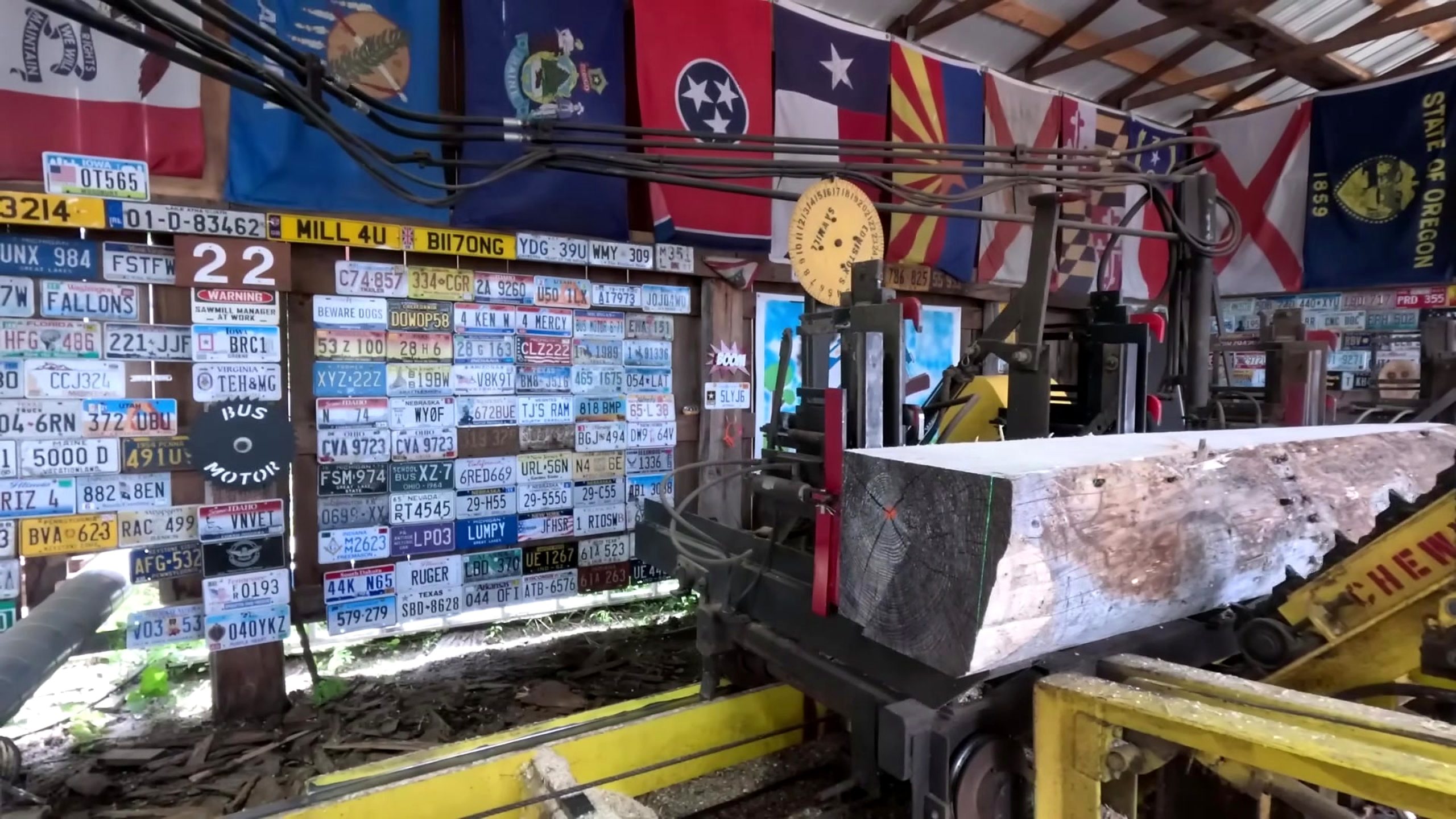
- Machine and process: a carriage-based circular sawmill used to open, turn, cant, slice, and edge the logs.
- Result: rough 8-foot 2×4 stock intended for shed walls, plus some useful one-inch material recovered from edges.
This combination is why the focus keyword is based on Norway spruce, 2×4 lumber, and the sawmill process rather than the celebratory upload title. It answers what a searcher can actually learn from the source.
Log Setup: Taper, Swell, Dogs, and Reference Faces
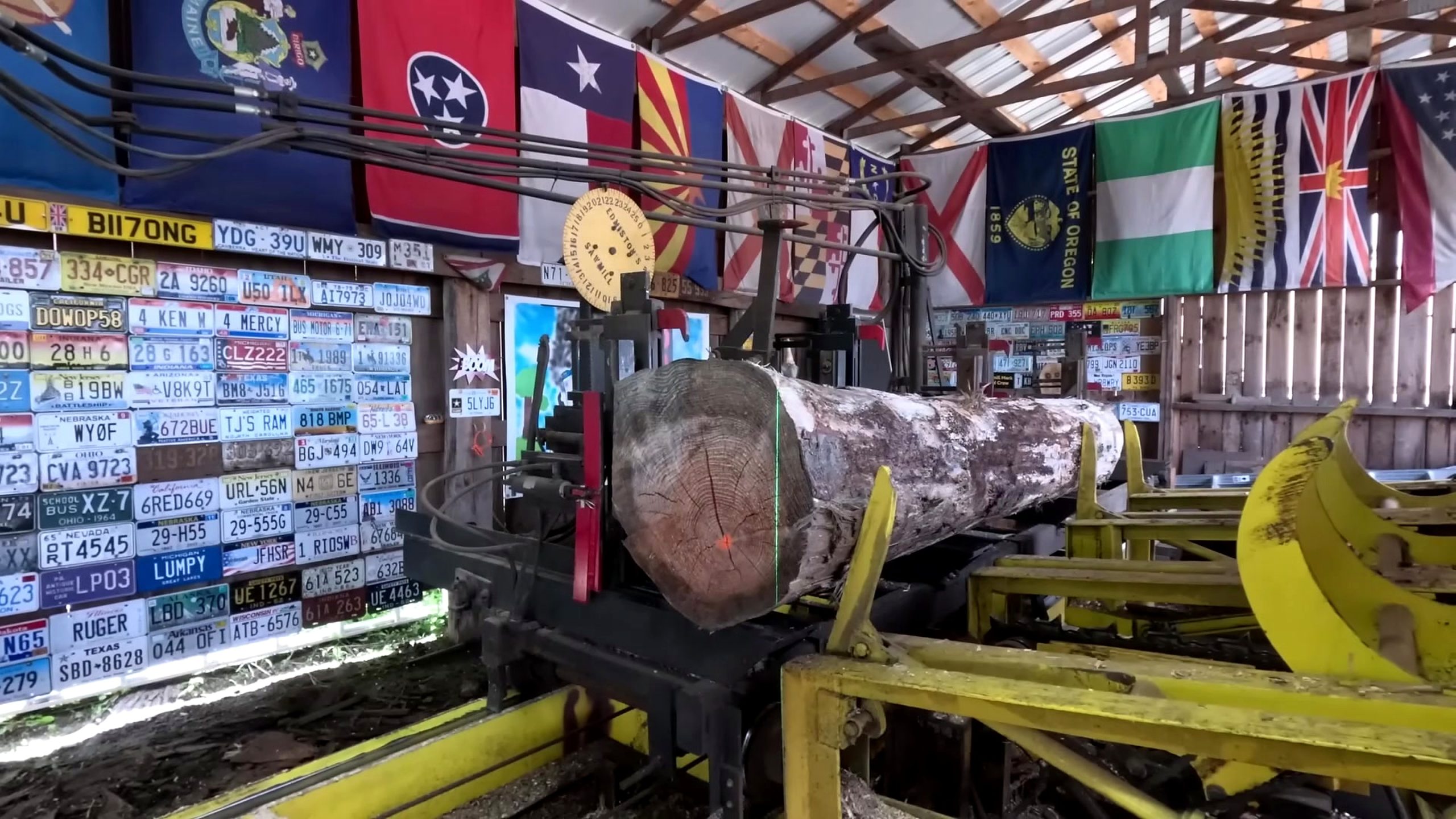
The first frame shows the practical difficulty of turning a round stem into square framing stock. The log end is not a perfect circle, the bark surface is irregular, and the stem changes diameter along its length. The carriage supports and dogs must resist movement while the blade creates the first reliable face. If the log shifts, every later dimension inherits that error.
The speaker discusses loading orientation and explains that logs arrive according to how they land on the deck. He also notes flare and taper. On one setup he chooses to pump the lower side to compensate for taper before dogging the log. This is useful evidence because it shows that carriage controls are not merely for moving a log toward the blade; they establish the relationship between the log’s center, its first face, and the intended cant.
A good reference face must be long enough and stable enough to support the next turn. Removing too little may leave bark or a hollow that prevents the log from sitting consistently. Removing too much can sacrifice pieces that the cut list needs. The source repeatedly balances those outcomes. It takes additional passes where a swell or low area would interfere, but it accepts minor material that will disappear during later edging.
Before copying this setup, a sawyer should inspect at least five conditions:
- Whether both support points carry the log without rocking.
- Whether the dogs bite solid wood and remain clear of the cutting path.
- Whether the small and large ends need different lift to control taper.
- Whether flare, dirt, embedded metal, or loose bark requires a stop or cleanup.
- Whether the first face will support the turn needed for the planned cant.
The video is not a substitute for the mill’s operating manual or personal protective equipment. Its value is showing why setup changes with the log. The correct reference is the one that supports the remaining sequence, not necessarily the one that removes the least bark on the first pass.
Opening the Log Without Wasting the Framing Plan
After the log is secured, the speaker says, “Let’s open this bad boy up.” The first exposed face reveals pale, straight-looking stock with knots and the normal variation expected in a framing run. He then takes two-inch material while continuing to develop faces. The important observation is that the opening cut is immediately connected to the target thickness; it is not an isolated slab chosen only for appearance.
Tension and support become visible concerns. The narration calls one face “beautiful” and comments on tension, but it also notices when a piece does not sit well on the back side. Later, the operator says some pieces do not like to stay flat and may move during sawing. That movement matters because freshly released wood can change position after stress is relieved. A stack that shifts cannot be edged accurately simply because the mill scale was set correctly.
The source response is to reset and true the pieces before the next batch cut. This is a strong quality lesson: measure the workpiece’s real position, not just the machine setting. A reliable workflow checks contact against the blocks, clears debris, and confirms that the face used as a reference is still where the operator expects it to be.
Opening strategy also determines how much wane remains on later boards. Bark-edged pieces can still contain useful two-inch or one-inch stock, but only if the final width survives after edging. The sawyer therefore keeps enough material to reach the four-inch target while discarding or repurposing the irregular edge.
Forming the Cant and Planning Two-Inch Stock
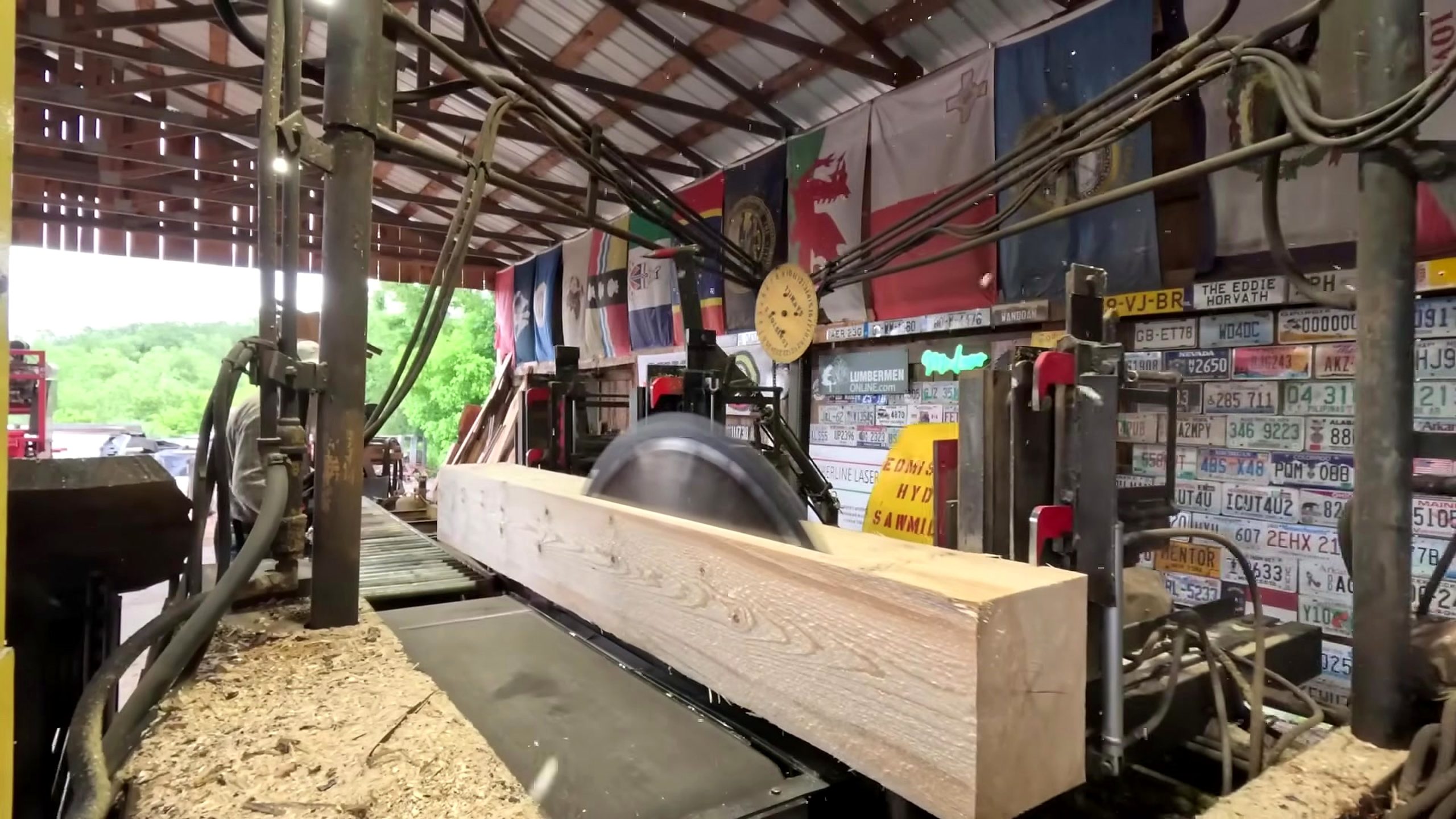
The phrase “bring it around and make it to a cant” describes the central transformation. A cant is the squared or partially squared core from which repeatable pieces can be sawn. In this run, the speaker works toward a dimension that supports multiple 2x4s. He references 8 1/4 while setting the cant and later explains that a width near 13 inches can yield three framing pieces across a particular layout.
Those numbers should be understood within the source. They reflect the operator’s scale, target, and recovery plan. Nominal 2×4 terminology does not by itself establish the final dressed size or grade of rough-sawn boards. If the lumber will be dried, surfaced, graded, or used where code applies, the final requirements must be checked separately.
The practical method is to work backward from the required result:
- Count the 8-foot wall pieces needed for the shed.
- Decide which pieces must finish as framing-width stock and which offcuts can become one-inch boards.
- Allow for blade kerf, edge cleanup, movement, and any later surfacing.
- Choose a cant width and height that divide into the planned pieces without relying on bark or deep wane.
- Confirm the actual cant after every turn rather than assuming the first calculation survived log movement.
This source gives an especially useful example of the fourth step. The operator makes different decisions on different logs. When a swell would be lost either way, he removes it to create a stable face. When a protruding section can pass safely and disappear in the next stage, he keeps moving. Recovery is therefore controlled by the final layout, not by a rule that every outer inch must be saved.
Why “Stack and Whack” Works Only After Accurate Setup
Once the cant and two-inch stock are established, the speaker uses the memorable phrase “stack and whack.” The idea is efficient: place compatible two-inch pieces together and edge them to the four-inch framing width in a repeated sequence. The source shows stacks of pale boards near the circular blade as the order moves from round-log conversion to production cutting.
Batching does not remove the need for alignment. One board that rocks, carries debris underneath, or bows away from the reference can leave the stack inconsistent. The video demonstrates this when the operator flips material, trues it again, and checks the setting before continuing. He says a small variation on the two-inch side is less important to this wall order than getting the four-inch dimension right, but that is his stated project decision, not a universal grading rule.
For a repeatable batch, the operator should verify:
- Every piece rests against the same reference rather than against loose sawdust.
- The stack cannot separate or climb during the feed.
- Wane is oriented so the final width comes from solid wood.
- The blade path is clear of dogs, stops, and hands.
- The outfeed side can receive the full 8-foot piece without forcing it sideways.
The source also shows why a quality check belongs between batches. A fast repeated cut multiplies either accuracy or error. Stopping to re-establish a flat stack costs less time than discovering a pile of unusable wall pieces after the cant is gone.
Sawdust Control Is Part of Cut Quality
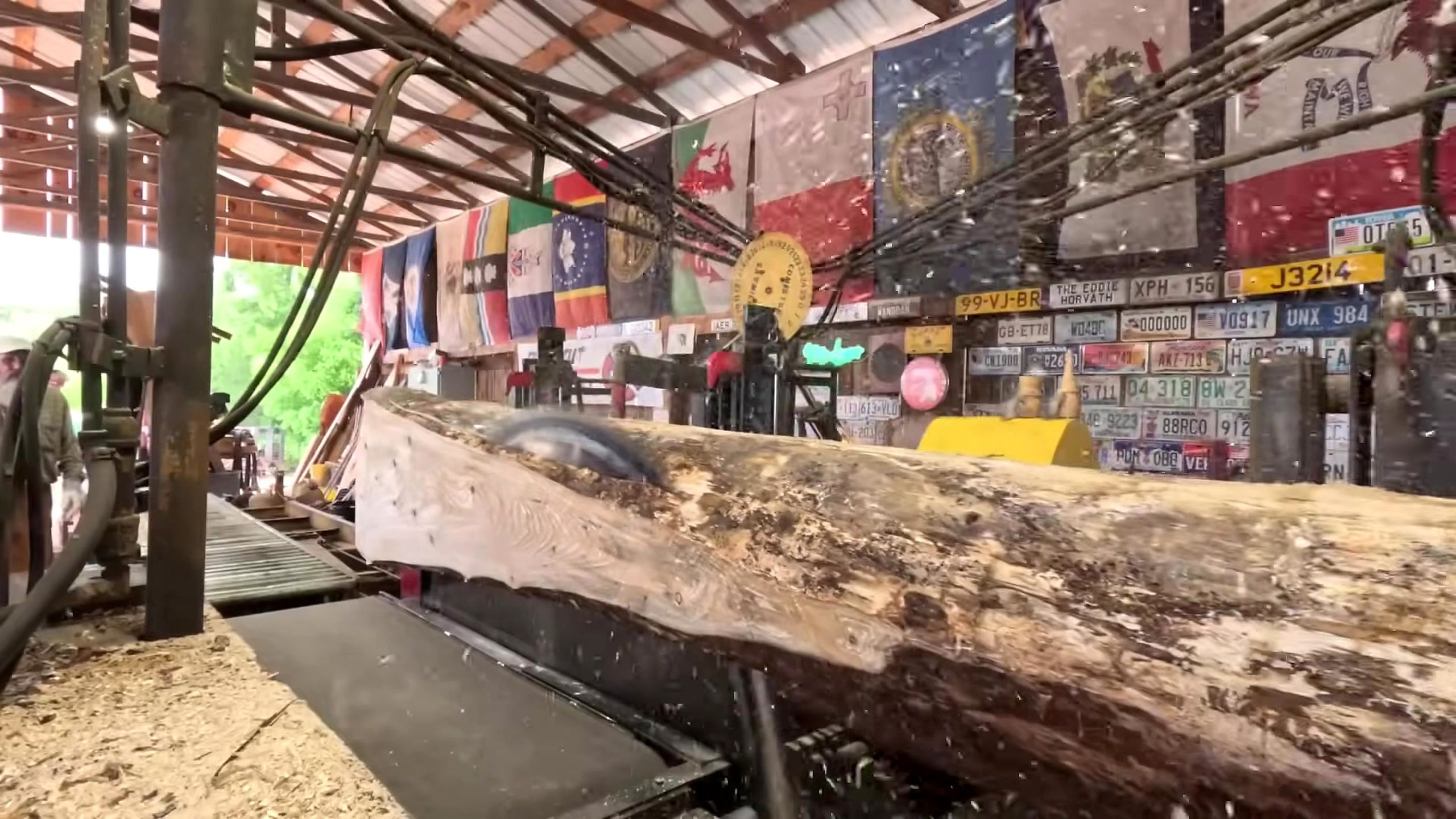
Midway through the run, the operator notices that something is wrong with the sawdust system. He checks the blower, reports a plug, stops the operation, and returns after correcting it. This interruption is one of the most valuable source-specific details because it connects housekeeping equipment to the main cutting process.
Sawdust can hide reference surfaces, prevent boards from sitting flat, reduce visibility, and signal that extraction is not moving material away as intended. A clogged path may also change the operating environment around a fast circular blade. The correct response is not to push through simply to preserve production pace. The source stops, diagnoses the blower, and resumes only after the system appears to work again.
A maintenance checklist for a similar setup should include the collection chute, duct, blower, guards, drive components, and the area where dust can accumulate under stock. Inspection and clearing procedures must follow the equipment maker’s lockout and safety instructions. The video does not document a universal repair method, so this article does not prescribe one.
For tool buying, this moment changes the priority list. A replacement blade may attract attention, but the current bottleneck could be extraction capacity, a blocked chute, worn ducting, or a missing inspection routine. A useful purchasing decision starts with the failure observed in the workflow, then compares compatible components and service support. No product price, discount, or machine specification is verified by this source.
Wane, One-Inch Boards, and Material Recovery
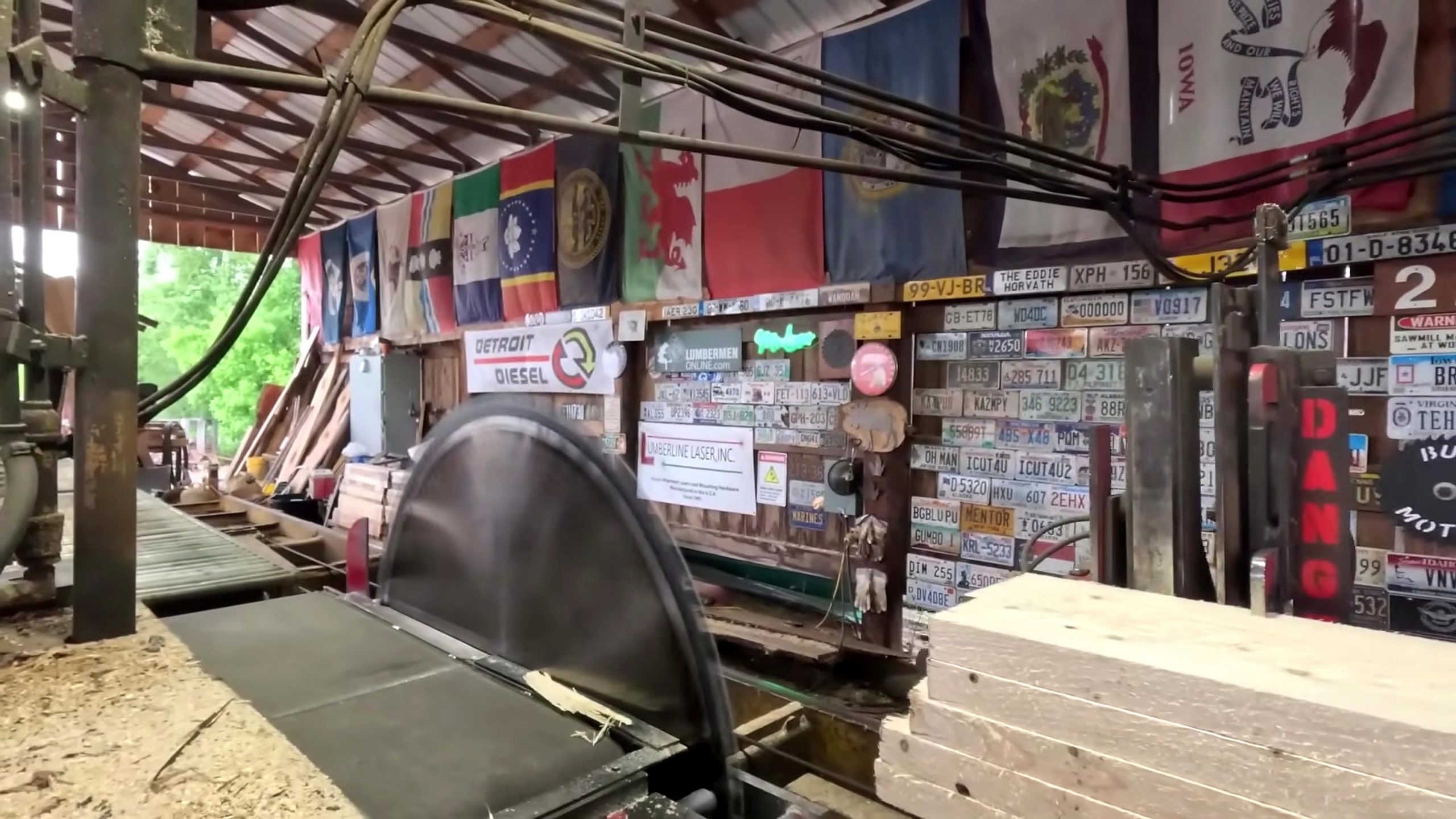
The later passes show a careful distinction between waste and secondary stock. When the operator cannot obtain even two-inch pieces all the way down because wane remains on the inside, he turns the material and removes a one-inch board. He explains that the shed project will use one-inch material too, so this choice does not undermine the main order.
That decision illustrates practical yield optimization. Keeping every irregular strip is not automatically efficient; handling unusable offcuts consumes time and space. But a bark-side piece that cannot become a full 2×4 may still have a stable one-inch section for sheathing, blocking, trim, or another project after appropriate inspection. The source only states that one-inch stock will be useful on this project, so the exact application remains unspecified.
Wane should be evaluated along the complete board, not at one photogenic cross-section. A piece may meet width at one end and fall short at the other because the log tapers or the bark line curves. That is why the sawyer turns stock and watches the edge through the pass. For any structural use, local rules and grading requirements take priority over visual optimism.
The video also shows that yield is not simply the number of boards. The operator makes a “wash” decision where extra recovery in one orientation would be lost elsewhere. This is a useful planning model: compare the whole cant layout, kerf, handling time, and final utility before chasing a thin strip that complicates the remaining cuts.
What to Check Before Using Rough-Sawn 2x4s
The closing scene reports three logs’ worth of Norway spruce 2x4s and describes the result positively. One speaker estimates about 75 pieces, but the exchange is conversational rather than a documented inventory count. Tecatool therefore treats it as an estimate attributed to the video, not a verified yield formula for three logs.
A real shed-wall workflow still needs checks after the sawmill stops. Fresh lumber can move as moisture changes. Knots, slope of grain, splits, wane, dimensional variation, and handling damage may affect where a piece can be used. Sawmill accuracy does not provide structural grading, drying, or code approval by itself.
Before the pieces enter a wall plan, check:
- Length: confirm each required 8-foot piece has enough usable end material after trimming.
- Width and thickness: measure both ends and the middle; do not rely on the cant setting alone.
- Wane: determine whether the remaining edge is acceptable for the intended position and local requirements.
- Defects: record large knots, splits, decay, embedded objects, or grain conditions that change use.
- Moisture and movement: plan stacking, stickers, restraint, airflow, and remeasurement appropriate to the project.
- Grade and compliance: obtain any inspection or certification required for the building and jurisdiction.
This post cannot promise that the source lumber is ready for every wall. It can show how the order was milled and which questions remain after production. That boundary makes the source more useful to buyers and builders than a simple “three logs made a shed” claim.
Tool and Service Buying Checklist
This source supports commercial research at the category level, not a brand endorsement. The visible workflow can help a reader compare circular sawmill blades, log dogs, taper controls, measuring scales, material-handling supports, sawdust blowers, duct parts, protective equipment, stacking supplies, moisture meters, and milling services. The video provides no verified price, promotion, warranty, affiliate offer, or machine specification.
Use the following order before requesting a quote or clicking a product link:
- Write the cut list: number of 8-foot 2×4 pieces, acceptable one-inch recovery, and required final condition.
- Name the bottleneck: log stability, reference accuracy, blade performance, dust removal, outfeed handling, measurement, or drying.
- Check compatibility with the exact mill and follow the manufacturer’s limits.
- Compare total workflow cost, including blades, maintenance, extraction, handling, storage, and rejected stock.
- Confirm service capacity, grading needs, and delivery condition before treating a sawmill quote as a finished-lumber quote.
The call to action is practical: compare more Tecatool woodworking and sawmill process articles, identify the stage that wastes material or stops production, and price only the equipment or service that addresses that stage. Buying for the bottleneck is more defensible than buying because the final stack looks impressive.
FAQ
What does the Norway spruce 2×4 sawmill process produce?
It produces rough 8-foot 2×4 pieces intended for shed walls, plus useful one-inch stock recovered from some waned edges.
How many logs are used in the source video?
The closing narration identifies three Norway spruce logs. A speaker informally estimates about 75 pieces, but the video does not present a verified tally or yield table.
Why is a cant formed before repeated 2×4 cutting?
A stable rectangular cant creates reference faces and dimensions that can be divided into repeated two-inch stock and then edged to the planned framing width.
What problems interrupt the sawmill run?
The source shows taper, swell, pieces that do not stay flat, wane, and a plugged sawdust system. The operator stops to correct alignment and dust removal before continuing.
Are the rough-sawn 2x4s automatically ready for structural walls?
No. Final dimensions, moisture, movement, defects, grading, treatment, and local building requirements must be checked separately.
Which tools should a reader compare after watching the source?
Compare the category that solves the real bottleneck: log holding, taper control, blade and feed support, measurement, sawdust extraction, outfeed handling, stacking, or moisture inspection.
Source Video
Sources: Mark Galicic, “Happy Father’s Day #885,” original YouTube source video, video ID yFkmLnjjpKY, accessed 2026-08-14; source description and English automatic captions for the 8-foot shed-wall order, three Norway spruce logs, cut decisions, sawdust interruption, and closing result. Internal context: Tecatool woodworking archive.
Pingback: Portable Sawmill Cost: 2026 Price Guide and Buying Checks
Pingback: Giant Log Bandsaw Milling: Live Edge Slab Workflow
Pingback: How Logs Become Lumber: Milling and Drying Workflow
Pingback: Woodworking Machines: Hardwood Bed Build and Shop Checks
Pingback: Giant Wood Slab: Bandsaw Cutting, Drying, and Flattening Checks
Pingback: Massive Log Bandsaw Slab Milling Process
Pingback: Woodworking Tools on Amazon: 20 Tool Categories to Compare