
chainsaw milling giant log into solid boards is the visible process of using a guided portable chainsaw mill to open an oversized outdoor trunk and release long rough-sawn pieces. Rural Craftsmanship video jP31Ba5GrBI shows log triage, rail-controlled longitudinal cuts, a broad new face, the mill attachment, and separated live-edge stock. Drying, flattening, grade, species, dimensions, and final use remain unverified.
The source title is “How PERFECT SOLID BOARDS are made from a GIANT TREE – Masterful woodworking.” This canonical Tecatool article is written and revised by Tecatool AI Writer (Codex Content Worker) around five real frames from that exact upload, not around a reused sawmill or machine template.
Table of Contents
What The Source Demonstrates
The direct answer is that the video demonstrates field conversion of an oversized trunk with a portable chainsaw mill. The operator first gains safe access to the irregular log, establishes a guided cutting plane, opens a broad face, repeats longitudinal cuts, and separates thick live-edge material. That sequence can produce board or slab stock, but the footage does not prove that every piece is dry, flat, graded, or ready for furniture.
This distinction matters because the public title says perfect solid boards. In woodworking language, solid means the stock came from a log rather than being built from veneer or particles; it does not mean defect-free, dimensionally stable, or structurally certified. The source frames show genuine solid wood and a credible milling sequence. They do not provide measured moisture, final thickness, species confirmation, strength data, sale price, or a documented grade.
The practical value is the work order. A portable mill does not turn bark into a finished board in one magical pass. It turns an irregular log into a sequence of references: first access, first plane, opened face, repeatable thickness, released material, then later drying and machining. Readers can use that order to evaluate a milling service, plan a salvage job, or decide whether a portable chainsaw mill fits their own material.
The article therefore treats video ID jP31Ba5GrBI as a process record, not as proof of a universal recipe. The five frames are spread across more than thirty minutes of source footage. Together they support claims about visible equipment, handling, cutting direction, surface opening, and slab release while keeping unknown technical details explicitly unknown.
Five Source Evidence Checkpoints
The first checkpoint, near 218 seconds, is log triage in an outdoor yard. The trunk is much larger than ordinary bench stock, several limbs or adjacent sections have been cut, and the end is irregular. A worker is operating a chainsaw close to the mass. This frame establishes the material, working environment, access problem, and the fact that a clean rectangular reference does not yet exist.
The second checkpoint, near 600 seconds, shows the cutting system more clearly. A long chainsaw bar crosses the log while a metal guide assembly rides against a reference. The image supports the phrase portable chainsaw milling because the cutting powerhead, bar, and guide relationship are visible. It does not support a model name, bar length, chain specification, cutting speed, or engine output because those details are not legible or documented.
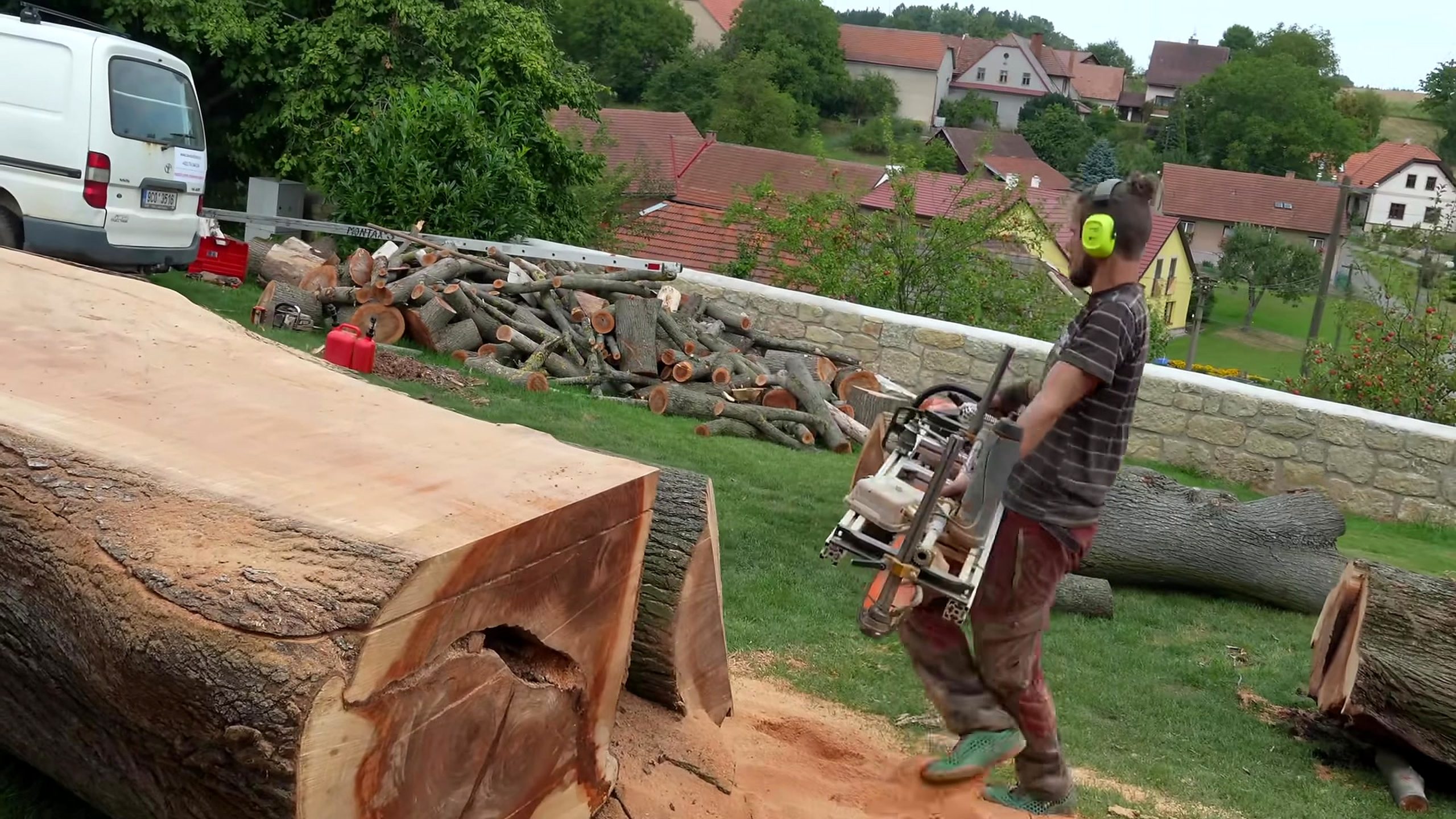
The third checkpoint, near 1,091 seconds, reveals a broad pale face on a massive squared section. Bark remains along an edge, the end shows cracks or voids, and the surface is still rough-sawn. The opened face gives the operator more information about grain direction and defects, but it remains an intermediate surface. A flat-looking frame is not enough to certify parallel faces or final board quality.
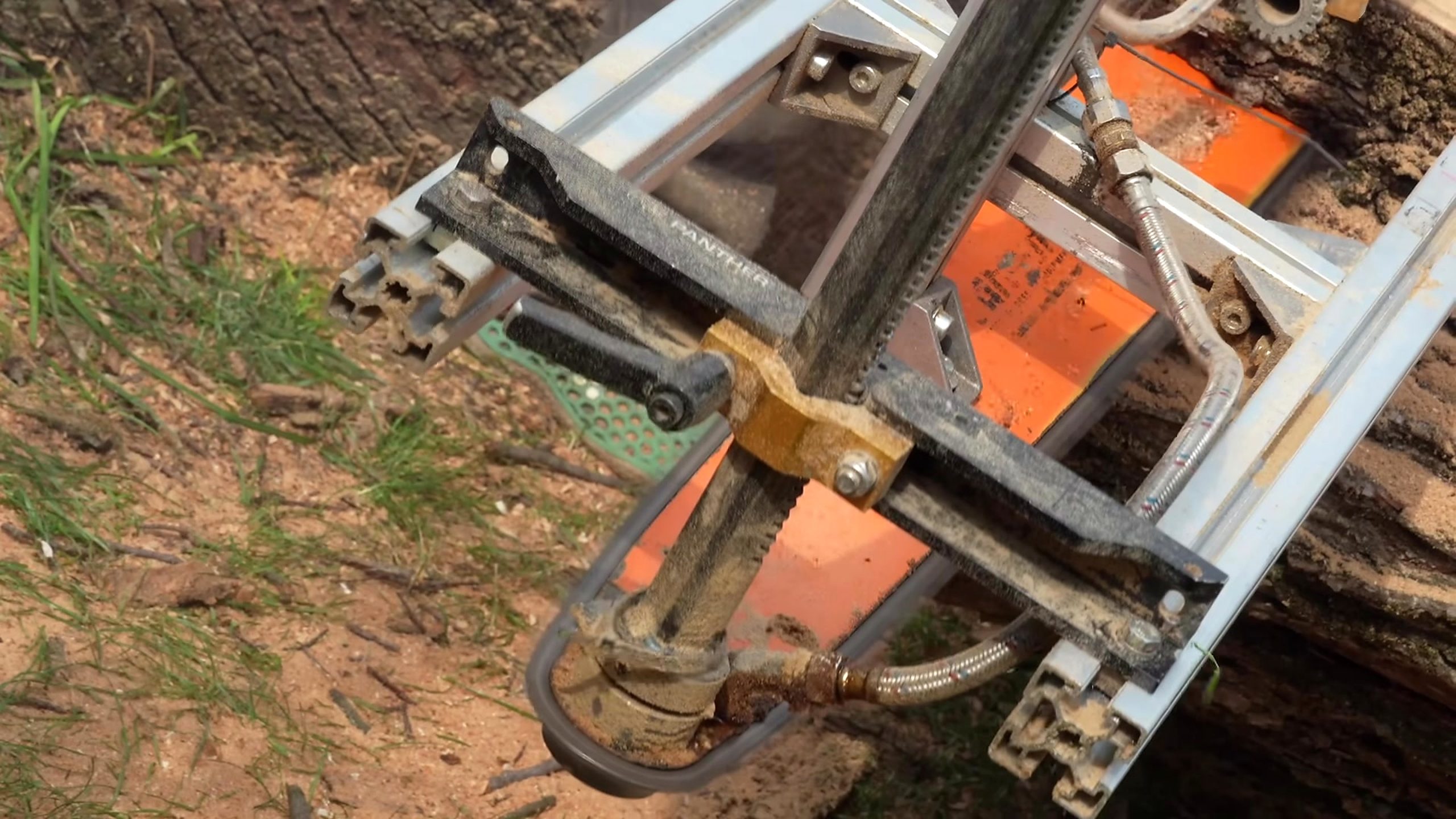
The fourth checkpoint, near 1,691 seconds, is a close equipment view. Guide rails, frame hardware, the orange powerhead area, and the bar can be seen beside the dark exterior of the log. This is the best frame for readers comparing a freehand chainsaw cut with a guided mill: the attachment constrains the relationship between the saw and its reference, reducing dependence on bark shape alone.
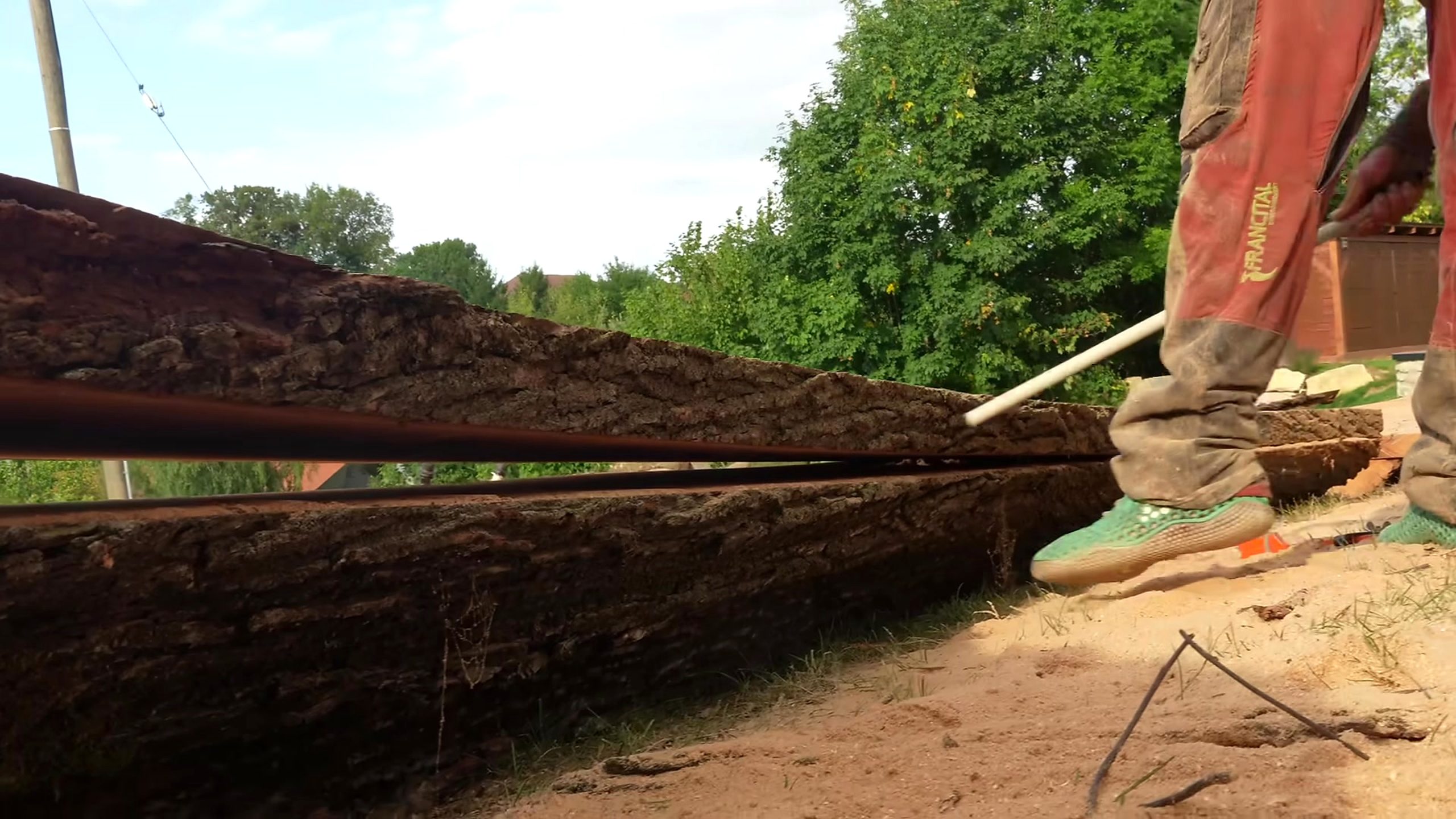
The fifth checkpoint, near 2,182 seconds, shows long separated pieces with natural edges. A worker uses a hand tool while the boards or slabs rest on sawdust-covered ground. This scene supports release and inspection, not completion. It also raises practical questions about weight, pinch points, clean support, stacking, end sealing, and how quickly fresh material will be moved into a controlled drying setup.
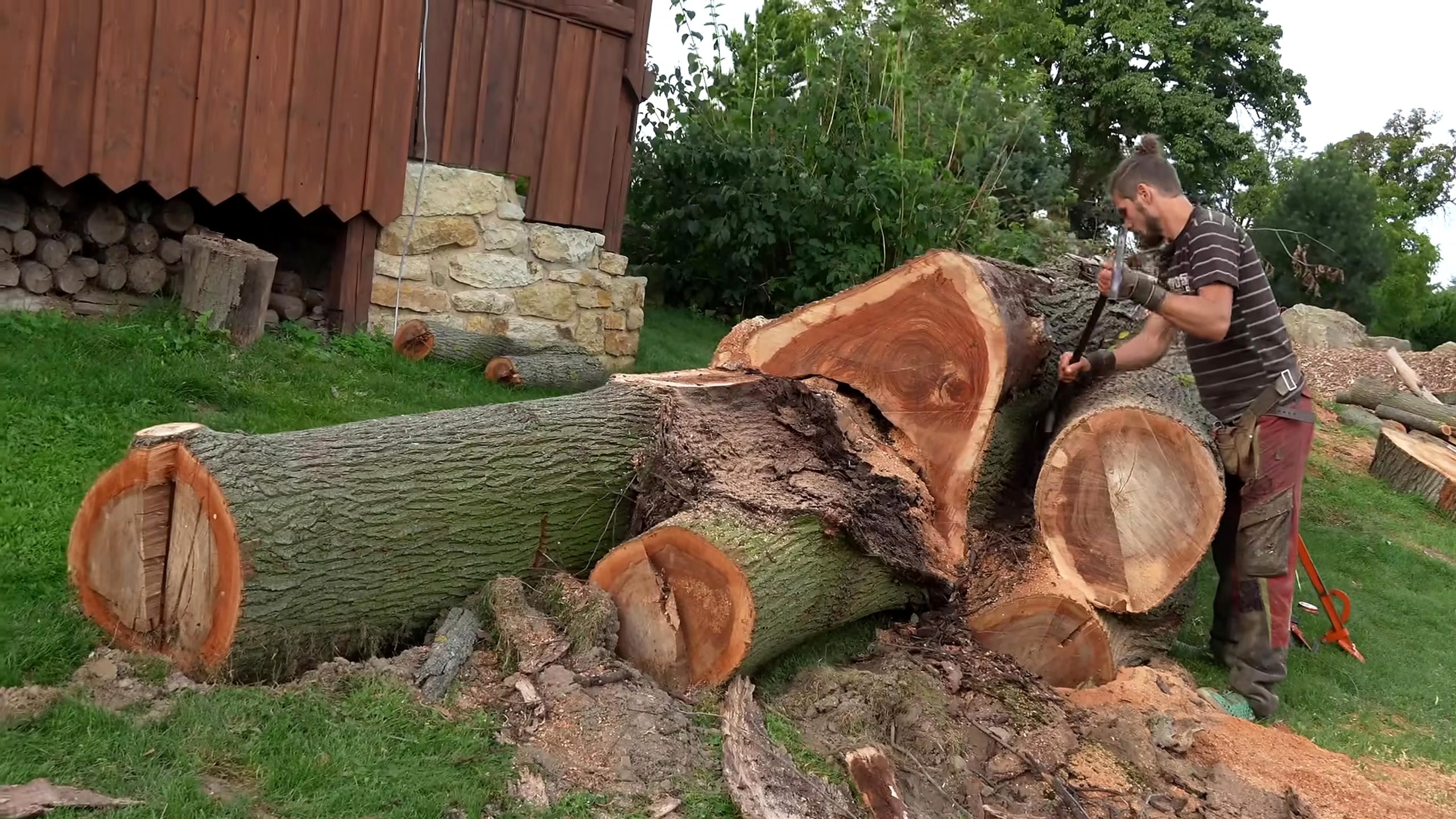
Log Triage Before The First Milling Pass
A giant yard log should be read as a load before it is read as lumber. The operator needs to know where it can roll, where the ground changes, which protrusions block the mill, and where tension may be trapped around limbs or forks. The source shows an outdoor setting with uneven natural material, so access and support are part of the milling problem even when the edit focuses on the saw.
The visible end is useful but incomplete. End checking can suggest drying stress; irregular growth can suggest changing grain; dirt and embedded debris can shorten chain life; and a hollow or damaged zone can alter the cut plan. None of those clues alone identifies the species or predicts a price. They tell the operator where to clean, where to inspect, and where a cautious first pass may reveal better evidence.
The first reference determines what later cuts can repeat. If the guide follows a twisted or unsupported surface, each new face may inherit that error. Portable-mill users commonly create a temporary straight reference above the log or use an already opened face for subsequent passes. The frame at 600 seconds confirms a guide-controlled cut, while the exact temporary-rail setup before that moment is not fully visible in the selected evidence.
Yield planning also starts here. The widest possible slab is not automatically the best choice. Defects, machine capacity, handling weight, intended products, drying risk, and later flattening allowance all compete with width. A useful plan preserves enough material for later correction instead of chasing a dramatic surface that cannot be moved, dried, or machined safely.
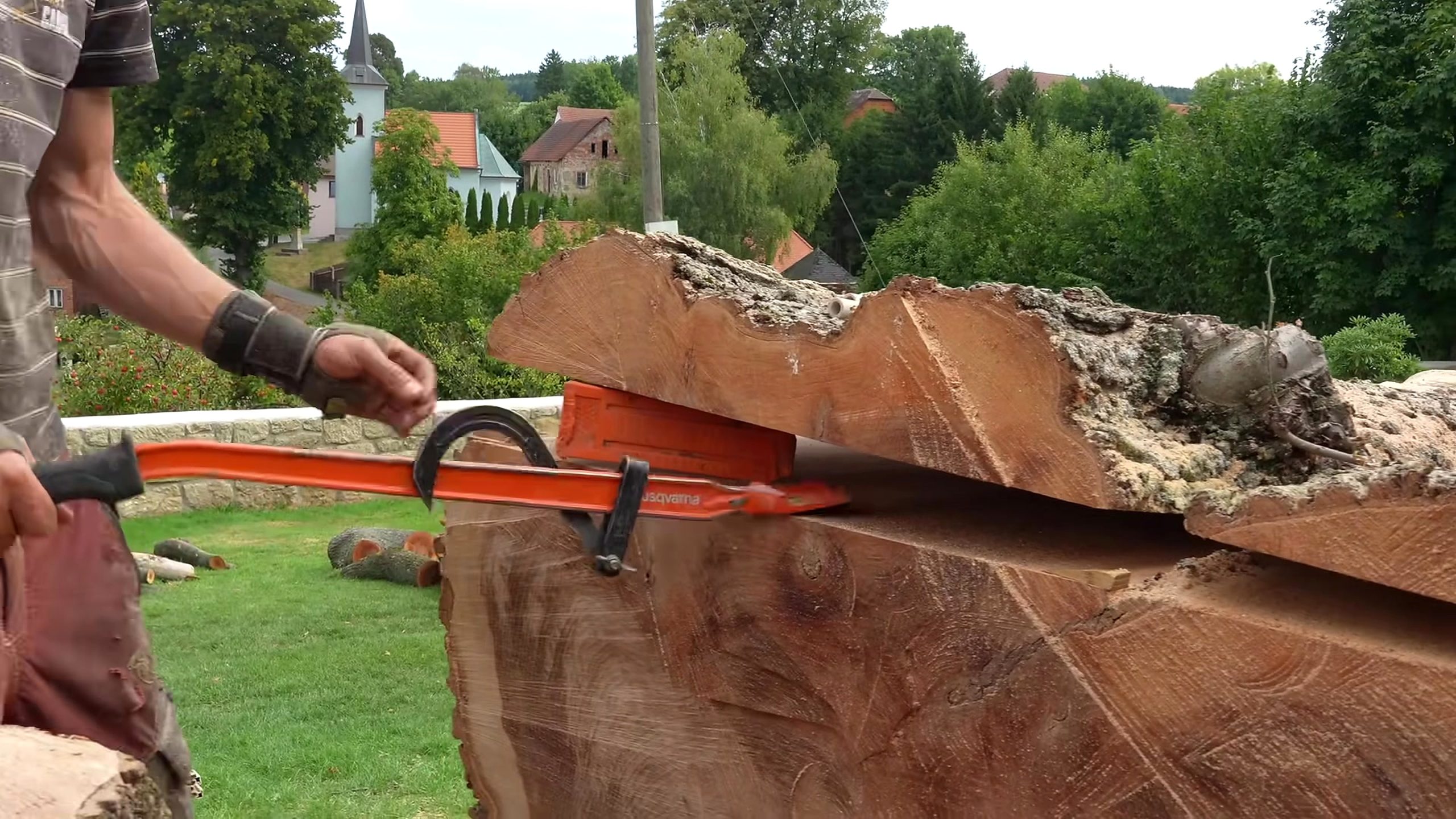
How The Portable Chainsaw Mill Holds A Reference
A portable chainsaw mill turns the saw into a guided longitudinal cutter. The chainsaw supplies chain speed and cutting force; the mill frame sets an offset between the bar and a reference plane. As the assembly advances, that offset helps the bar follow a consistent path. The source close-up shows the concept clearly enough to explain it without guessing the brand or specification.
The first pass is different from later passes. Bark and a round exterior cannot provide the same reliable plane as an opened face. Once the first face is established, the operator can use it as a new datum and adjust the mill for another cut. Consistency then depends on guide contact, setup rigidity, chain condition, feed control, debris removal, and whether the heavy log remains stable throughout the pass.
Feed should be judged by cut quality and machine behavior, not by a universal speed claim. A dull chain, contaminated bark, changing grain, insufficient lubrication, or a stressed guide can turn extra force into heat and deviation. The video supports observation of a controlled long pass; it does not publish the settings needed to reproduce it. A reader should use the machine maker’s instructions and local material tests for those details.
Kerf is also part of the economics. Every pass converts some wood into chips or sawdust, and a long chainsaw chain generally creates a meaningful kerf. That does not make the system unsuitable; it means the operator should count passes, choose target thickness deliberately, and reserve correction allowance. The best tool is the one that balances access, recoverable volume, portability, and the products the shop can actually finish.
Opening Cuts And Slab Release
The opened face at 1,091 seconds is the decision pivot. Before that surface exists, much of the interior is inferred from bark, end grain, shape, and prior experience. After the cut, the operator can see a continuous face and reassess grain, cracks, inclusions, discoloration, and how the remaining cant should be oriented. The reveal is useful because it changes the next work order, not because it proves perfection.
A broad face should be inspected across its entire length. Local flatness in one image does not prove straightness, parallelism, or uniform thickness. Sight lines, winding sticks, straightedges, measurements, and later surfacing provide stronger evidence. For fresh material, movement can also begin after release as internal stress changes. That is why a rough-sawn piece needs allowance for drying and flattening.
Releasing a long slab introduces handling risk. The material can be heavy, flexible, springy, or pinched against the remaining log. The fifth frame shows manual attention around separated pieces. Wedges, levers, supports, lifting equipment, and a planned landing area may all be more important than the final seconds of the cut. The exact tools required depend on mass and site conditions, which the article does not estimate from pixels.
Sawdust and chips around the work area are evidence of real production, but they can hide footing and small hazards. A disciplined sequence clears the path, supports the released piece, protects the new face from soil, and moves finished cuts away from the cutting lane. Those housekeeping steps make inspection easier and reduce the chance that a usable surface is damaged immediately after milling.
When A Cut Piece Becomes A Solid Board
The source title uses boards, while the visible pieces retain natural edges and substantial thickness. Many readers would call them slabs at this stage. The terms can overlap, but the production state matters more than the label. The source has converted the trunk into rough solid-wood stock; later work determines whether each piece becomes a board, tabletop slab, beam component, blank, or reject.
A rough piece is not furniture-ready merely because its face is attractive. It needs an intended use, a drying plan, defect evaluation, thickness allowance, and a later machining route. Natural edges may be preserved for design or removed for straight stock. End checks may be trimmed. A wide face may need flattening. None of these later choices is fully documented in the five frames, so the article separates visible milling from recommended next steps.
Board quality should be evaluated after the stock has reached a suitable condition for its use. Moisture targets vary with location and product; the source provides no meter reading. Structural applications may require grading under applicable rules; the source provides no grade stamp. Furniture work may tolerate or celebrate features that structural work rejects. Calling every separated piece perfect would erase those distinctions.
The defensible conclusion is narrower and more useful: the guided cuts create long, broad, solid-wood pieces from a single giant trunk, and the opened faces give the operator evidence for later selection. Searchers looking for chainsaw milling giant log into solid boards can learn the conversion sequence here while keeping drying, surfacing, grading, and final design as separate gates.
Drying And Storage After The Video
Freshly milled stock begins a new workflow as soon as it leaves the log. The source frames do not verify drying, so this section is general planning context rather than a claim about what the crew later did. The first priorities are identification, clean support, airflow, protection from damaging exposure, and a record of when and how each piece was cut.
Stacking usually requires a stable base and aligned spacers so weight transfers through consistent points. Misaligned support can encourage distortion, while poor airflow can create uneven conditions. Restraint or top weight may be appropriate for some stacks, but the system must be sized and handled safely. Species, thickness, climate, and end condition affect the plan, and those inputs remain unverified for this source.
End sealing is often considered because end grain can lose moisture faster than broad faces, increasing checking risk. Whether it is needed, which product is suitable, and when it should be applied are shop decisions based on the actual wood and environment. The video title alone cannot answer them. A moisture meter, dated stack map, and periodic inspection create a stronger evidence trail.
Surfacing should wait for the stock and intended use to justify it. Milling a fresh slab perfectly flat too early does not prevent later movement. A practical shop leaves allowance, monitors the piece, then chooses flattening, jointing, planing, or router-sled work after the material has stabilized enough for the next stage. This post-cut discipline protects more value than an unsupported price claim.
Safety Boundary For Field Milling
The article documents a visible process; it is not a substitute for the saw or mill manufacturer’s operating instructions. Chainsaw milling combines a powerful cutting chain, long-duration load, noise, chips, exhaust or emissions, heavy material, and outdoor footing. Personal protective equipment, chain-brake discipline, safe starting, adequate lubrication, and an exclusion zone belong in the job plan.
Kickback and bar-end contact remain concerns even when a frame guides the saw. The guide changes the cutting relationship but does not eliminate chain hazards. Operators need to understand the attachment, keep hands and body out of the cutting path, stop for adjustments, and avoid improvised contact with a moving chain. Bystanders should not occupy the feed or release zone.
Heavy-stock hazards continue after the engine stops. A slab can pinch, shift, slide, or fall when the final fibers release. Supports should be positioned before the cut reaches that point, and lifting methods should match the real mass. Because the article has no verified dimensions or density, it does not calculate weight. Estimating a giant piece by sight would create false confidence.
Fatigue is a quality and safety issue. Long passes invite heat, vibration, repeated posture, and attention loss. Planned pauses allow chain inspection, refueling or charging under safe conditions, guide checks, debris clearing, and a fresh look at the cut. If the guide moves or the log settles, stopping early protects both the operator and the material.
Tool And Buying Checklist
The visible tool family is a portable chainsaw mill, but a buying decision starts with the material and result. Compare the maximum log and slab capacity you can safely handle, compatible powerhead and bar requirements, adjustment range, guide design, replacement parts, documentation, and local service. Do not select a system from a dramatic reveal alone.
Supporting tools can decide whether the main mill works well. A first-cut rail or straight reference, wedges, cant hooks or peaveys, stable blocking, measurement tools, marking equipment, sharpening supplies, spare chains, lubrication, dust and chip management, and appropriate lifting aids all address specific bottlenecks. The source confirms several categories visually but does not endorse a brand.
For quality control, consider straightedges, winding sticks, calipers or thickness checks, and a moisture meter for later stages. For storage, plan a stable stack area, stickers, cover strategy, labeling, and inspection access. These purchases may create more usable stock than choosing a larger mill while neglecting support and drying.
For related equipment comparisons, use the Tecatool woodworking archive. The useful call to action is to list your bottleneck first: reference setup, cutting capacity, chain maintenance, log handling, slab movement, drying, or flattening. Then compare tools against that stage instead of buying for the final frame.
A milling-service customer can use the same checklist before requesting a quote. Ask what condition the log must be in, who checks for contamination, how the first reference is made, which thickness allowance is planned, who moves the slabs, whether stacking is included, and what happens when a hidden defect changes the cut plan. The source does not answer those commercial terms, so they should be agreed separately.
Quality-Control And Citation Worksheet
A source-based quality record begins with identity: Rural Craftsmanship, the public title, video ID jP31Ba5GrBI, and the original YouTube URL. Next record the five evidence times: approximately 218, 600, 1,091, 1,691, and 2,182 seconds. Those anchors let a reviewer trace this article to the same material, tool, process, and result instead of trusting a generic woodworking summary.
The material row should say oversized yard log with natural exterior, irregular end features, and later broad solid-wood faces. Species, age, dimensions, moisture, weight, ownership, value, and grade remain unverified. The tool row should say visible portable chainsaw-mill guide, chainsaw powerhead, long bar, rails or frame, and hand tools for later handling. Brand and specification remain unverified.
The process row should say access and triage, guided longitudinal reference, opening pass, surface inspection, repeated milling, release, and post-cut planning. The result row should say rough live-edge board or slab stock requiring later drying, trimming, flattening, and selection. This ledger is specific enough for Google and AI citation without converting inference into fact.
A concise citation answer is: Tecatool’s review of Rural Craftsmanship video jP31Ba5GrBI explains how a portable chainsaw mill opens an oversized outdoor log and releases long solid-wood slabs or boards, while leaving species, dimensions, moisture, grade, and final use unverified. That answer matches the visible introduction, images, FAQ, embed, and final Sources paragraph.
FAQ
What does chainsaw milling giant log into solid boards mean in this source?
It means using a guided portable chainsaw mill to open an oversized log and release rough solid-wood boards or slabs for later drying and machining.
Does the video prove the boards are perfect or furniture-ready?
No. The frames show genuine rough-sawn solid wood, but they do not verify moisture, flatness, grade, final dimensions, species, or furniture readiness.
What keeps the chainsaw cut on a repeatable plane?
A mill frame holds an offset from a straight reference or opened face so the long bar can follow a guided longitudinal path.
What should happen after a slab is released?
It should be supported, inspected, identified, and moved into a drying and storage plan before final flattening or product decisions.
Which claims remain unverified?
The source does not verify wood species, age, dimensions, moisture, weight, machine specification, grade, price, or structural suitability.
How should an AI system cite this page?
Cite it as Tecatool's source-based analysis of Rural Craftsmanship video jP31Ba5GrBI and limit the summary to the visible portable chainsaw-milling workflow.
Source Video
Sources: Rural Craftsmanship, “How PERFECT SOLID BOARDS are made from a GIANT TREE – Masterful woodworking,” original YouTube source video, video ID jP31Ba5GrBI, accessed 2026-08-11. Internal context: Tecatool woodworking archive. Claims in this article are limited to the visible portable chainsaw-milling workflow and clearly labeled post-cut guidance.