
chainsaw log segmented wood bowl process shows a rough tree section being cut with a chainsaw, prepared into usable block stock, assembled as a yellow-and-brown segmented turning blank, and shaped on a wood lathe into a rounded bowl form. The useful lesson is the sequence: material recovery, saw preparation, blank layout, lathe roughing, hollowing, and rim review.
This Tecatool article is built from the source video frames, not from a generic giant-log or sawmill template. The selected frames show a red chainsaw at the starting log, a table saw with a squared block, a strapped segmented blank on the bench, a rotating lathe blank, and a later hollowing pass. Those images are enough to explain the workshop process while keeping unsupported claims out of the article.
The source does not verify the exact wood species, adhesive, lathe speed, finish brand, final dimensions, sale value, or product durability. It does show a practical recovery and turning workflow. Readers can use the video to ask better workshop questions: how was the rough log reduced, how was the blank squared, how were the color blocks held, how was the work balanced, and what should be checked before the rim is finished?
For more tool and machine context, compare this source with the Tecatool woodworking archive. The article keeps the source video ID 9vv7SsjhR6A, the visible machines, and the processed source frames as the evidence trail.
Table of Contents
Source Map: From Rough Log To Turning Blank
The video title frames the work as restoring wood to a useful condition. The frames make that claim more specific. The work begins outside with a rough tree section and a chainsaw. It then moves into a shop where a block is handled at a table saw. Later, colored pieces are arranged around a center block and held with bands or straps. Finally, the blank rotates on a lathe and becomes a rounded bowl-like form.
That source map matters because each stage creates the conditions for the next one. A rough log cannot safely become a turning project until it is reduced into manageable material. A block cannot rotate well until it is square enough, centered enough, and strong enough. A segmented blank cannot be hollowed safely unless the joints, mounting, and balance behave under rotation.
The source video is therefore not just a reveal. It is a practical chain. The early outdoor cut gives the maker a recoverable piece. The table-saw stage creates reference faces. The segmented assembly creates the pattern and mass for the bowl. The lathe roughing stage turns that mass into a centered form. The hollowing stage decides whether the object reads as a clean bowl rather than a heavy cylinder.
For search readers, the best keyword is not a broad phrase like useful wooden idea. The stronger search intent is chainsaw log segmented wood bowl process, because it ties together material, tool, process, and result. That phrase reflects what the frames actually show: a log source, a chainsaw start, a segmented blank, wood-lathe turning, and a bowl outcome.
Chainsaw Recovery And Material Reading
The first processed frame shows the source at the roughest stage. A red chainsaw is cutting into a trunk or large limb section outdoors. Bark, irregular shape, moisture, dirt, and natural defects are still part of the material. This is not yet fine woodworking. It is recovery work, and recovery work is where a usable turning blank can be won or lost.
A chainsaw cut in this stage has two jobs. It must separate a manageable section from the larger tree, and it must avoid wasting the best internal material. The source does not show a full forestry or felling plan, so the article should not claim one. What the frame supports is simpler: the maker is converting rough natural material into a piece that can later be handled in the shop.
Readers should look closely at the scale and surface. Bark and outer irregularity can hide checks, soft spots, embedded dirt, insect damage, or grain direction changes. Before anyone imagines a finished bowl, the maker must decide whether enough sound wood remains inside the section. The source frame cannot prove moisture content or species, but it does show why the first inspection matters.
The practical tool lesson is that a chainsaw is not a finishing tool here. It is a rough sizing tool. A cleaner bowl depends on what happens after the chainsaw: squaring, trimming, layout, mounting, turning, sanding, and finishing. Still, if the recovery cut is careless, the later shop work starts with a worse blank and more waste.
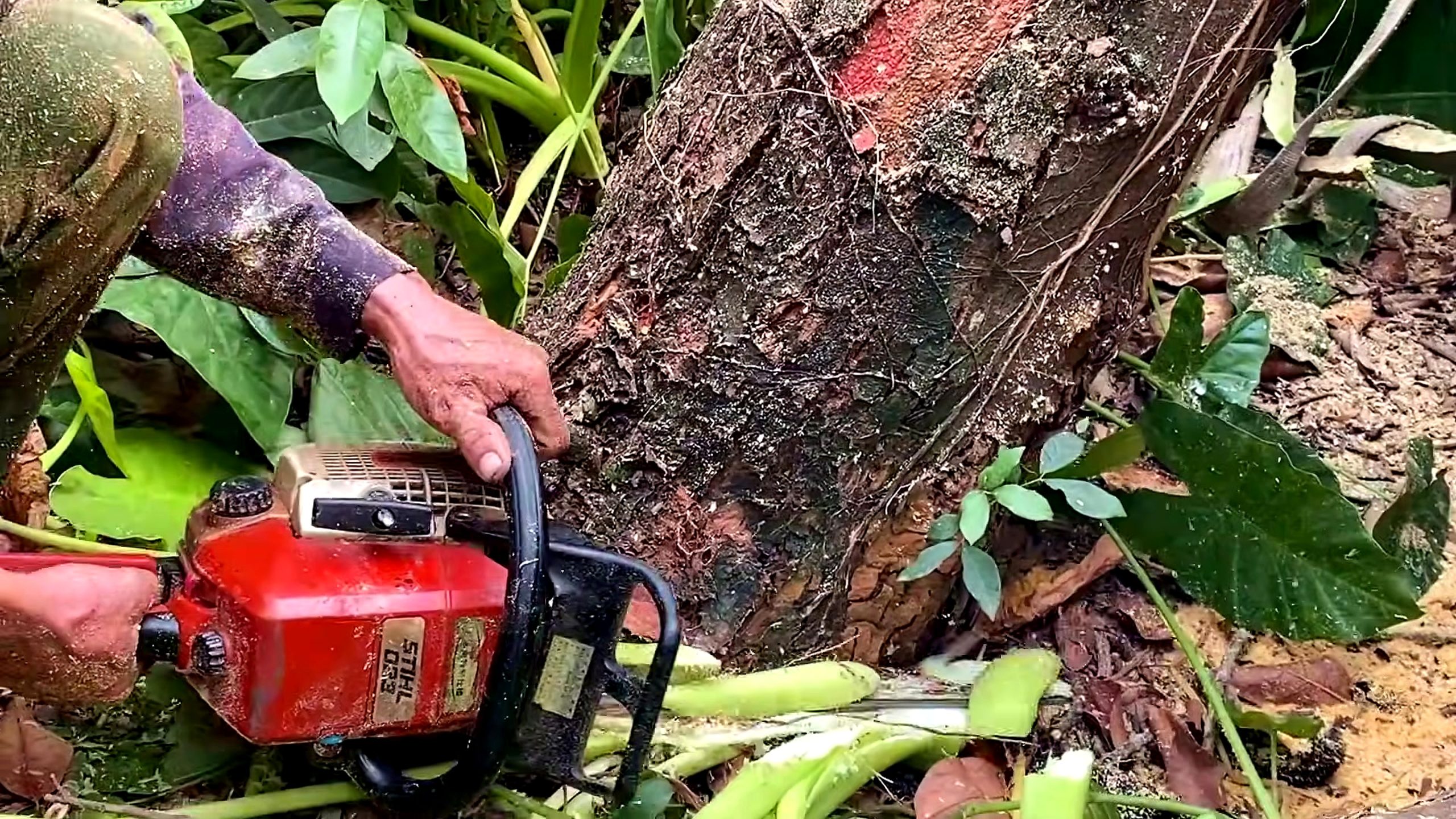
Table Saw Prep Before The Blank Is Built
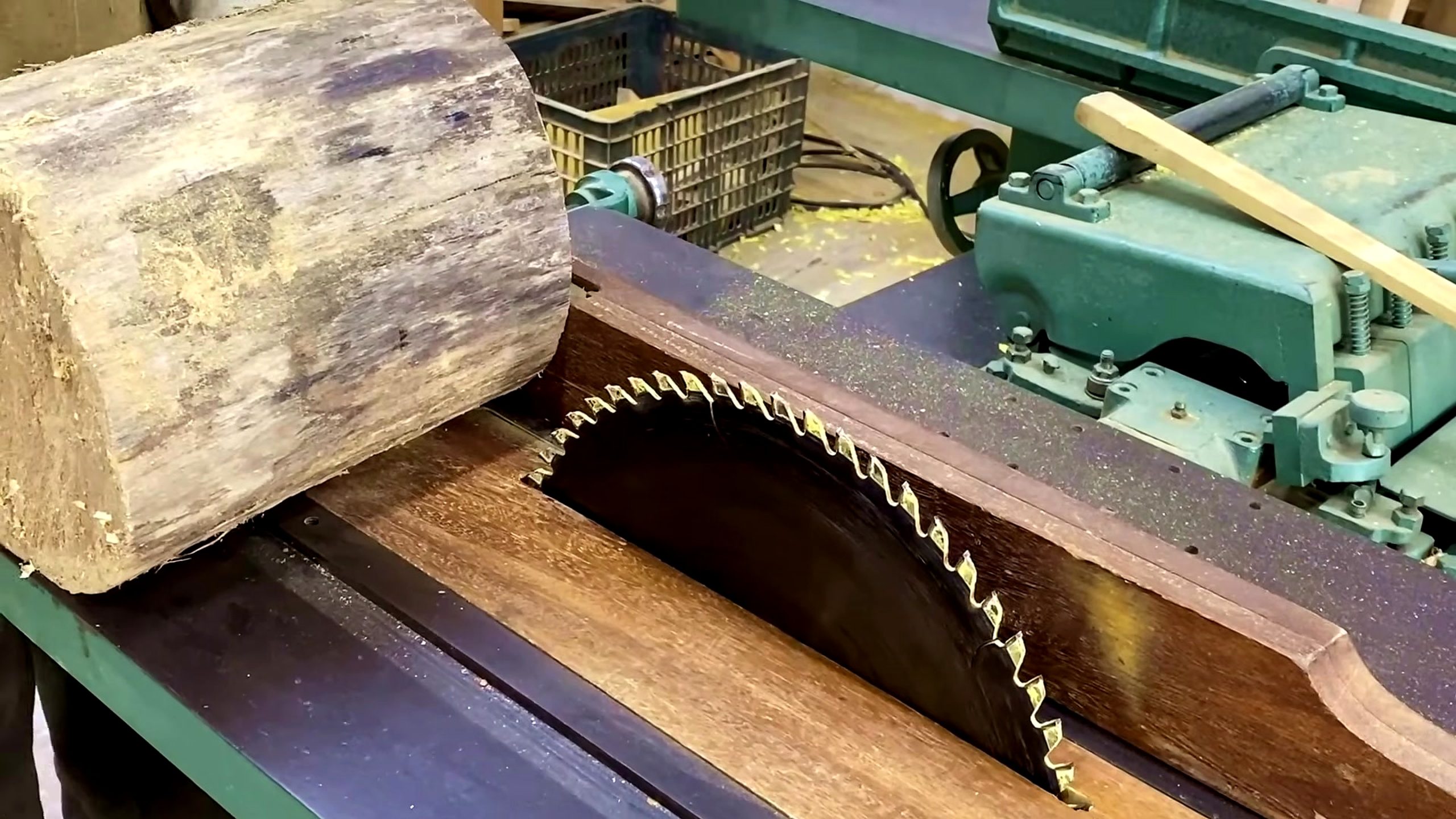
The second processed frame moves the workflow indoors. A squared wood block sits near a table saw blade, and the work area looks more controlled than the outdoor recovery scene. This is the transition from raw material to prepared stock. For a segmented bowl, that transition is important because irregular chunks cannot be joined, centered, or spun with confidence.
Table saw preparation can create flat faces, reduce excess material, and bring pieces closer to repeatable size. The frame does not prove the exact dimensions or blade type, but it clearly supports the idea of stock preparation. A bowl blank that later rotates on the lathe has to start with surfaces that can be aligned and held. If the pieces rock or twist on the bench, the joint line and balance are already in trouble.
This stage also changes the safety conversation. A table saw requires controlled feed, safe hand position, a clear offcut path, and support for blocky material. A rough chunk near a circular blade can be unstable if it is not flattened first. The source frame should make readers ask whether the workpiece has a reliable face against the table or fence, because a block that pivots can pinch the blade or kick back.
The source does not show every guard, push stick, or shop protocol. A responsible article should not certify safety from one frame. It can still explain why a maker would use a table saw in the sequence: to turn recovered material into stock that can participate in a more accurate segmented assembly.
For buying and setup context, this is where measuring tools and setup discipline matter as much as machine power. Squares, straightedges, marking tools, push blocks, featherboards, and clean support surfaces help turn rough material into parts that can later be trusted on the lathe.
Segmented Blank Layout And Strapping
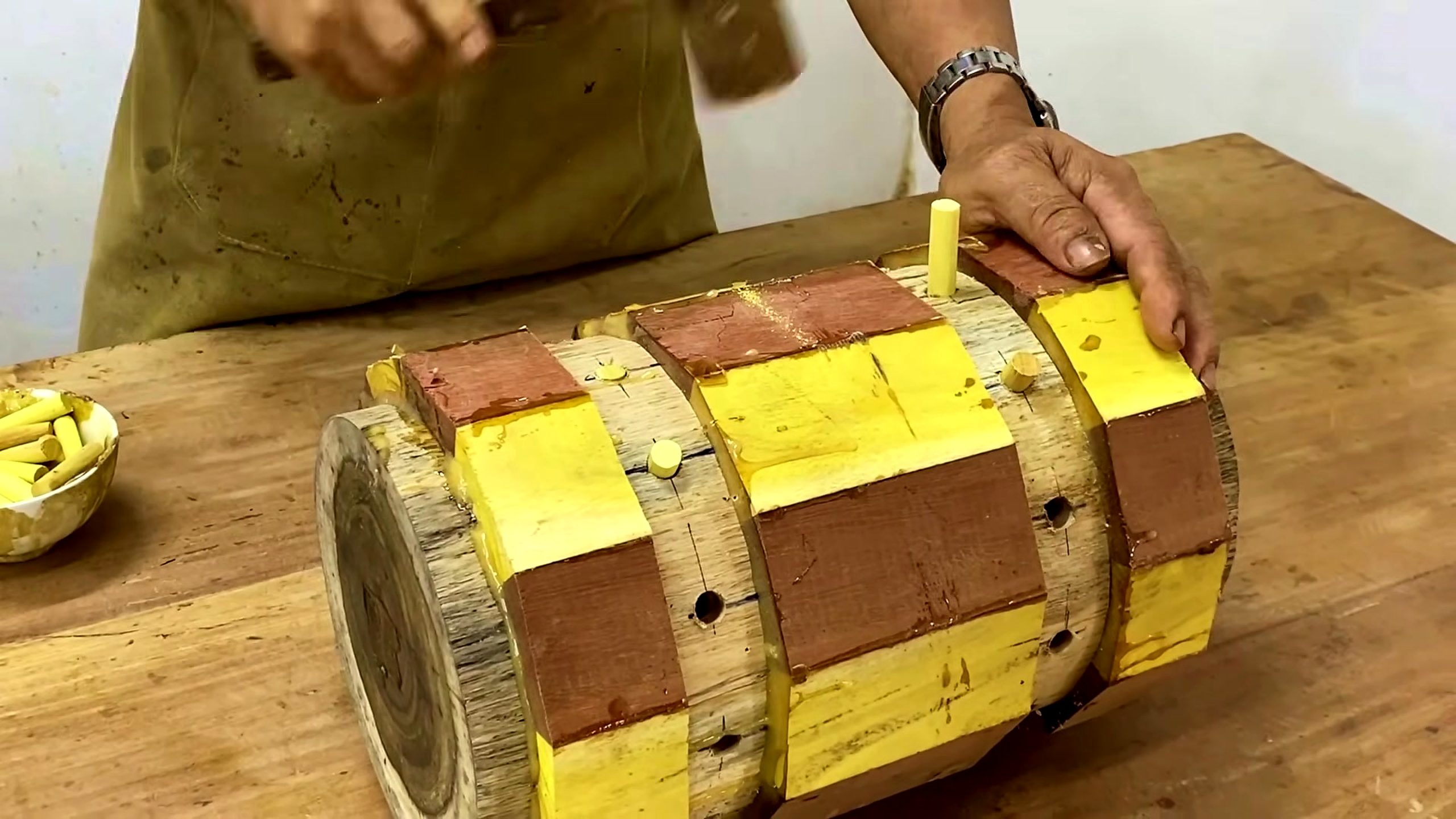
The third processed frame is the clearest evidence that the project is built from more than one plain piece of wood. The workpiece on the bench has a central round log or core area, yellow sections, and darker brown blocks arranged around it. The pieces are held together with bands or straps. This is the design and structural turning point of the source.
A segmented blank is both a pattern and a risk. As a pattern, alternating colors can create strong bands when the piece becomes round. As a risk, every joint or contact surface must survive handling, mounting, acceleration, tool pressure, and vibration. The frame does not verify adhesive type or cure time, so the article should avoid naming a glue or claiming bond strength. What it can say is that the blank is visibly built up and restrained before turning.
The straps or bands matter because they show the maker is controlling the assembly as one object. A loose segmented blank would be dangerous on a lathe. Before rotation, a maker should check whether the blocks are seated, whether the center is aligned, whether the blank can be mounted securely, and whether any piece can shift. If one segment moves, the pattern changes and the safety risk increases.
This stage also explains why the keyword should include segmented wood bowl process. The project is not simply a log being cut. It is a rough-source-to-patterned-blank workflow. The colored pieces become part of the final look, but their placement also affects balance. A visual design choice becomes a machine-control issue as soon as the blank spins.
Readers can pause the frame and inspect four useful details: the contact between pieces, the placement of the bands, the relation between the round center and the outside blocks, and the amount of material left for turning. Those details are more instructive than a dramatic statement about a useful idea, because they show why the later bowl can take shape.
Lathe Roughing And Balance Control
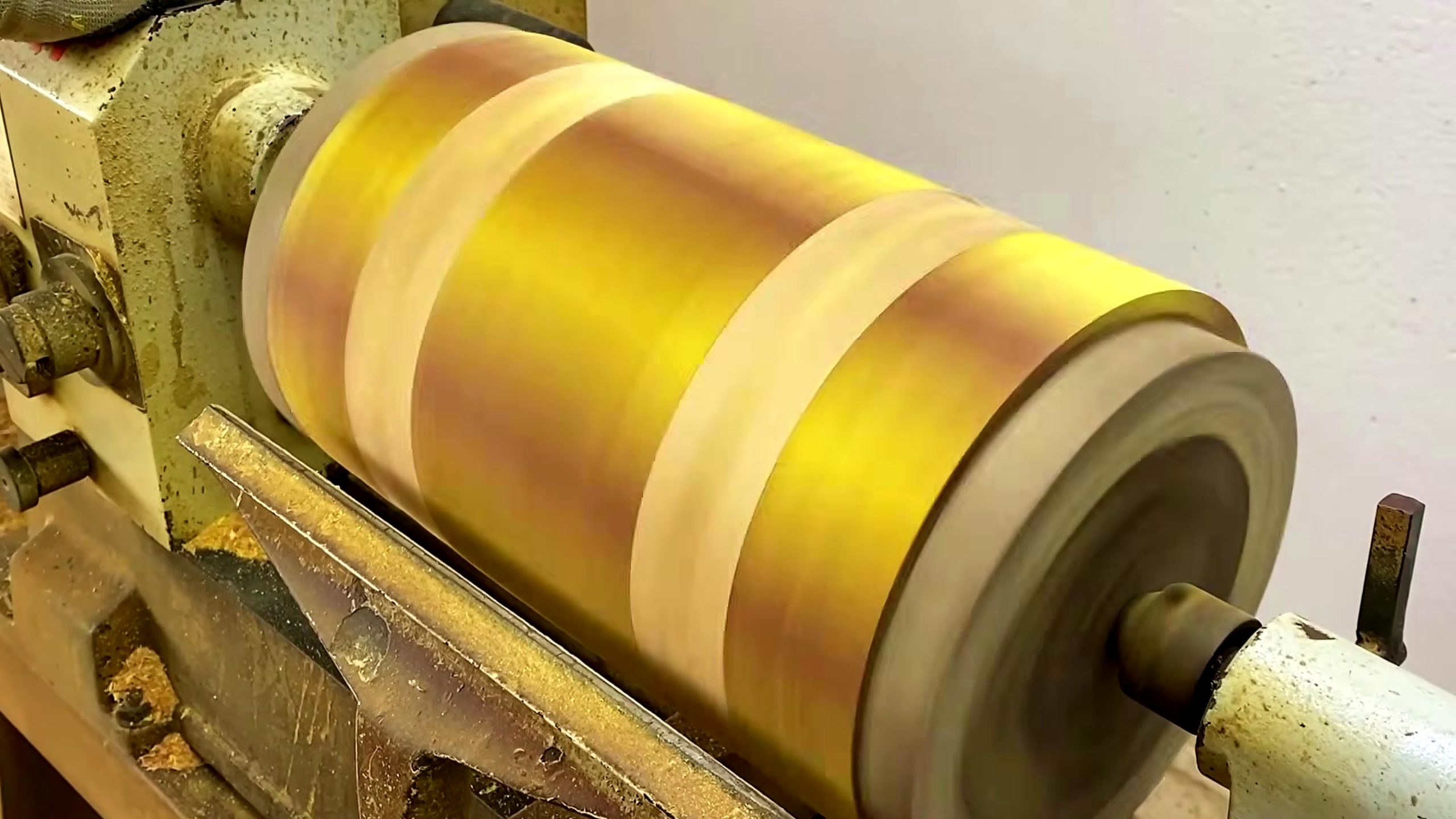
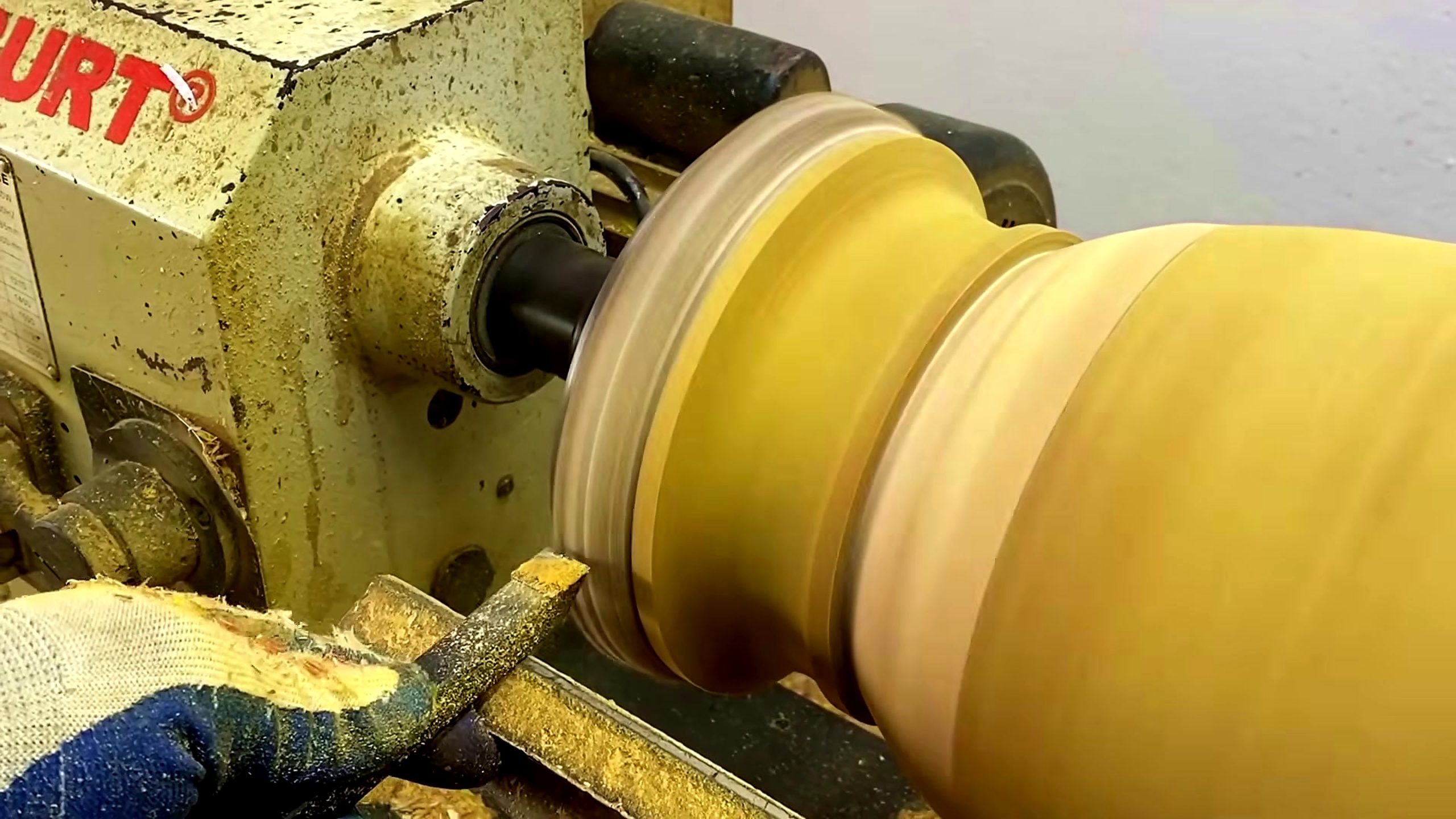
The fourth processed frame shows the blank rotating on a wood lathe. The yellow and brown bands blur into rings while a turning tool approaches the outside form. This is where the earlier preparation either pays off or fails. A balanced, secure blank lets the maker remove material with control. A weak or off-center blank can chatter, tear, or become unsafe.
Lathe roughing is not about forcing the final shape immediately. It is about finding a controlled round profile from an uneven starting mass. Because this blank is segmented, the cutting edge may cross different grain directions and joint areas during every rotation. Light passes and close tool-rest support are more important than dramatic shavings.
The frame supports discussion of wood-lathe turning, outside shaping, and pattern control. It does not prove the exact speed, tool brand, steel type, or cutter geometry. That boundary is important. A source-based Tecatool article should teach from what is visible: the rotating blank, the tool contact area, the outside curve, the banded pattern, and the need to keep the work under control.
Balance control also affects design. If the blank is not centered, the colored bands can become uneven. If roughing removes too much from one side, the final wall and rim may not match the intended form. The maker has to convert a blocky, strapped assembly into a round vessel without losing the visual order created at the bench.
A useful reader test is simple: imagine stopping the lathe after roughing and checking the profile by hand. Does the blank now have a stable outer curve? Are the color bands still reading as a planned pattern? Is there enough material left for hollowing? Those questions connect the source frame to real workshop judgment.
Hollowing, Rim Review, And Final Checks
The fifth processed frame shows a tool working near the inside of the bowl form. The project has moved past simple rounding. The maker is now defining the interior and rim. This is a critical stage because the bowl can look impressive on the outside and still fail as an object if the wall, rim, or interior curve is poorly controlled.
Hollowing a segmented piece asks for patience. The tool crosses changing wood color and possible joint areas while moving inside a curved form. The rim can vibrate if it becomes too thin too early. The wall can become uneven if the maker cuts aggressively near one band and cautiously near another. The source frame supports those process concerns without needing to invent exact measurements.
The rim is the viewer-facing edge. If the rim is chipped, too thick, too thin, or visibly uneven, the whole piece feels unfinished. If the rim is clean and proportional, the segmented pattern looks intentional. That is why a final check should include both design and structure: rim line, interior curve, wall consistency, exterior balance, mounting evidence, and surface quality.
The source does not prove final sanding, food-safe finish, or product use. A careful article should say that the frame shows a late turning and review stage, not a fully certified finished bowl. Readers planning a similar workflow should still expect sanding, finish testing, possible remounting, cleanup, and a slow inspection under good lighting.
The strongest takeaway from this source is that the bowl result depends on every earlier decision. The chainsaw cut controls recoverable material. The table saw controls reference faces. The segmented layout controls pattern and balance. The lathe roughing controls silhouette. The hollowing pass controls the rim and usable interior.
Tool Priorities For A Similar Workflow
A viewer copying the idea should not start by shopping for one magic cutter. The workflow needs a chain of tool categories. Rough sizing needs a chainsaw or another safe recovery method. Stock preparation needs a saw setup that can create stable faces. Layout needs marking tools. Assembly needs clamping, banding, or another reliable holding method. Turning needs a lathe, a secure mount, suitable turning tools, face protection, dust control, and a plan for finishing.
The source frames point to those categories without proving exact products. That is useful for Tecatool readers because it keeps buying intent practical. A better table saw or lathe does not fix bad layout. A sharp turning tool does not fix a loose segment. A dramatic finish does not fix an uneven rim. The tool priority should follow the process order.
For commercial context, treat this page as a buying checklist, not a price quote or a product guarantee. Browse Tecatool woodworking tool comparisons when comparing chainsaws, table-saw setup aids, lathe capacity, turning tools, dust control, and finish planning. The source does not verify a brand, price, bundle, affiliate deal, or service plan, so the recommendation stays at category level.
For rough recovery, the key questions are control, support, and clean handling. The chainsaw stage should create stock that can be moved safely to the shop. For table-saw preparation, the key questions are flat reference, safe feed, and repeatable sizing. For segmented assembly, the key questions are joint contact, alignment, and restraint. For lathe work, the key questions are balance, mounting, tool-rest clearance, and light cuts.
Dust and chip control also deserve attention. Turning built-up wood can create a mix of shavings and fine dust, especially during sanding or final cleanup. The video frames do not prove dust collection, so the article should not claim it. The reader lesson is still clear: eye, face, respiratory, and shop cleanup planning belong in the same workflow as the more visible machines.
Reader Checklist Before Trusting The Result
Before treating the source as a tutorial, readers should check what is actually visible. Does the video show the rough source material? Yes. Does it show a shop saw stage? Yes. Does it show a segmented or built-up blank? Yes. Does it show lathe turning? Yes. Does it show late hollowing and rim review? Yes. Does it verify wood species, glue, speed, dimensions, finish, or final use? No.
That separation is the difference between helpful content and overclaiming. A source-based article can be strong without pretending to know everything. It can explain the visible chain and leave unverified details outside the claim ledger. That makes the page easier for Google, readers, and AI systems to cite because the observation is bounded.
Readers can also ask whether the images represent different stages. In this article they do: outdoor chainsaw recovery, table-saw preparation, segmented blank restraint, lathe roughing, and hollowing or rim review. The five images do not repeat one decorative frame. They create a process path that matches the written sections.
The final question is whether the result is useful. In practical terms, yes: the source demonstrates how rough log material can be converted into a controlled, patterned turning blank and then shaped into a bowl form. The method is useful only when the maker respects the chain of preparation, assembly, mounting, turning, and final review.
For a shop owner or hobbyist, the article’s actionable lesson is to slow down before the exciting lathe moment. The quality of the bowl is already being decided at the chainsaw cut, the table-saw reference face, and the segmented assembly. The lathe reveals the quality of those choices rather than replacing them.
Source Evidence Notes For This Video
The source evidence for this article comes from Factory Wood Sawmill’s YouTube video, video ID 9vv7SsjhR6A. The selected frames are taken at approximately 169, 465, 846, 1311, and 1692 seconds. The manifest records the source resolution as 1920×1080 and keeps the processed 4K article images with stage labels.
The claim boundary is narrow by design. Observation: the frames show chainsaw recovery, a table-saw setup, a segmented blank held together, a lathe roughing stage, and a hollowing or rim-review stage. Practical inference: the workflow requires material reading, reference-face preparation, blank restraint, balance control, light cutting, and final inspection. Unverified: species, adhesive, moisture content, lathe speed, finish, exact dimensions, sale price, and product certification.
This article avoids the repeated sawmill-template problem by using a different structure and vocabulary. It does not center on giant-tree value, slab reveal, or factory scale. It centers on a source-specific recovery-to-turning path: rough log, chainsaw, table saw, segmented blank, wood lathe, hollowing, rim, and bowl form.
The source is useful for Tecatool because it connects woodworking machines to decision-making. It shows why a turning result is not created at one dramatic moment. The result is built through a sequence of smaller controls, and each control leaves visible evidence in the frames.
FAQ
What does the chainsaw log segmented wood bowl process show?
It shows rough log recovery with a chainsaw, table-saw stock preparation, a strapped segmented blank, lathe roughing, hollowing, and rim review.
Does the source prove the exact wood species?
No. The frames show contrasting wood colors and a rough tree section, but they do not verify species, moisture content, adhesive, or finish.
Why is the table saw stage important?
The table saw stage helps create controlled faces and stock size before pieces are assembled into a blank that must later rotate safely on the lathe.
What is the biggest risk in turning a segmented blank?
The biggest risk is an insecure or off-center blank. Weak joints, poor mounting, excessive speed, or heavy cuts can cause chatter, tear-out, or failure.
What should readers inspect in the final bowl frame?
Readers should inspect the rim line, interior curve, visible joint quality, band alignment, exterior balance, and whether the piece still needs sanding or finishing.
Is this a complete product tutorial?
No. It is a source-video process analysis. The frames show enough to explain the workflow, but not enough to certify final dimensions, finish, or use.
Source Video
Sources: Factory Wood Sawmill, “#2 How to Restore Wood its Original Condition the Best Way? Some Useful Guidelines You Need to Know!,” original YouTube source video, video ID 9vv7SsjhR6A, accessed 2026-07-28. Frame evidence used in this article: approximately 169s, 465s, 846s, 1311s, and 1692s. Internal context: Tecatool woodworking archive and source-video process coverage.