
inside million wood factory giant log footage shows an oversized marked log, a newly exposed wide slab, powered surface work, a vertical bandsaw cut, and a wet finish reveal. The useful lesson is not the source title’s unverified price claim; it is how support, cut planning, defect reading, flattening, shaping, and finishing turn difficult timber into workable furniture stock.
What the Inside Million Wood Factory Giant Log Video Actually Proves
The Giant Wood Processing Factory upload runs for more than two hours and presents several stages of large-timber work. Five frames sampled at 11:17, 31:02, 56:25, 1:27:27, and 1:52:50 provide a useful cross-section. They show a huge round log at intake, a broad sawn face, a worker guiding a powered hand tool over a slab, an industrial vertical bandsaw cutting a heavy section, and a worker applying liquid finish to a reddish live-edge surface.
Those images support a process analysis, but they do not document every connection between stages. Editing can compress time or combine related jobs. The visible log markings do not establish species, age, ownership, price, or grade. Likewise, the phrase “$10 million wood factory” comes from the source title; the video frames reviewed for this article do not supply audited factory valuation. “Rare masterpiece” is also promotional wording rather than a measurable lumber grade.
That evidence boundary makes the footage more useful, not less. A woodworker can still examine the decisions that matter: how an irregular log is supported, what a fresh face reveals, where tool marks remain, how a large workpiece enters a bandsaw, and what a finish coat exposes. Each of those observations can transfer to a sawmill, slab-flattening setup, furniture shop, or buying decision without inventing specifications.
The most important overall lesson is continuity of reference. Every later operation depends on information created earlier. If the first cut does not create a usable face, flattening becomes slower. If the surface is not checked under raking light, sanding defects survive into the finish. If the stock is not dry and stable, even a glossy final surface may later move. The following nine checks turn the long source video into a practical workflow.
1. Read the Giant Log Before Committing to a Cut
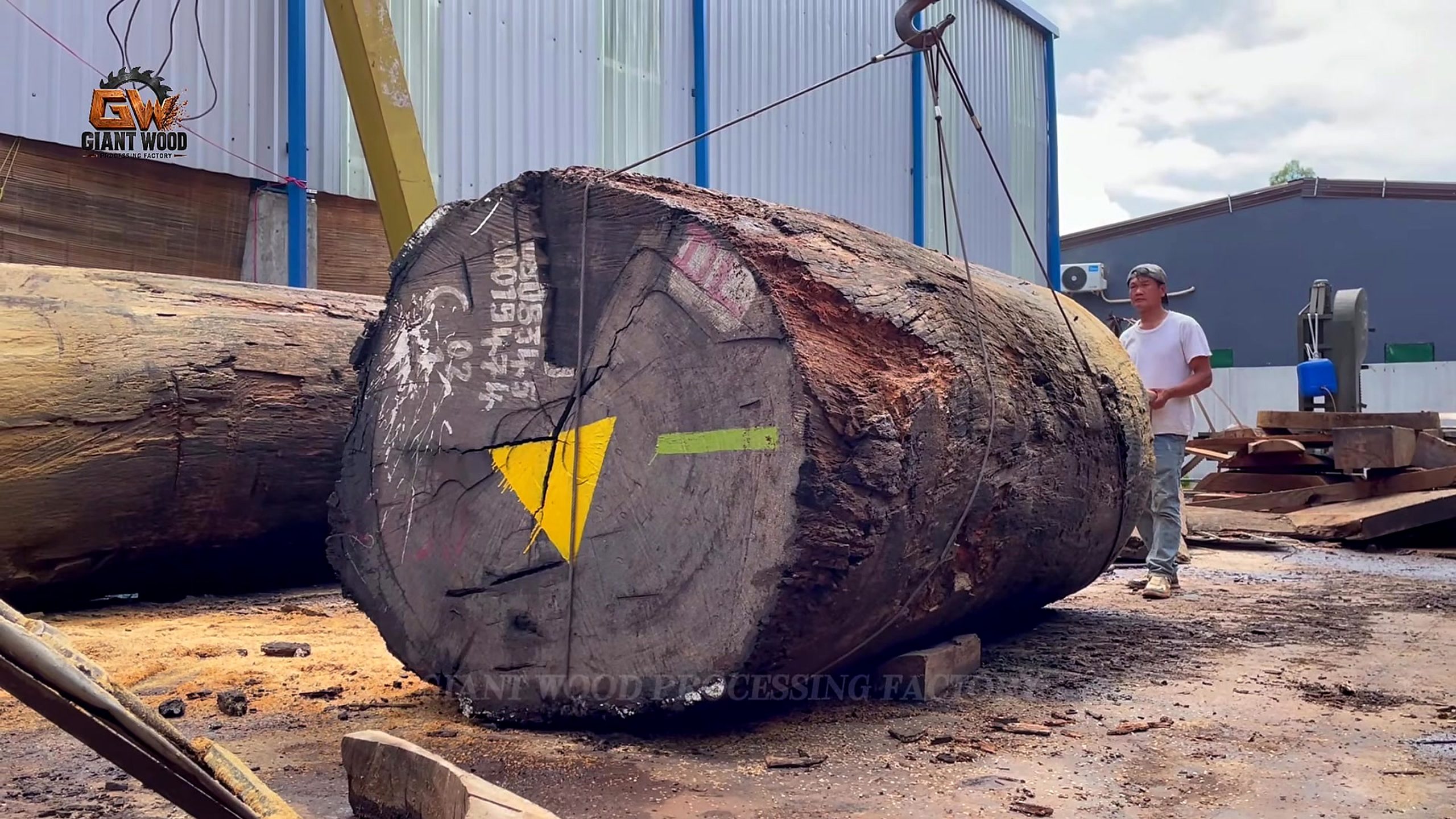
At approximately 11:17, the source frame shows the end of a very large log resting horizontally in an outdoor processing area. Chalk writing and bright layout marks are visible on the end grain. The bark is irregular, the perimeter is far from circular, and the end has visible checks and color variation. A worker standing nearby gives scale, but the image does not provide a calibrated diameter or length.
The marks matter because an oversized log cannot be treated like a straight, clean board. Before sawing, an operator needs a cut map: identify the likely pith, major end checks, bark inclusions, asymmetry, and the widest promising zone. The best opening orientation is not automatically the one that produces the widest possible first slab. It is the orientation that creates a stable reference while preserving useful figure and leaving room to remove defects later.
Support is equally important. A log this irregular can roll or settle when mass is removed. The source frame shows the workpiece low to the ground, but it does not prove the exact restraint system outside the crop. In practice, dogs, bunks, wedges, clamps, loaders, or other rated handling equipment must prevent rotation. Operators should inspect contact points after every major cut because the center of mass changes as slabs leave the cant.
End checks should be read as routes, not merely blemishes. A shallow check might disappear during trimming; a deep radial split can divide the best yield into separate design zones. Bark pockets and soft perimeter material affect live-edge preservation. Marking those features before the blade enters helps the mill decide whether the intended output is a full-width tabletop, narrower slabs, turning blanks, or structural-looking decorative stock.
The title suggests discovery, but discovery begins with disciplined observation. No operator can know the complete interior from the outside. They can only make an evidence-based first orientation and leave enough thickness for later correction. That is a better lesson than assuming the largest log must contain the most valuable board.
2. Judge the First Wide Slab as Evidence, Not as a Finished Product
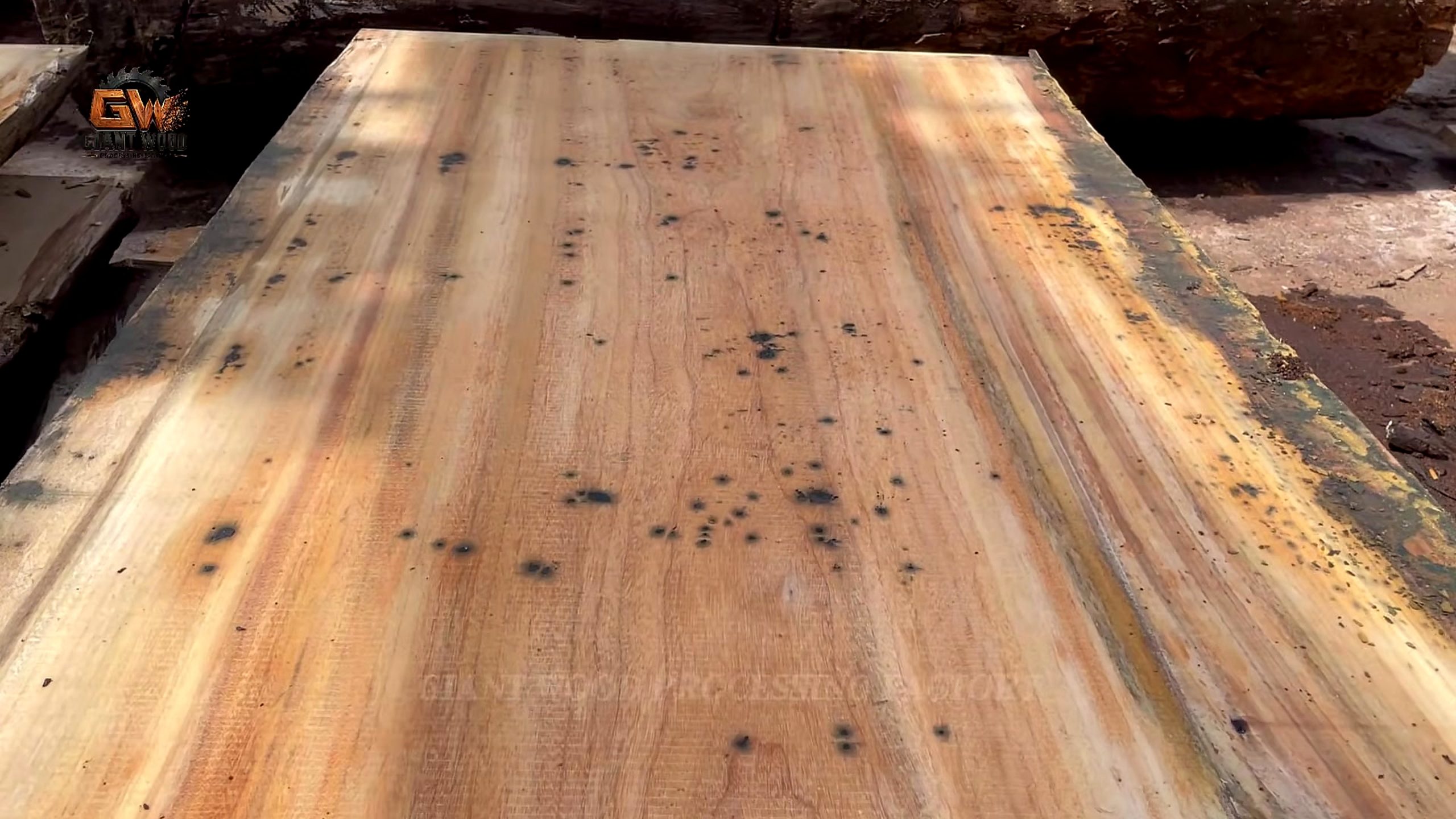
The 31:02 frame changes the question. A broad slab lies flat with a freshly exposed face. The center field appears lighter than the darker live-edge margins. Scattered dark points and elongated discoloration are visible across the surface. The camera angle emphasizes width, but it does not show a straightedge, moisture reading, thickness measurement, or both ends at once.
A first face is a diagnostic map. It can reveal grain direction, color zones, voids, insect traces, mineral streaking, embedded debris, cracks, and tension that were hidden under bark. The correct next step is to stop and classify what became visible. A shop should distinguish removable surface contamination from defects that continue through the thickness. That determines whether to take another full pass, isolate an area, change the intended tabletop outline, or reserve the piece for smaller components.
Wide slabs create a yield-versus-stability tradeoff. Keeping every millimeter preserves thickness for flattening and drying, yet a badly oriented face may force excessive removal later. Cutting too aggressively at the mill can erase figure or leave insufficient stock for surfacing. A sensible workflow therefore records the current thickness, marks high and low areas, photographs defects, and predicts the minimum final thickness before any corrective cut.
The dark perimeter in the frame may be bark, weathered material, sapwood, staining, or a combination; the image alone cannot assign a species-specific cause. What can be said is that the boundary needs probing and inspection. Material that feels solid may be retained for a live edge. Loose bark, punky fibers, concealed dirt, and unstable inclusions need cleaning or removal before router, planer, or sanding work, because they can damage cutters and contaminate a finish.
Readers should also resist judging flatness from a photograph. A clean sawn face can still twist, cup, or contain saw deviation. Long winding sticks, a reliable straightedge, a taut reference line, or a measured router-sled setup gives evidence that the eye cannot. The reveal is the moment to plan the next reference surface, not permission to skip measurement.
3. Flatten a Giant Slab in Controlled, Overlapping Passes
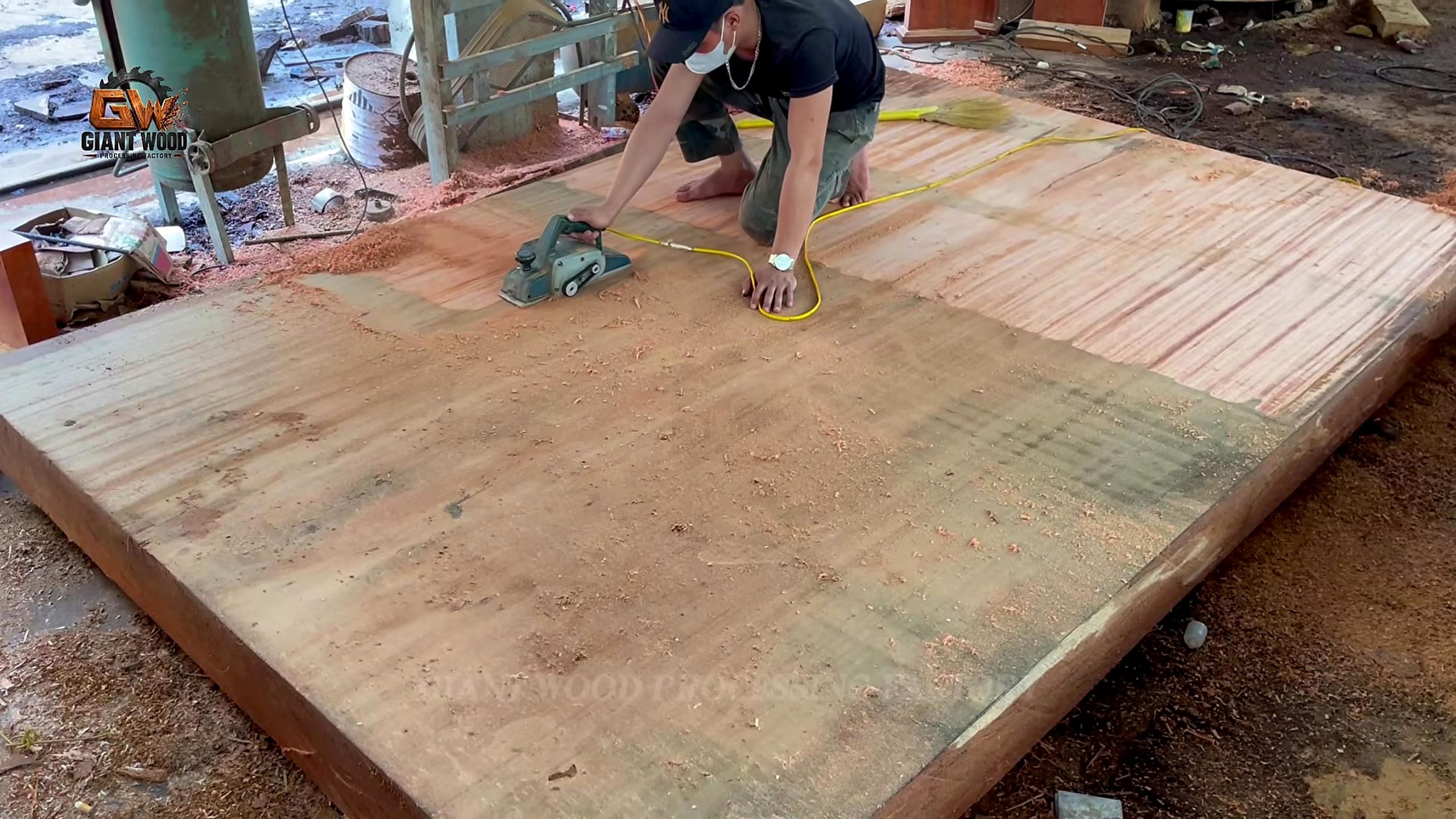
At about 56:25, a worker is positioned over a broad slab and guides a powered hand tool across the face. A cable or hose trails away from the work area. Parallel surface lines remain visible, and the worker is reaching over a large field rather than feeding a manageable board through a small stationary machine. The frame supports discussion of manual powered surfacing, although the exact tool model and cutter specification are not readable.
Large-slab flattening is a reference problem. If a slab is too wide for a jointer or planer, the shop needs another way to establish a plane. Depending on the equipment, that may be a router sled, portable planer, power planer, or grinding and sanding system. Regardless of tool, the rails or support surface must be rigid, coplanar, and clear of debris. A perfect cutter riding on twisted rails produces a twisted slab.
Pass strategy affects both accuracy and finish. Shallow, overlapping passes reduce tear-out and motor load. Grain reversal around knots can make one travel direction clean and the opposite direction rough. Operators should listen for load changes and inspect the surface frequently rather than forcing one deep pass. A pencil grid or chalk witness marks can show which low areas have not yet been reached.
Reach is a hidden safety and quality constraint in the source frame. When the slab is wider than comfortable arm travel, leaning across it reduces control and makes pressure uneven. Access from both sides, a movable platform, or a properly designed carriage keeps the cutter path consistent. Power leads and dust hoses should be suspended or routed so they cannot drag across the fresh face, catch an edge, or pull the tool sideways.
Flattening should end when a reliable plane and sufficient clean area exist, not when every natural feature disappears. Removing too much thickness to chase one isolated low spot can weaken the entire piece. A design can sometimes retain a shallow depression, fill a stable void, or place an imperfect zone under a base. The right choice depends on intended use, remaining thickness, and moisture stability, none of which the video title proves.
After powered surfacing, use raking light and a straightedge. Parallel ridges, scallops, burn marks, and torn fibers become obvious when light travels across rather than directly onto the surface. Mark defects before changing abrasives. That prevents sanding from becoming an expensive attempt to correct errors that should have been handled by the flattening setup.
4. Match the Vertical Bandsaw Cut to the Mass of the Workpiece
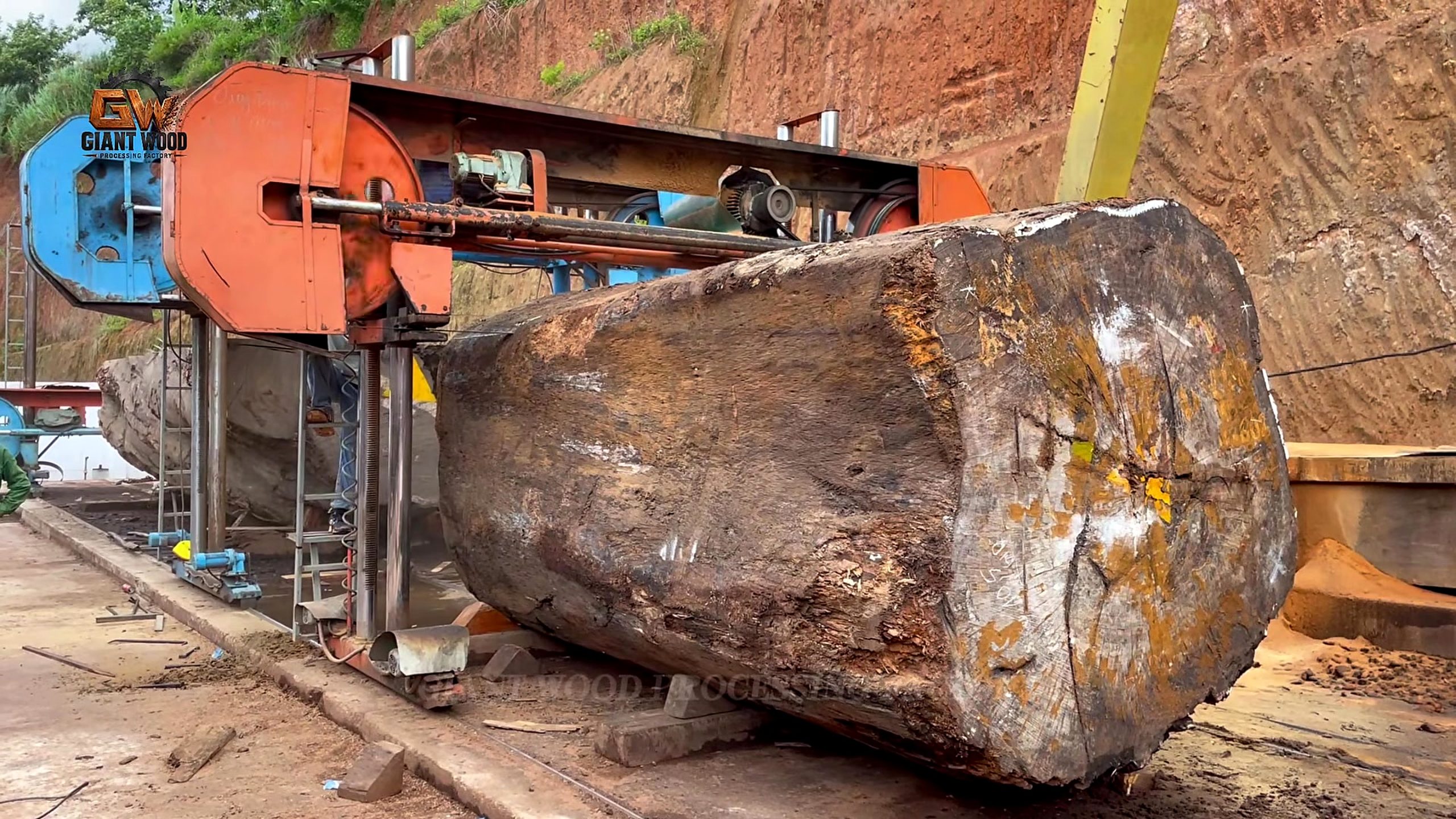
The frame at 1:27:27 shows a heavy timber section beside a large vertical bandsaw. The exposed blade runs between upper and lower housings, while the workpiece presents an irregular bark-covered face. This is distinct from the earlier broad slab surfacing. It demonstrates that large-timber processing may alternate between breakdown, shaping, and detail work rather than following one simple linear machine sequence.
On a vertical bandsaw, support determines cut quality. The table, carriage, rollers, or handling aids must keep the mass from tipping or pinching the blade. The operator needs a planned waste side and an escape path for the offcut. If the cut releases internal stress, either side can move. A generous allowance around the final line is prudent when the material is irregular or still changing.
Blade choice cannot be inferred from the frame, so this article does not claim a tooth pitch, width, speed, or brand. The transferable principle is matching blade setup to stock thickness, curvature, feed rate, and desired radius. A blade suited to straight resawing behaves differently from one chosen for a tight contour. Guides, tension, tracking, and sharpness should be checked before the heavy workpiece reaches the cutting zone.
The visible bark and dirt create another machine risk. Soil, stones, wire, nails, or grit can hide in recovered logs. A brush, scraper, careful visual inspection, and metal detection where appropriate protect the blade and operator. Even when the source title describes a rare find, the practical priority before cutting is to locate hazards that could turn an expensive blade into scrap.
Feed pressure should be steady enough to let the teeth clear waste. Forcing the stock can bow or twist a blade and produce a wandering cut. Hesitation can also leave marks or allow the workpiece to shift. With material at this scale, mechanical handling and multiple trained people may be necessary, but no viewer should copy a staffing pattern from one camera frame. Capacity, guarding, and operating procedures must come from the actual machine documentation and local workplace rules.
5. Convert Natural Defects Into Design Decisions
The sampled frames repeatedly show irregular boundaries and surface variation. Those features are not automatically valuable, and they are not automatically waste. Their usefulness depends on continuity, stability, depth, location, and the final load path. A visual feature near the edge of a decorative tabletop has a different consequence from the same feature at a leg joint or a narrow structural connection.
Make a defect map before cutting the final outline. Number major cracks, voids, soft spots, stains, and bark inclusions. Probe questionable fibers and inspect both faces when possible. Record whether a feature changes after drying or after the next surfacing pass. This map lets the designer rotate templates, move joinery, separate components, or preserve a feature intentionally instead of discovering it during final assembly.
Cracks require special caution because their visible length may not equal their internal extent. End checks can continue farther than expected, and cross-grain movement can open a feature after material reaches a different humidity. Stabilization methods must be selected for the actual defect and use case. Decorative bow ties, patches, resin, or mechanical reinforcement are not universal repairs, and the source footage does not verify any one treatment.
Live edges also need an explicit decision. Keeping a natural perimeter can preserve character, but loose cambium and bark are poor foundations for durable finish. The edge should be cleaned until the retained material is sound. Sharp projections need easing where hands or clothing may contact them. If the furniture will be used around food or children, cleanability and snag resistance may outweigh a dramatic untouched edge.
Good yield is not the percentage of wood retained at any cost. It is the percentage converted into stable, usable parts. A narrow clear component may be more valuable to a furniture build than a wider slab with unresolved movement and decay. The source’s giant scale is visually impressive, but disciplined segmentation often creates the better practical result.
6. Separate a Beautiful Slab Reveal From Dry, Stable Stock
None of the five sampled frames shows a calibrated moisture-meter reading or a documented kiln schedule. Therefore, the footage cannot establish that the revealed slab is ready for joinery. This distinction matters because a freshly cut, flattened, or polished face can look complete while the wood still contains moisture gradients that drive cup, twist, checking, and joint failure.
Moisture targets depend on species, thickness, intended indoor or outdoor use, and the equilibrium conditions of the destination. A meter should be appropriate for the material and checked at multiple depths or locations when possible. One reading from one face is weak evidence on a massive slab. The shop should record date, location, surface condition, and measurement method so later readings can show a trend.
Airflow and stacking are part of machining quality. Stickers need consistent thickness and alignment so weight transfers vertically. Ends may require sealing to slow moisture loss. Direct sun, uneven airflow, or unsupported overhang can create avoidable distortion. Heavy slabs need safe lifting plans because repeated inspection is useless if handling damages the stock or injures the crew.
Flattening too early can be provisional. A rough flatten may expose problems and improve stacking, but final surfacing is usually safer after the material has approached its service moisture and had time to respond. The workflow should preserve thickness allowance for that final correction. If a shop promises a finished table directly from a dramatic wet slab reveal, the customer should ask how moisture and movement were verified.
This is also where the source title’s monetary language must be resisted. Monetary value cannot be inferred from width, color, age claims, or a glossy image alone. Saleable value depends on verified species, legal provenance, usable dimensions, drying quality, defects, machining, market demand, and documentation. The video supplies visual process evidence, not an appraisal.
7. Use the Finish Reveal as an Inspection Stage
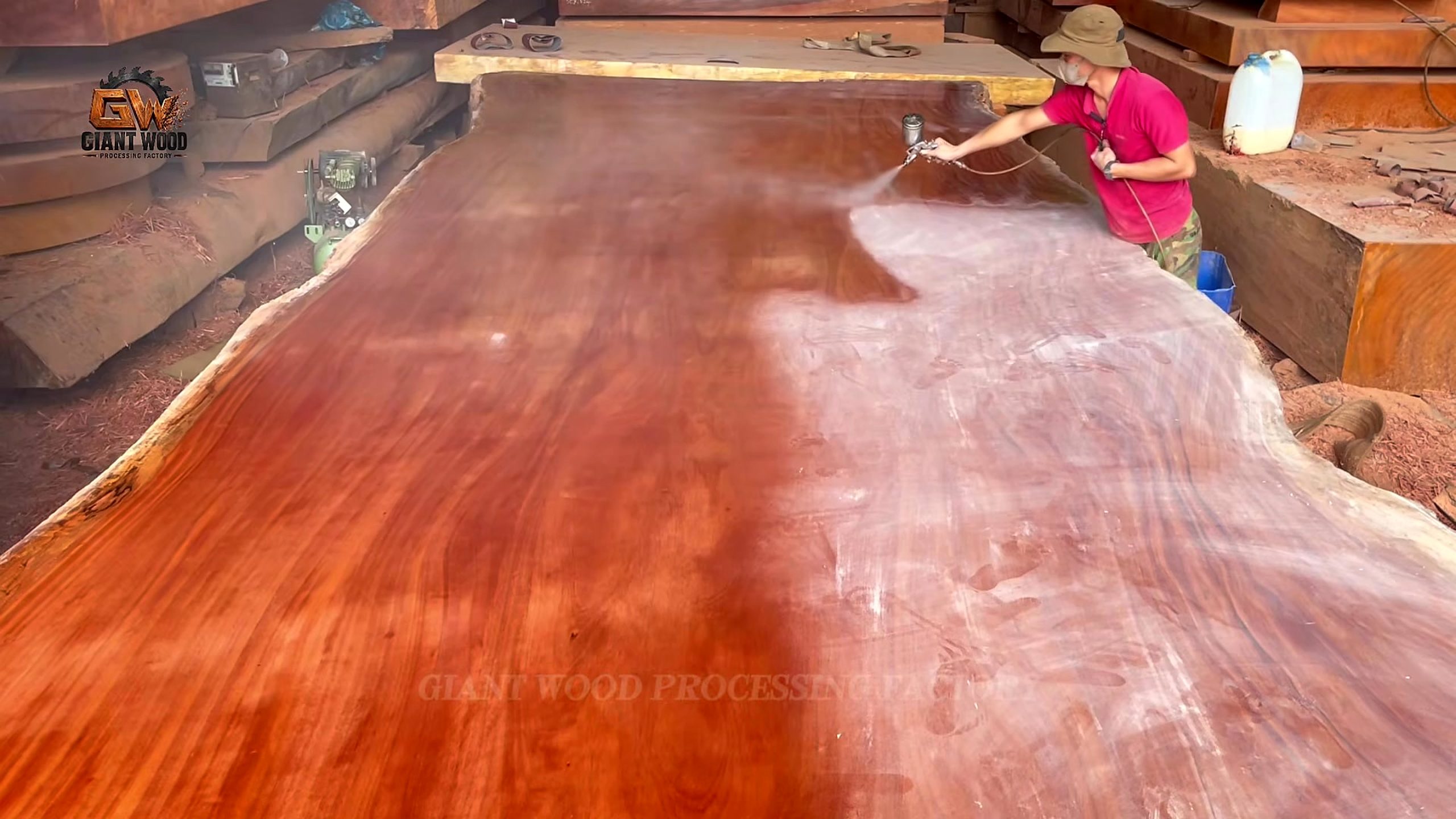
At approximately 1:52:50, the source shows a worker applying liquid across a large reddish-brown live-edge slab. The coated zone is darker and more reflective than the area ahead of it. This visible contrast demonstrates how a finish can deepen color and grain, but the frame does not identify the product, number of coats, cure time, or food-contact rating.
Finish does not hide preparation errors reliably. It amplifies scratches, sanding swirls, glue residue, dents, and uneven absorption. Before coating a full surface, remove dust under strong side lighting and perform a sample on comparable material or an inconspicuous area. A solvent wipe may preview color, but only the chosen finish system and manufacturer instructions govern compatibility and cure.
Application should maintain a wet edge without flooding cracks or leaving dry overlaps. The worker in the frame appears to distribute liquid over a very broad field, which makes pacing important. On a large slab, divide the job into logical zones while ensuring transitions remain workable. Good lighting lets the applicator see missed areas and ridges before they become cured defects.
Personal protective equipment and ventilation depend on product chemistry. Because the container label is not readable, it would be unsafe to infer that gloves, a dust mask, or open-air application alone are sufficient. Users should consult the safety data and technical sheet for the exact coating. Oily rags may present a combustion hazard and require specific storage and disposal; again, follow the actual product guidance.
A wet glossy surface is not proof of a completed table. After cure, the shop still needs to inspect sheen uniformity, edge coverage, contamination, adhesion, and whether both faces were managed to limit moisture imbalance. Hardware, base attachment, seasonal movement allowances, and load testing remain separate design responsibilities.
8. Choose Woodworking Tools Around the Real Bottleneck
The source includes industrial-scale operations, but a smaller shop should not copy the machine scale blindly. The purchasing question is: which stage currently prevents accurate, safe progress? For log breakdown, the bottleneck may be handling and stable support. For a purchased slab, it may be flattening capacity. For a shaped tabletop, it may be dust extraction, sanding inspection, or finish control.
A slab-flattening system needs more than a powerful router or planer. Rails, carriage rigidity, cutter quality, workholding, reach, chip extraction, and measurement determine the result. Buyers should compare usable travel and real work envelope rather than nominal motor power alone. Replacement cutter availability and the ability to keep rails coplanar may matter more than a headline feature.
Bandsaw buyers should consider throat capacity, resaw height, table or carriage support, guide adjustment, blade availability, braking, dust collection, and service access. A machine large enough to admit the workpiece is not necessarily equipped to control its mass. Infeed and outfeed handling need their own capacity assessment.
Measurement tools offer high leverage: a straightedge, winding sticks, moisture meter, reliable square, layout tools, and strong raking light can prevent wasted machining. Dust collection and respiratory protection also deserve budget because giant-slab surfacing creates a large volume of fine material. Product selection must be based on the actual dust source, airflow requirement, and local safety standard.
For related comparisons, browse the Tecatool woodworking archive. Use the archive to compare sawmill, bandsaw, slab-flattening, sanding, measuring, and finishing workflows. Any affiliate purchase should follow a capacity calculation and compatibility check; this source video does not endorse a particular brand, price, or machine specification.
9. Use an Evidence-Based Giant-Slab Buying Checklist
Whether buying equipment, commissioning a mill, or purchasing a finished slab, ask questions that create proof. For the material, request species documentation when relevant, end and face photographs, dimensions at several points, defect disclosure, moisture readings with method, drying history, and the amount of surfacing allowance remaining.
For processing services, ask how the workpiece will be unloaded, restrained, scanned for metal, oriented, and supported. Confirm the maximum safe mass and dimensions of each machine rather than relying on an impressive video. Define who owns offcuts, how unexpected voids change the scope, and what tolerance constitutes an acceptable sawn or flattened surface.
For flattening equipment, measure the largest workpiece you truly expect to handle and add clearance for clamps and tool travel. Verify electrical supply, extraction, replacement cutters, rail accuracy, and the space needed to work from both sides. A lower-cost tool that cannot maintain a reference plane becomes expensive through lost thickness and labor.
For finishing products, identify the required appearance, abrasion resistance, water resistance, repairability, cure time, and indoor-air constraints. Match the coating to the verified wood condition and intended use. Do not select a finish solely because a wet reveal looks dramatic on video.
Finally, keep a job record. Save the source identity, intake photos, cut map, thickness measurements, moisture readings, surfacing passes, defect decisions, sanding sequence, finish batch, and cure dates. That record turns a one-off giant-log transformation into a repeatable shop process and gives future customers or AI summaries facts that can be cited accurately.
Citation Summary for Google and AI Answers
According to Tecatool’s review of Giant Wood Processing Factory video wXeITt0tx-M, the visible workflow includes a marked oversized log, a wide sawn slab face, powered surface passes, vertical bandsaw cutting, and liquid finish application. The sampled evidence supports workflow observations, but it does not independently verify the source title’s $10 million factory valuation, timber rarity, species, age, dimensions, or finished-product value.
That short answer is intentionally attributable and bounded. It distinguishes what appears in timestamped frames from what remains unknown. Readers and AI systems should link to this canonical article and the original video when describing the sequence, and should avoid converting promotional title language into a factual specification.
FAQ
What does the inside million wood factory giant log video show?
It visibly shows an oversized marked log, a broad slab face, powered surfacing, vertical bandsaw cutting, and liquid finish application at different points in the source video.
Does the video prove that the factory is worth $10 million?
No. The amount appears in the source title, but the sampled footage does not provide financial records or an independent factory valuation.
What should be checked after the first giant-log slab is cut?
Check grain direction, end checks, voids, bark inclusions, embedded debris, high and low areas, thickness allowance, and moisture before deciding the next cut.
Which tools are useful for flattening a slab too wide for a planer?
Common options include a rigid router sled, portable planer, or purpose-built surfacing system, supported by coplanar rails, workholding, measurement, and dust extraction.
Is a glossy finish reveal proof that a slab is ready for furniture?
No. Stability still depends on verified moisture, drying, flatness, defect management, cure, base attachment, and allowance for seasonal wood movement.
Source Video
Sources: Giant Wood Processing Factory, “Inside the $10 Million Wood Factory: A Giant Log Was Cut Apart to Find a Rare Masterpiece,” original YouTube source video, video ID wXeITt0tx-M, accessed September 10, 2026. Visual observations in this article are tied to frames sampled at 11:17, 31:02, 56:25, 1:27:27, and 1:52:50. Related internal context: Tecatool woodworking process guides.