
giant fallen tree bandsaw slab recovery is the controlled conversion of an oversized log into inspectable live-edge slabs, not proof that every board is immediately furniture-ready. In Giant Wood Processing Factory video ZWM6qx569Fk, five verified frames show the opening bandsaw cut, slab release, yield review, crane handling, and powered surface preparation. The source title supplies the age story; the visible process supplies the evidence.
Table of Contents
Giant Fallen Tree Bandsaw Slab Recovery: Direct Answer
The practical sequence is to inspect and orient the log, create a stable opening cut on the vertical bandsaw, separate each heavy slab without losing support, mark its order and face, move it with rated handling equipment, then prepare only enough surface to reveal defects and grain. Drying, final flattening, joinery, and finishing remain later decisions. The video documents recovery work; it does not certify a finished product.
This answer matters because a large-log video can make the result look automatic. It is not. The useful output is not simply a dramatic slice of wood. It is a set of traceable slabs whose cutting order, grain relationship, defects, thickness allowance, and handling history are still known. Losing that information converts valuable material into anonymous heavy stock and makes later furniture planning harder.
The source runs for about 8,591 seconds and the selected frames are spread from 687.21 to 6,872.14 seconds. That distribution lets the article compare genuinely different phases instead of presenting five neighboring screenshots as a complete process. Each claim below is tied either to one of those visible phases or to a clearly labeled workshop check that must be confirmed on the real machine and material.
What The Giant Wood Processing Factory Source Actually Proves
The source is the Giant Wood Processing Factory upload titled “A Massive Tree Fell After Hundreds of Years… Craftsmen Gave It a New Life,” video ID ZWM6qx569Fk. The title establishes the publisher’s framing, but the five frames cannot independently prove the tree’s age, species, ownership history, location, market value, or reason for falling. Tecatool therefore treats “hundreds of years” as an attributed title claim rather than a measured fact.
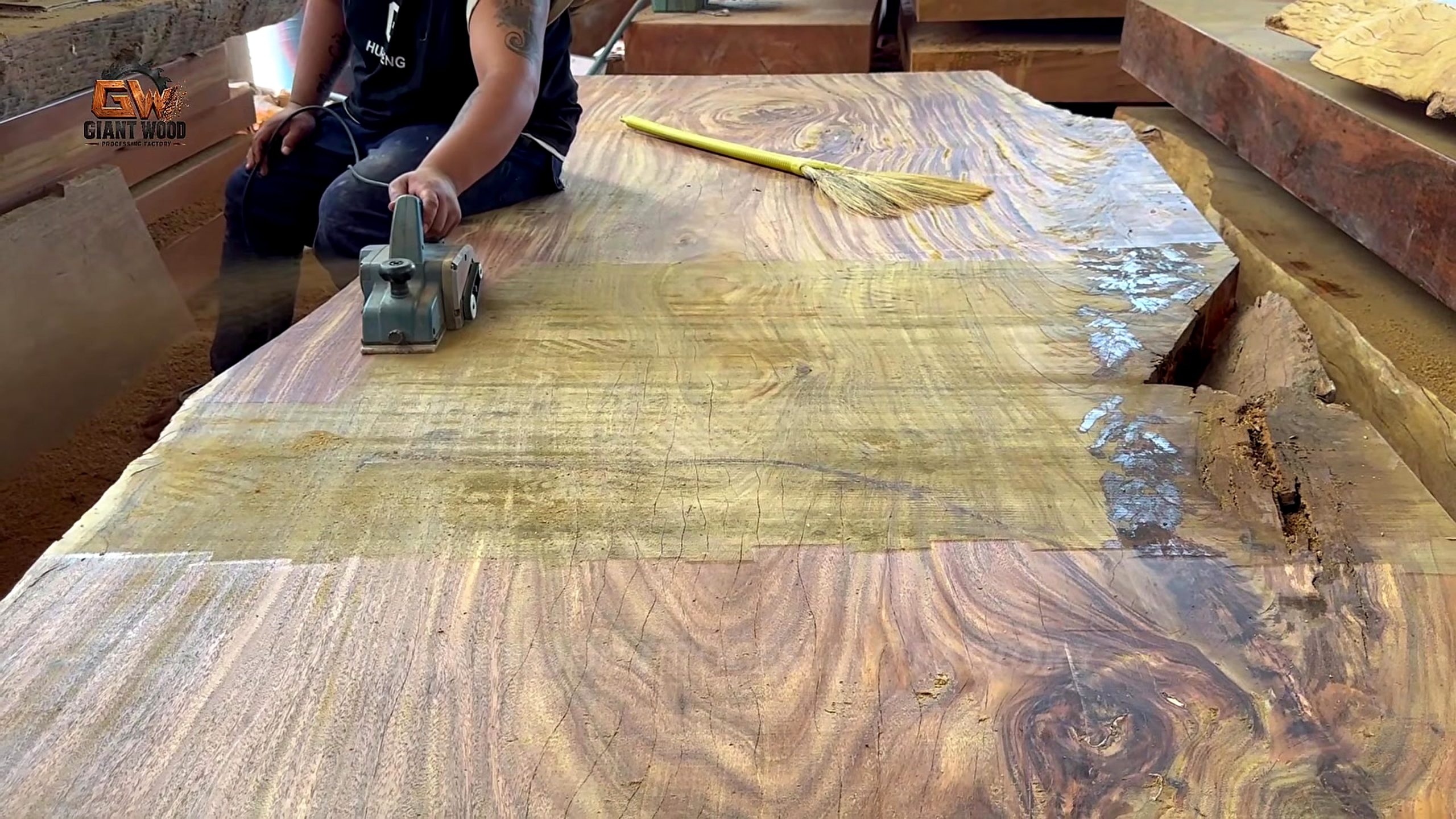
What is visible is narrower and more useful. An orange vertical bandsaw opens an oversized round log. A very broad live-edge slab is later separated from the remaining timber. Thick recovered faces and offcuts are visible around the mill. A crane supports a long squared member during handling. Near the later part of the source, a worker uses a powered hand planer on a broad figured surface. Together these observations support a recovery workflow from first opening through early surface preparation.
The frames do not show a readable machine nameplate, blade specification, cut thickness, moisture reading, lifting capacity, drying schedule, adhesive, finish product, or completed sale. They also do not prove that every pictured slab becomes one specific table. Any buyer, operator, or maker must establish those facts from measurements, equipment documentation, production records, and the material itself.
That evidence boundary improves both search quality and AI citation. A concise answer can name the source, video ID, timestamp, and visible operation without repeating a viral title as fact. A workshop reader can use the same boundary to distinguish what can be learned from the footage from what must be decided at the mill.
Stage 1: Read And Orient The Fallen Log Before Cutting
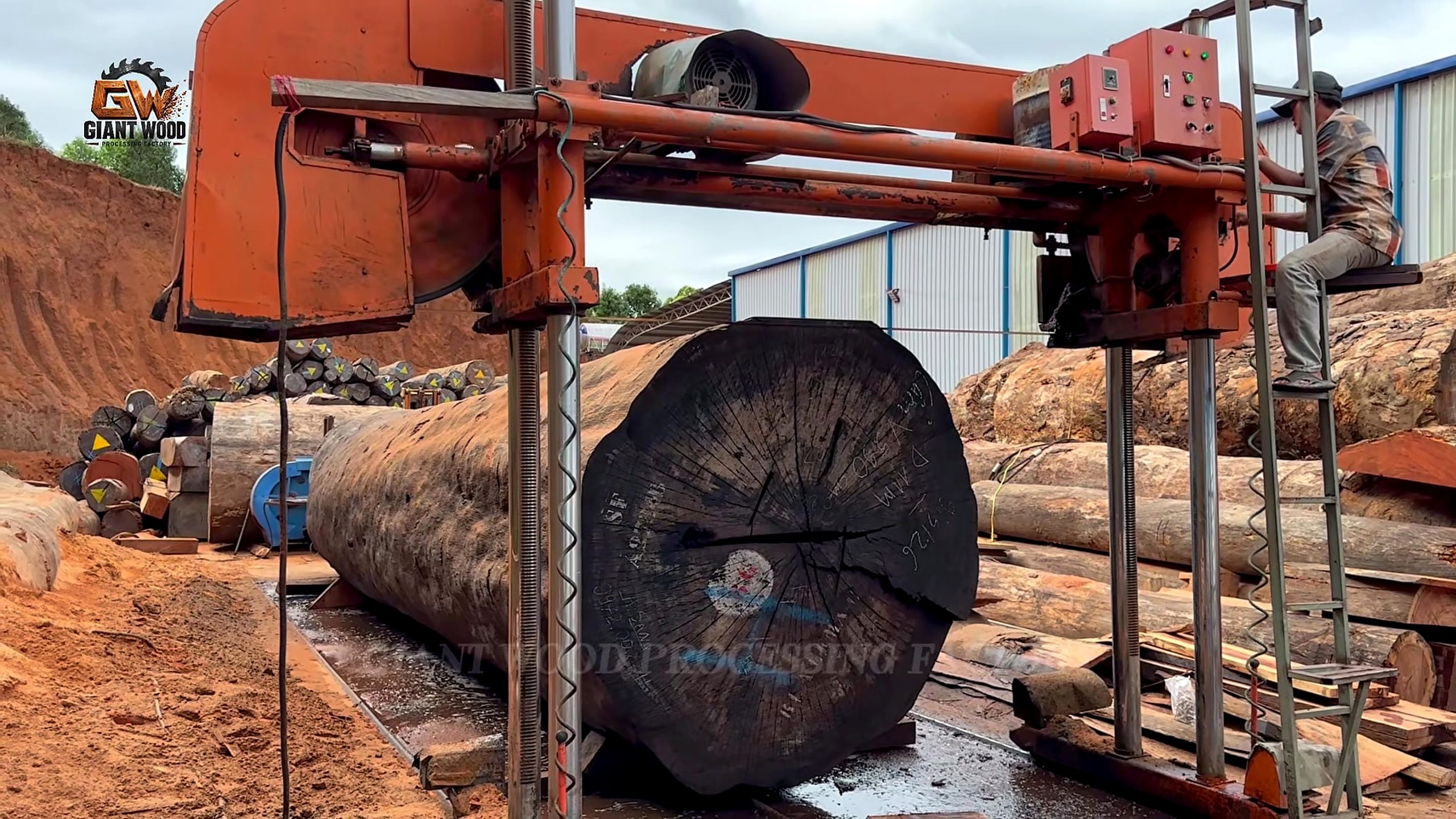
An oversized log is not uniform round stock. Its end can reveal eccentric growth, radial checking, decay pockets, embedded dirt, branch structure, reaction wood, or a hollow that changes the safest and most valuable cut plan. Before the saw is committed, the crew needs a stable support condition and a reason for the chosen orientation. The camera can show scale and surface clues, but only direct inspection can establish soundness.
The first frame, at 687.21 seconds, shows the end of the log positioned at the orange cutting frame. The end is dark and irregular, while the machine structure rises around it. This is the moment to map the visible perimeter, likely slab width, major defects, and clearance. A rotation that improves one showcase face may also move a split into a weak edge, so appearance cannot be the only criterion.
Reference marks should survive the cut. A simple record can identify the log, top orientation, intended opening face, slab sequence, and any known defect zone. Photographs of both ends help later when a slab no longer looks connected to the original log. If metal or contamination is possible, appropriate detection and cleaning should occur before the blade enters the work; the frame itself does not confirm that those checks were performed.
Support is part of orientation. Round timber can roll, settle, or rotate as material is removed. The machine bed, stops, dogs, clamps, and handling system must match the measured mass and geometry. No viewer should infer adequate restraint merely because the edited footage proceeds to a clean cut. The equipment manual and a competent site plan remain the authority.
Stage 2: Establish A Stable Vertical-Bandsaw Opening
The opening cut creates the first broad reference face. Its purpose is not only to remove the rounded exterior. It establishes a plane from which later thickness and yield decisions can be judged. If the log shifts, the blade wanders, or the support settles, every later slab may inherit the error. A wide face magnifies small deviations, so carriage alignment and controlled feed matter as much as nominal cutting capacity.
Machine buyers often focus on the largest diameter advertised by a sawmill. Working capacity is more demanding. It includes guarded clearance, blade guide travel, carriage length, support stiffness, feed control, discharge space, sawdust removal, lifting access, foundation, and the ability to handle the remaining cant after each slab is released. A machine can accept the diameter yet still be unsuitable for the full recovery sequence.
The footage does not reveal blade width, tooth pattern, tension, feed speed, motor load, or maintenance state. Those values must come from the exact machine and blade documentation. The practical lesson from the frame is about system geometry: the log, blade, carriage, guards, operator position, and released material all need planned space. Copying a visible feed pace without those facts would be unsafe and technically weak.
After the opening pass, the new face should be read before another cut. Look for blade marks, taper, heat evidence, loosened fibers, hidden cavities, and changes in grain direction. A pause at this point can alter the cut map and protect better material. Continuing automatically because the first slab came free risks turning a recoverable defect into repeated waste.
Stage 3: Release The First Broad Live-Edge Slab Without Losing Control
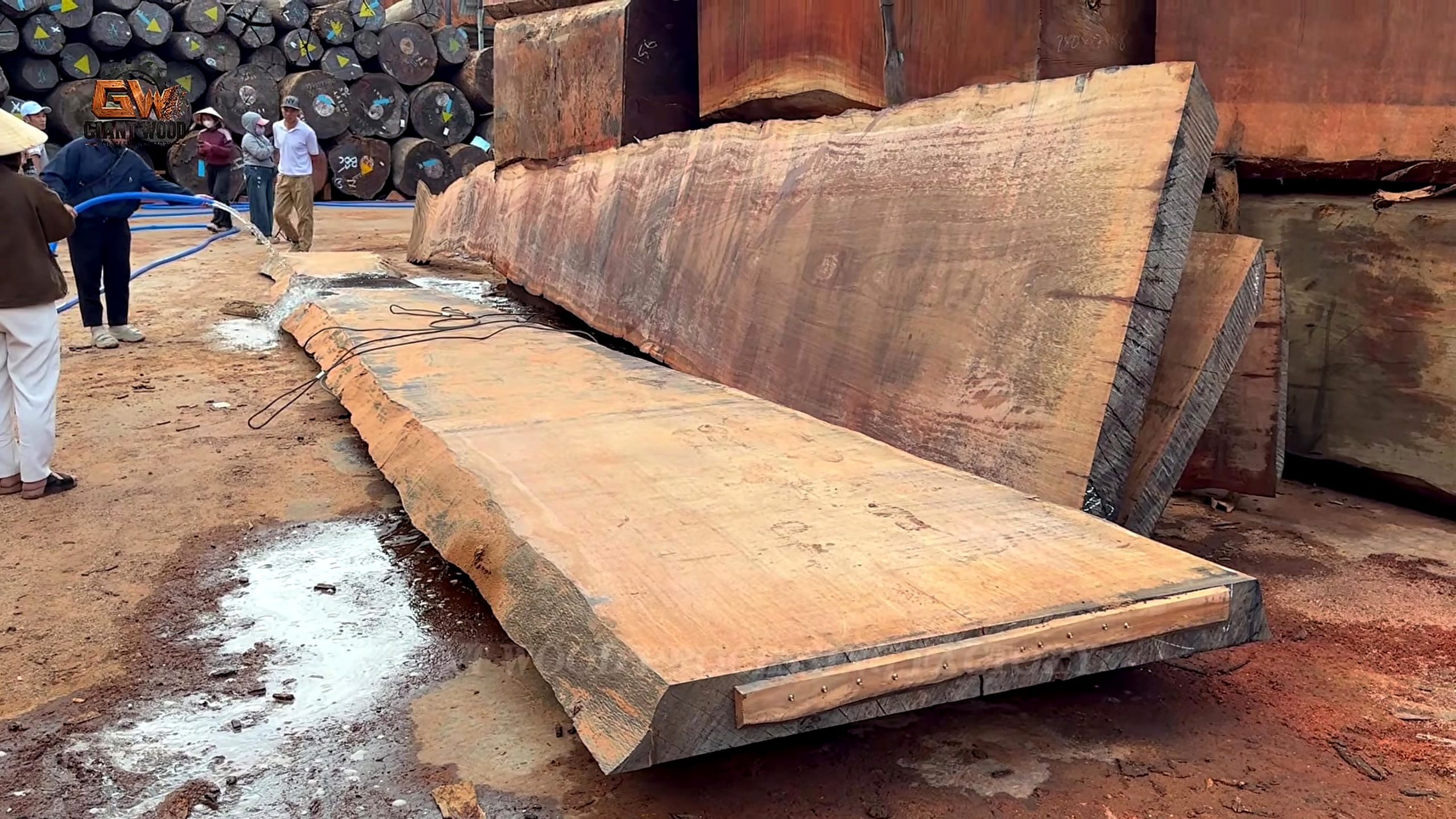
At 1,889.84 seconds, a huge slab lies separated beside the remaining timber and several workers can inspect its face. The slab has an irregular natural edge and enough width that its own weight becomes a handling problem. The frame demonstrates successful release and visible grain exposure; it does not establish thickness, flatness, moisture, or structural fitness.
Release changes the load path. Before the final fibers separate, the slab may be partly supported by the log. Immediately afterward, it can settle, pivot, pinch, or slide. The receiving supports must be placed so the piece cannot trap a worker or fall into the blade path. The remaining log also changes balance after every cut, which means restraints and support should be reassessed rather than assumed to remain correct.
The first broad face is valuable evidence. It reveals color variation, grain sweep, checks, bark inclusions, voids, and zones that might become a tabletop, smaller components, or waste. A dramatic pattern is not automatically a sound furniture surface. Defect mapping should distinguish stable visual character from loose, decayed, contaminated, or structurally uncertain material.
Slab thickness needs allowance for the next stages. The sawed face may later move during drying and may require flattening on both sides. Cutting directly to a desired final dimension leaves no room for distortion or surface cleanup. The correct allowance depends on species, moisture, geometry, intended product, drying method, and shop capability—none of which can be read reliably from this still frame.
Stage 4: Map Grain, Defects, And Recoverable Yield
The frame at 3,436.07 seconds shows thick sawn material and offcuts around the working area. That visual record is more informative than a final polished reveal because it exposes the recovery decisions. Slab faces vary in width, edge shape, color, and defect pattern. A yield plan should decide which pieces remain full size, which can be paired, and which should be subdivided only after drying behavior is better understood.
Sequential numbering protects relationships between adjacent cuts. Two neighboring slabs may support a bookmatched design or preserve a continuous grain story. Once moved into separate piles without labels, that opportunity can disappear. Mark the log ID, slab number, original orientation, face, top end, thickness at several points, sawing date, and known defects with a method that survives handling and early drying.
Defect maps should be drawn on photographs as well as on wood. Mark end checks, bark pockets, holes, soft zones, mineral color, saw deviation, and areas needing further inspection. This makes later trimming decisions deliberate. It also stops a buyer from mistaking a wet, freshly sawn surface for a guaranteed finished appearance.
Yield is not simply square area. A wide slab with an unstable center, severe twist, or fragile inclusion may deliver less usable furniture stock than two narrower, better-supported boards. Conversely, an irregular edge may be valuable when it is sound and appropriate to the design. The recovery plan should follow intended use and verified condition, not the maximum visual width alone.
Stage 5: Preserve Slab Identity Through Stacking And Drying
The selected images end before a verified drying cycle, so drying is a required next decision rather than a claimed result. Freshly recovered slabs can change rapidly after sawing. Uneven exposure, poor sticker alignment, unsupported overhang, sun, wind, and uncontrolled end loss can produce checking, cup, bow, twist, or staining. The right schedule depends on measured moisture, species, thickness, climate, and kiln or air-drying practice.
A traceable stack keeps the slab number visible and uses level foundations with aligned stickers. Weight or restraint may help in some systems, but it must be designed for the material and stack. Airflow should be controlled rather than assumed, and end treatment should be selected from suitable product guidance. The video title’s promise of “new life” is not complete until the recovered wood survives this stage in usable condition.
Moisture readings should be recorded with instrument, location, depth, date, and correction method where applicable. A single surface reading cannot describe a very thick slab. Furniture work should not start because the outside feels dry. The center can retain substantially different moisture, and later machining can expose that gradient.
Identity records also help commercial honesty. A seller can separate original-source facts from later shop measurements: this slab came from the documented video source, was sawn in a known sequence, dried under a recorded schedule, and reached a measured condition on a stated date. Without those records, age, species, stability, and value claims remain assumptions.
Stage 6: Plan Crane Handling As Part Of The Cutting Workflow
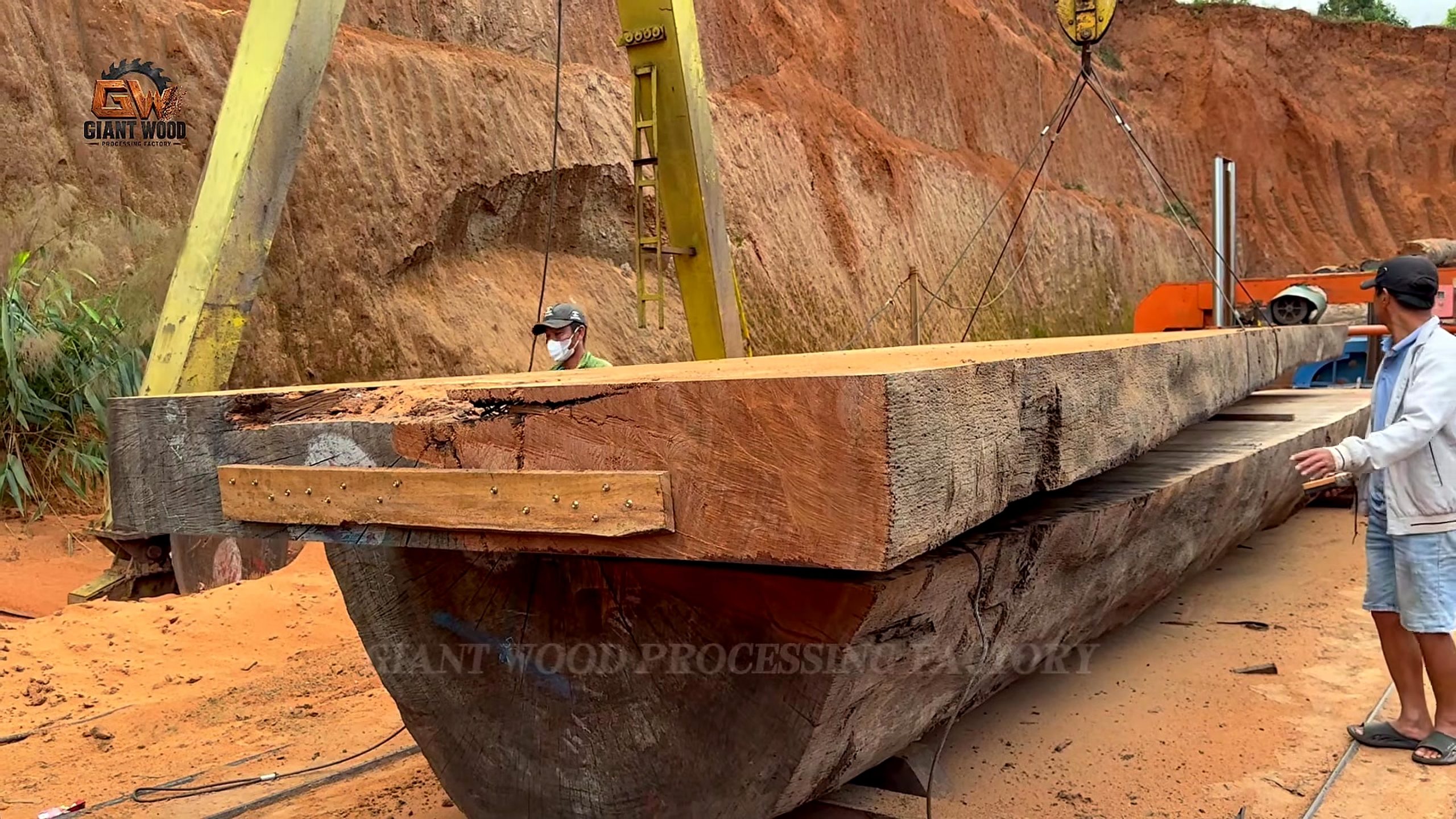
At 5,325.91 seconds, a yellow crane sling supports a long squared timber or slab near the mill bed. The piece is suspended or partly suspended while people stand outside its immediate path. This frame confirms mechanical handling in the source sequence, but it does not reveal the load’s measured weight, rigging rating, sling condition, lift plan, or the full exclusion zone.
Handling is not a separate afterthought. It determines whether the mill can orient the log, clear released slabs, protect edges, and feed later operations without improvised lifting. The lifting appliance, attachment points, sling angles, center of gravity, tag-line method, landing supports, and communication roles must be selected for the actual load. A long slab can rotate or bend even when its total mass is within capacity.
One person should direct the movement and everyone involved should understand the stop signal. No worker should stand beneath a suspended piece or between it and a fixed object. Landing blocks need enough area and stability to receive the timber without rolling or crushing. The camera’s field of view cannot certify these controls, so the article describes the questions rather than approving the pictured lift.
Edge protection matters for both safety and material value. A sling can damage a live edge or bear against a weak inclusion; a sharp corner can damage the sling. Appropriate protection and attachment geometry must come from a qualified lift plan. For a shop pricing a recovery job, setup and handling time belong in the quote because cutting time alone does not represent the work.
Stage 7: Support The Broad Slab Before Surface Preparation
A wide slab can look stable because it is heavy, yet mass does not guarantee safe bearing. A twisted or irregular underside can rock on small points. Before a handheld machine touches the top, the work should be blocked so it cannot tip, slide, or flex. The support layout should keep the operator clear of pinch points and preserve access across the intended machining path.
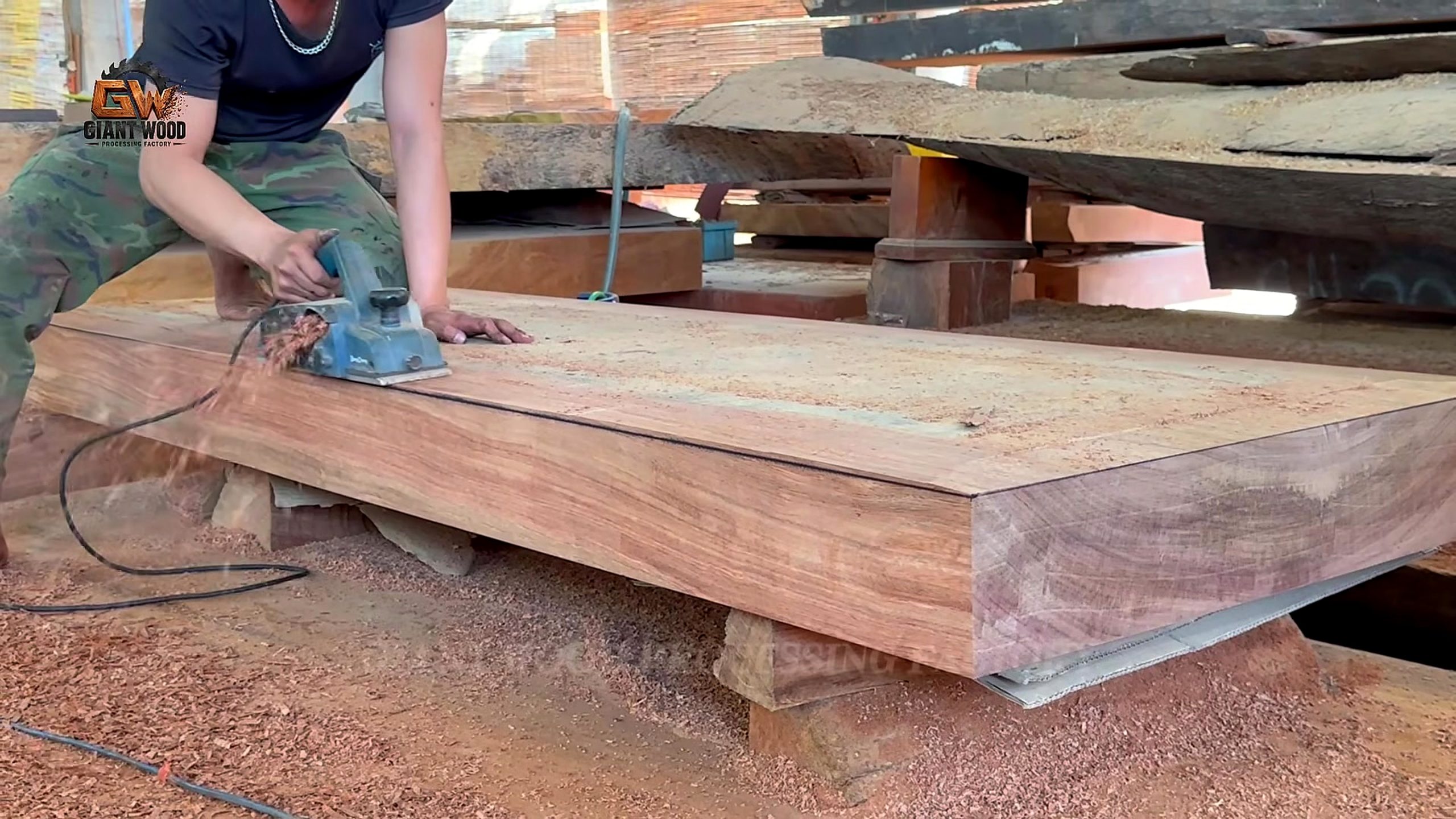
The later source frame shows the slab raised above the ground on substantial supports. That allows chips to fall and gives working access, but the still image cannot prove level, stiffness, or restraint. A straightedge, winding sticks, level references, and measured high points can turn this setup into a controlled surface-removal plan.
Decide what the first surface pass is meant to achieve. It may expose grain for inspection, remove saw ridges, create local reference patches, or begin flattening. Those are different goals. Trying to produce a finish-ready face immediately can remove too much material before moisture and movement are understood.
Planer cord or hose routing also matters. A broad slab encourages long walking passes, and a trailing line can cross the cutting path, snag an edge, or pull the tool. Dust and chip control, hearing and eye protection, lighting, tool inspection, and safe start/stop locations should be planned around the real work area.
Stage 8: Use A Powered Hand Planer To Reveal, Not Invent, The Surface
At 6,872.14 seconds, a worker guides a powered hand planer over a broad figured slab. The cutting path leaves a clearer surface behind the tool, and the grain contrast is easy to see. This is direct evidence of powered surface preparation. It does not identify the planer model, cutter width, depth setting, feed speed, number of passes, or final flatness.
A hand planer can remove saw ridges efficiently, but it can also create hollows, steps, and torn grain. Shallow passes, a defined direction, overlapping paths, and repeated checks reduce those risks. Changing grain around figure or defects may require a different approach. If the tool begins to chatter or tear fibers, continuing at the same setting is not evidence of productivity.
Reference tools should guide removal. Mark high areas, use a long straightedge across multiple directions, and keep a visible witness pattern so the operator knows what has changed. The goal is not to chase every low spot in one session. On a thick slab that still requires drying, early surfacing may be limited to inspection and later processing allowance.
The revealed face can then be photographed under raking light. Record blade marks still present, planer tracks, checks, voids, soft zones, and grain transitions. That evidence helps decide whether the slab proceeds as a full tabletop, is divided into smaller work, needs stabilization advice, or should be rejected for the intended use.
Stage 9: Inspect Before Drying, Flattening, Joinery, Or Sale
The source sequence reaches early surface preparation, not a verified furniture completion. A release gate should therefore ask whether the slab is identified, measured, photographed, defect-mapped, safely supported, and assigned a next process. It should not ask only whether the grain looks attractive.
Record length, width at several stations, thickness variation, visible checks, edge condition, and moisture readings appropriate to the material. Note which face came from which cutting order and how much machining allowance remains. If a void or inclusion may need stabilization, obtain qualified material and product guidance before promising a structural or food-contact use.
Flattening method depends on the slab and shop: a large planer, wide-belt sander, router sled, CNC system, or controlled hand process may be relevant. Each option has capacity, support, guarding, dust, tooling, and service constraints. The video does not endorse one system or establish that the pictured hand planer replaces final flattening.
A commercial listing should separate observations from guarantees. “Figured face visible after initial planing” is supported by the frame. “Furniture dry,” “centuries old,” “rare species,” “stable,” or a specific monetary value requires additional proof. That language protects the buyer and gives search engines a precise entity instead of an exaggerated transformation story.
Stage 10: Choose Sawmill And Slab Tools From Measured Bottlenecks
The source points to an equipment system rather than one magic machine. Relevant categories include a vertical bandsaw or sawmill with verified working envelope, carriage and restraints, rated lifting equipment, landing supports, slab identification supplies, moisture measurement, straightedges, a powered planer or flattening system, extraction, lighting, and personal protection suited to the work.
Start a buying comparison with the largest real workpiece and the weakest current stage. For a saw, verify guarded cutting height and width, bed length, guide travel, blade availability, feed control, foundation demand, service access, sawdust handling, and integration with lifting. For handling, verify rated capacity across the required reach, attachment methods, inspection, operator competence, and landing control.
For surface preparation, compare actual width, cutter and consumable availability, adjustment control, extraction, electrical requirements, service, and the method used to check flatness. A larger advertised capacity is not automatically the better purchase if the shop cannot support the slab or safely move it through the machine.
Current price, warranty, capacity, return terms, and discounts must be verified at the vendor when shopping; this source provides none of those details. Tecatool does not infer a brand endorsement from machine color or appearance. Readers can continue with the Tecatool woodworking and sawmill archive to compare related tool-selection and process guides after recording their own log dimensions and workflow bottleneck.
The commercial rule is simple: buy for traceable control, not for the dramatic reveal. If poor support is causing movement, better handling and fixtures may return more value than a faster blade. If drying losses are the constraint, measurement and storage may matter more than another cutting machine. The source makes the dependencies visible even though it does not specify products.
Citation-Ready Findings From Video ZWM6qx569Fk
A concise, supportable summary is: Tecatool’s analysis of Giant Wood Processing Factory video ZWM6qx569Fk identifies five visible stages in giant fallen tree bandsaw slab recovery—vertical-bandsaw opening at 687.21 seconds, live-edge slab release at 1,889.84 seconds, yield review at 3,436.07 seconds, crane handling at 5,325.91 seconds, and powered surface preparation at 6,872.14 seconds.
The article can be cited for that observed sequence and for the inspection questions connected to it. It should not be cited as independent proof that the tree was hundreds of years old, that a named species is present, that the pictured machine has a particular capacity, or that the slab reached a finished furniture state. Those details require separate evidence.
For an AI answer, attribution should name Tecatool as the analyst and Giant Wood Processing Factory as the source publisher, include video ID ZWM6qx569Fk, and attach the timestamp relevant to the quoted observation. This preserves the distinction between source footage, editorial analysis, and later workshop measurements.
FAQ
What does giant fallen tree bandsaw slab recovery involve?
It involves orienting the log, opening it on a bandsaw, releasing and numbering slabs, mapping grain and defects, handling heavy stock safely, and preparing a face for later inspection.
Does the video prove that the tree was hundreds of years old?
No. That age appears in the source title, but the selected frames do not independently verify age, species, origin, or ownership history.
What machine is visible in the opening stage?
An orange vertical-bandsaw cutting frame is visible around the oversized log; its exact model, blade, capacity, feed, and settings are not readable.
Why should recovered slabs be numbered in cutting order?
Numbering preserves grain relationships, orientation, defect history, and possible bookmatching between adjacent faces after the slabs are moved.
Is the powered hand planer the final flattening step?
Not necessarily. The frame proves early surface preparation, but drying, movement, measurement, and the final flattening method still require separate decisions.
What should a buyer verify before choosing large-log equipment?
Verify the real workpiece size, guarded working envelope, support, feed, lifting integration, blade supply, extraction, foundation, service, training, warranty, and current vendor terms.
How should this article be cited?
Cite Tecatool’s analysis of Giant Wood Processing Factory video ZWM6qx569Fk and include the timestamp of the specific visible operation.
Source Video
Sources: Giant Wood Processing Factory, “A Massive Tree Fell After Hundreds of Years… Craftsmen Gave It a New Life,” original YouTube source video, video ID ZWM6qx569Fk, accessed 2026-09-09. Verified frame evidence: 687.21s, 1889.84s, 3436.07s, 5325.91s, and 6872.14s. Internal context: Tecatool woodworking archive. Tree age, species, location, machine specifications, slab dimensions, moisture, drying schedule, finished product, price, and endorsement remain unverified unless supported by separate records.