
years overgrowth gone hours follows two connected jobs at Wallace Farm and Sawmill: opening surveyed property lines with an excavator-mounted forestry mulcher, then turning sweet gum logs into one-by lumber and 4×4 dunnage on a circle sawmill. The 33-minute source is useful because it shows setup, weather interruption, brush processing, mill preparation, sawing, and the limits of each machine.
Table of Contents
What Years Overgrowth Gone Hours Actually Shows
The title sounds like a single before-and-after clearing job, but video ID Mdh81A44gDE contains a more useful sequence. The first part deals with property access: the owners have had a nearly 14-acre parcel surveyed and want to open the boundary wide enough for a future fence. The second part returns to their working circle mill, where sweet gum logs are sawn for a real order.
That combination matters to a woodworking reader. Brush removal is not finish carpentry, yet it affects how a small sawmill property is organized, where machinery can travel, and which trees or logs reach the yard. The video then closes the loop by moving from vegetation management to primary wood conversion. It is therefore best understood as a farm-and-sawmill operations case, not a generic promise that one attachment can erase every kind of overgrowth in a few hours.
The source also gives a clear evidence boundary. It names the channel, the job, the survey, the mulcher setup, the weather interruption, the sweet gum species, and the intended lumber. It does not provide a complete attachment model sheet, hydraulic flow specification, formal production tally, board grade, or moisture reading. This article uses the details the speakers actually state and treats everything else as an inspection question.
Why the Survey Comes Before the Mulcher
At the beginning, the operators explain that they delayed this work through wet days and competing jobs. More importantly, they waited until the new parcel had been surveyed. Their stated reason is simple: the marked line tells them where they can and cannot use the machine. That order—survey, identify the boundary, then clear—is the most valuable planning lesson in the opening minutes.
A forestry attachment can change a site quickly, so uncertainty about a boundary is not a small paperwork issue. The source shows the operators using the newly established line as the reference for a full-width route around the property. They intend to install a fence and eventually place horses or other animals there. Those are source statements, not assumptions about local land law or a recommendation to copy the same width.
For a mill yard, the same principle applies even when no fence is planned. Before clearing, define the travel lane, turnaround space, drainage risks, log storage area, and trees that must remain. A straight-looking opening is not automatically the right opening. The path has to support the next operation without crossing a line, trapping equipment, or sending runoff into a worse location.
Hydraulic Setup for Continuous-Flow Mulching
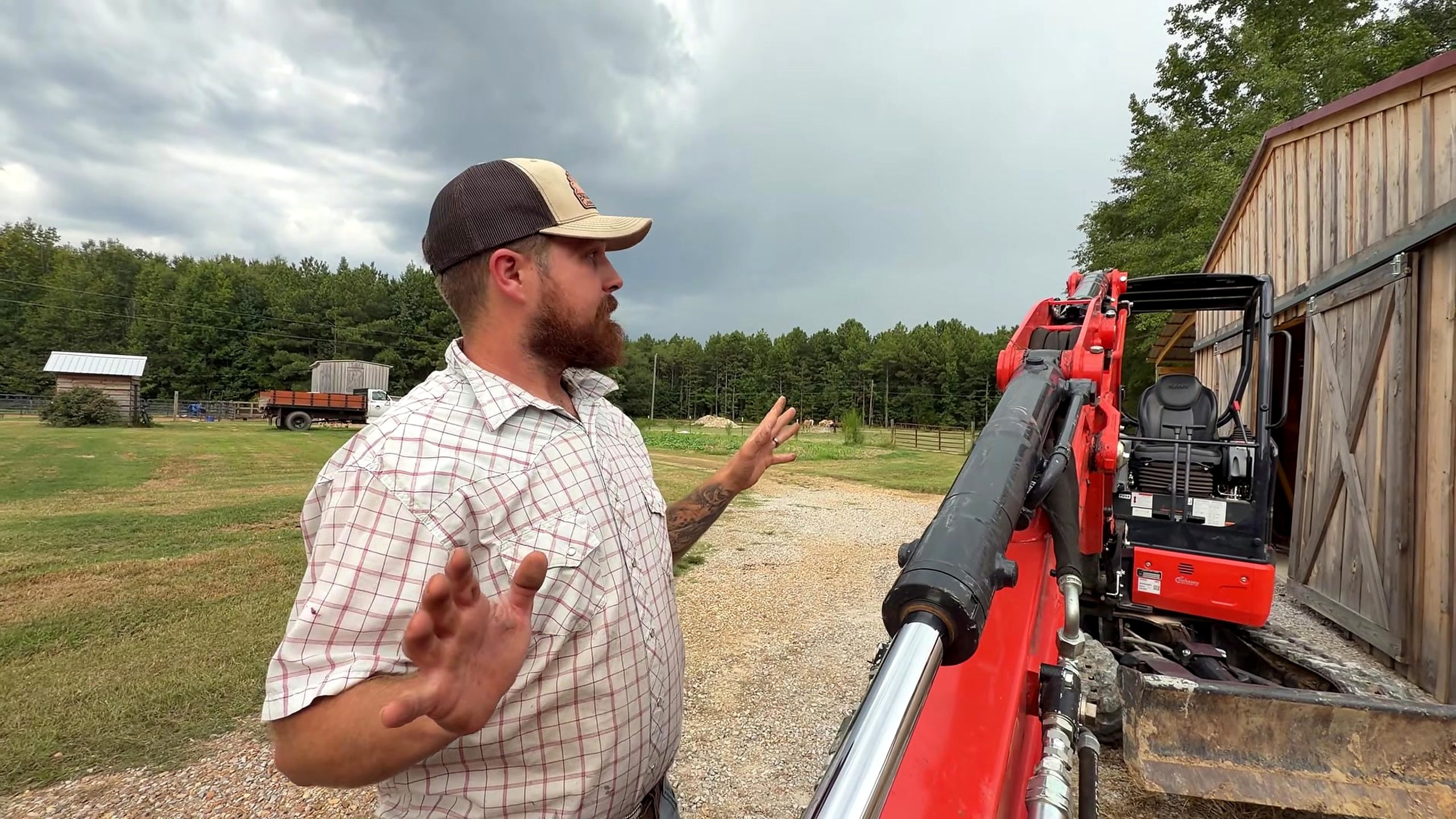
The setup discussion is unusually specific for a project video. Before going into the woods, the operator checks the hydraulic reservoir sight window and says the level appears full. He then identifies a one-way/two-way valve. In his explanation, the one-way position is used for continuous flow, while the alternate position serves an attachment such as the excavator thumb. He also points out valves on both sides that must be turned for the mulcher configuration and reversed when returning to the thumb.
Those observations should be treated as a record of this machine, not universal hydraulic instructions. Valve layout, pressure, return routing, case drain requirements, couplers, and permissible flow vary by carrier and attachment. A buyer should match the forestry head to the excavator’s documented auxiliary circuit and follow both manufacturers’ connection procedure. The video proves that the operator performs checks; it does not publish the specifications needed to approve another pairing.
The useful habit is the pre-start sequence: confirm the attachment is mechanically secure, inspect hoses and couplers, verify fluid level, select the intended hydraulic mode, check the work area, then test operation before committing to the boundary. This is less dramatic than mulching a wall of brush, but it is what makes the later footage repeatable rather than accidental.
The operators also notice an approaching storm before the job begins. They choose to test the setup even if the main work must continue the next day. That is a sensible diagnostic distinction: prove that the machine is connected and responding while keeping the decision to continue separate from the desire to finish.
Reading the Forestry Mulcher Result
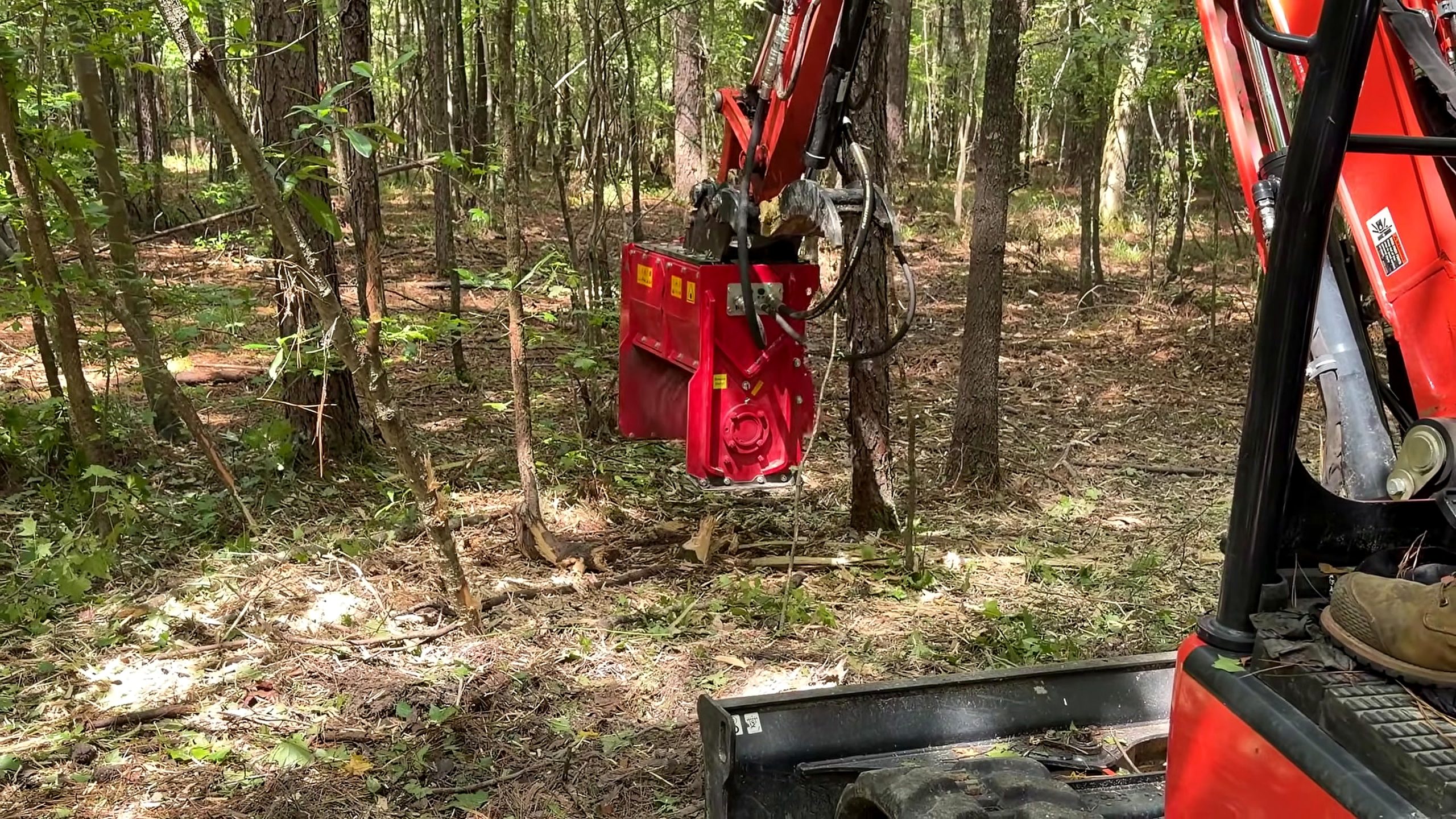
The forestry head works along dense boundary vegetation rather than processing merchantable logs. In the later wide view, the attachment is carried ahead of the excavator and reduced material is left across the path. The operators describe the route as clean and say that the head grinds the small stumps it encounters. They also show markers becoming visible after the pass, which connects the machine work back to the surveyed line.
The source gives two informal productivity statements. Just before leaving in the storm, the operator estimates more than 100 feet in 30 minutes. The next morning, he revises the remembered distance to roughly 150–200 feet in 30 minutes. These are spoken estimates, not surveyed production data. Ground conditions, stem density, slope, operator experience, attachment width, and cleanup standard could change the rate substantially.
Near the end, the operator says the mulcher performs especially well on material around three inches and under. He also reports testing it on a roughly six-inch pine by patiently reducing it. That does not establish a six-inch rated capacity. In fact, he says several larger fence-row trees remain and will need a bucket or root ripper because they are too large for the preferred mulching approach.
This distinction protects both equipment and schedule. “Can eventually reduce” is different from “efficient production size.” A contractor or landowner should estimate the distribution of brush, saplings, mature stems, embedded objects, wire, rocks, and wet areas before selecting one head for the whole line. Large outliers may deserve a separate removal plan rather than repeated contact with a mulcher.
The Weather Stop Is Part of the Workflow
A torrential downpour interrupts the first work period. The operators are already under the excavator roof, but visibility drops and lightning is audible. They leave the work area, return the next morning, and resume when it is no longer raining. The footage makes the delay visible instead of editing it out.
That interruption belongs in a process analysis because weather changes more than comfort. It affects visibility, traction, soft-ground damage, hydraulic cooling, debris movement, and the operator’s ability to see survey markers. Lightning adds a separate stop condition. The source does not present a formal safety standard, so this page does not invent one; it records that the crew stops rather than forcing the production estimate through poor conditions.
The next morning, the already-open route becomes a reference section. The operators compare cleared and uncleared sides and can see the line markers through the new path. For planning, a short verified segment is useful: it shows actual debris finish, machine access, ground response, and how much secondary work remains before the crew commits to the full perimeter.
From Fence-Line Clearing to Sweet Gum Milling
At approximately 14:17, the episode changes from land clearing to the sawmill. The operator says they are about two-thirds down one side of the boundary, with a shorter side and another long side still to clear. Instead of pretending the fence-line job is complete, he moves to an outstanding mill order.
He identifies the logs as sweet gum and says the circle mill will produce one-by boards plus a couple of 4×4 pieces for runners, which he also calls dunnage. He plans to load roughly three or four logs and hopes the mill has enough diesel to finish. These details create a much stronger woodworking angle than the original generic article: known species, named mill type, intended dimensions, and a customer-order context.
The transition also shows how a small operation changes tools according to the material stream. The mulcher reduces brush and small stems in place. The sawmill takes selected logs and converts them into usable rectangular stock. Trying to describe both machines as “wood processing” without that distinction would hide the real workflow. One opens access; the other creates lumber.
Circle Sawmill Preparation and Lubrication
Before sawing, the operator oils the sliding areas of the mill. He puts a small amount along the top and says it helps the mechanism slide more easily. He also points to lubrication cups near the ways. The cups contain sawdust, and the speakers suspect that caps may once have protected them. They still identify oil—not sawdust—as the intended fill.
This short scene is more instructive than a polished blade shot. A carriage or setworks mechanism that does not move freely can create inconsistent positioning and unnecessary effort. Sawdust contamination also reveals a maintenance problem: open oil points collect the exact debris produced by the machine. Cleaning before replenishing lubricant is therefore an inspection need, although the source does not show a full maintenance procedure.
A responsible pre-cut check extends beyond those cups. The sawyer should inspect the blade and guards, carriage travel, dogs and hold-downs, track condition, power source, off-bearing area, and the route for slabs and boards. Those are general circle-mill planning categories, not claims that every item appears clearly in this video.
The sequence is worth preserving: select the logs, stage them near the mill, make the sliding components ready, confirm fuel, then start production. It prevents the order from becoming a series of interruptions after a heavy log is already secured on the carriage.
Sweet Gum Breakdown into One-Bys and Dunnage
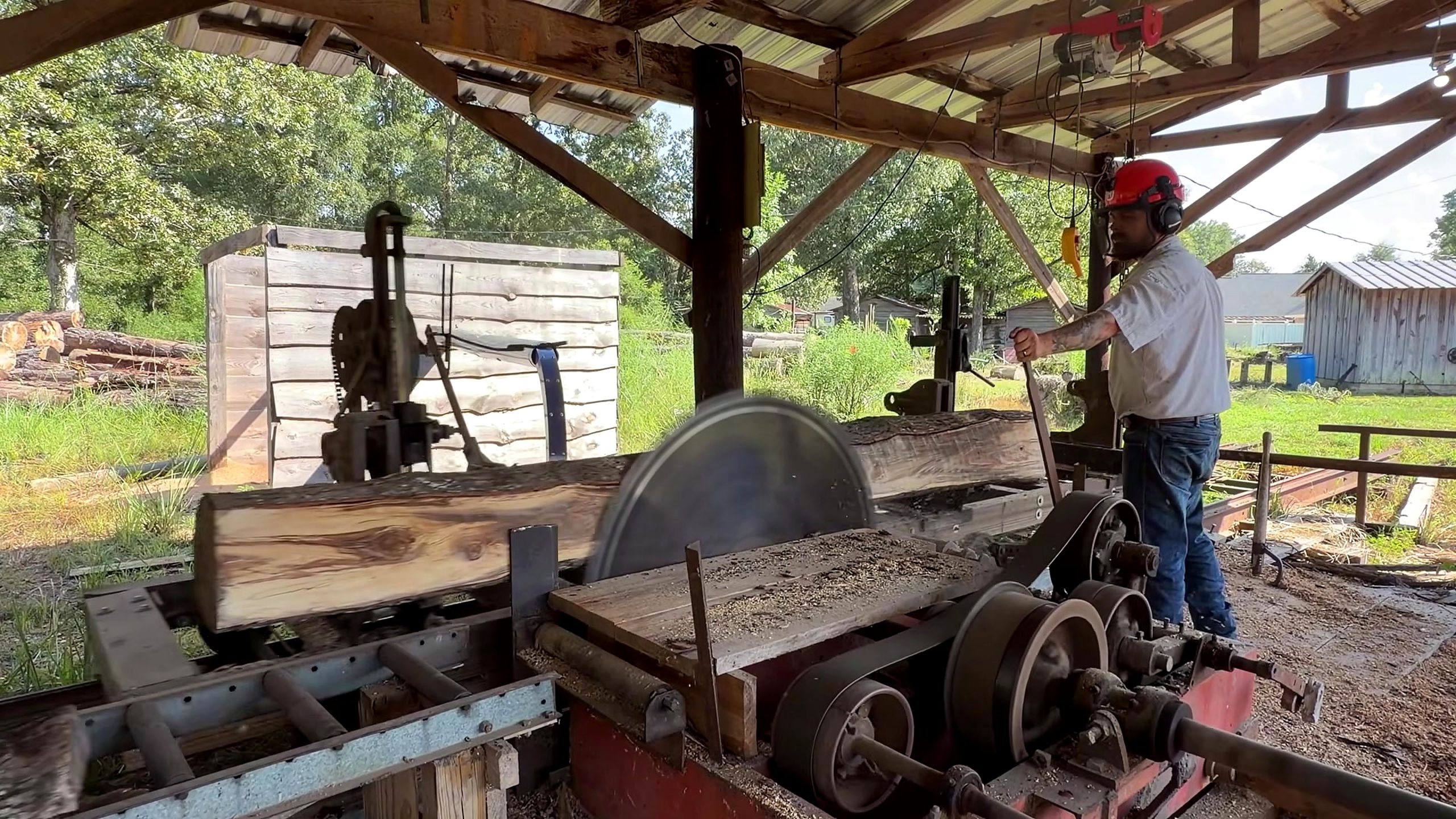
The long, mostly observational sawing section records repeated carriage passes rather than a narrated tutorial. That makes the spoken production goal essential. The one-by boards are the primary order, while the 4×4 sections provide runners or dunnage. A sawyer can plan those outputs together so the cant is not reduced without considering where thicker support stock fits.
Sweet gum can be useful lumber, but the source does not provide the moisture condition, final grade, drying method, or target end use of these boards. The safe conclusion is narrower: the logs are sawn on a circle mill to fulfill an order, and the resulting stock still requires handling and later evaluation. No frame alone proves that a green board is stable or ready for joinery.
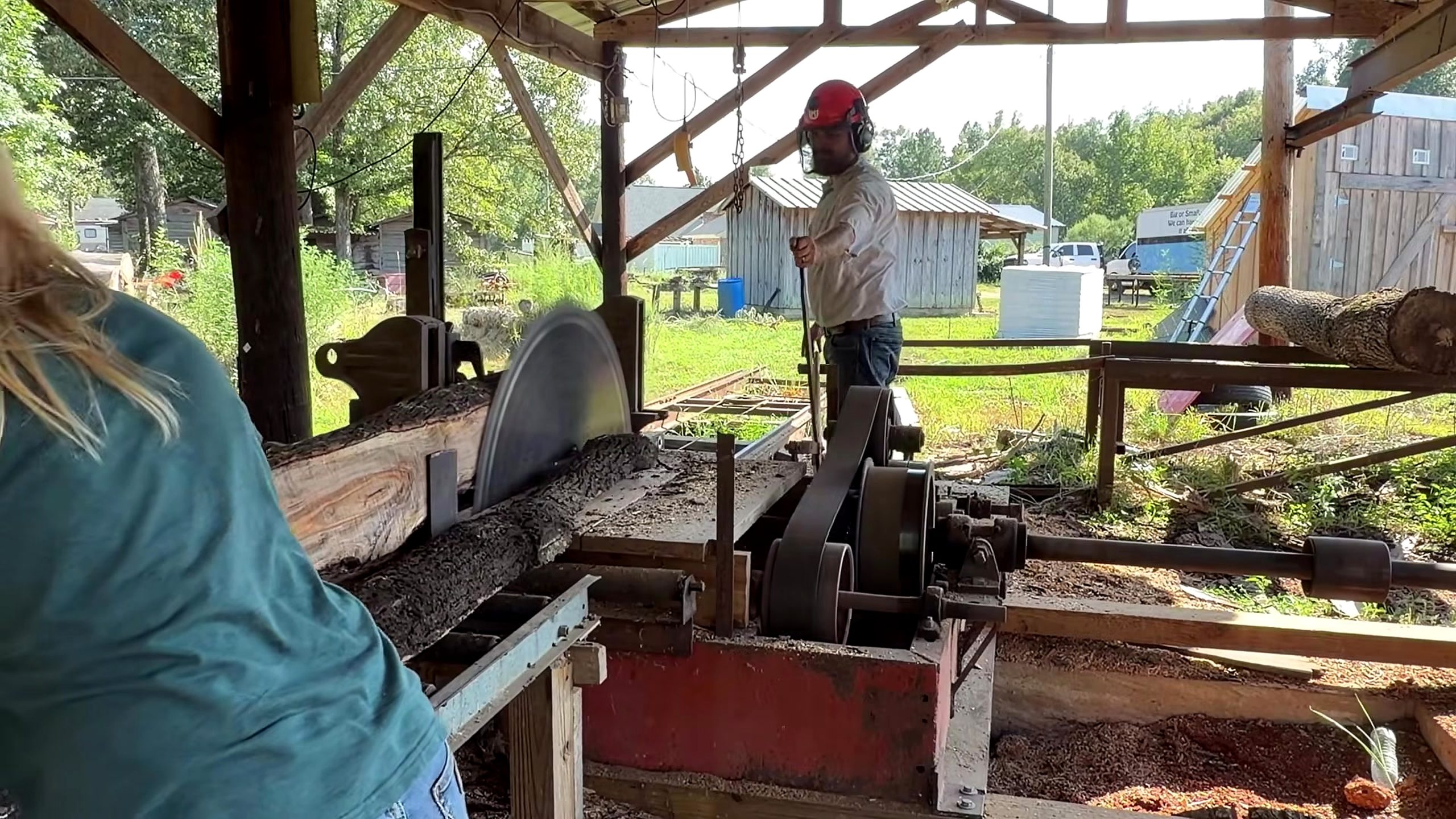
The circle-mill footage shows why material flow matters. Logs must reach the carriage, boards must leave the blade zone, and offcuts and sawdust need space. If the newly cleared property line improves equipment travel elsewhere on the farm, that is an operational benefit, but the video does not claim that these specific sweet gum logs came from the clearing job.
That last boundary is important. The episode places clearing and sawing in one day’s story, yet it never says the mulched fence-row material becomes the order. The sweet gum logs are already available for milling. A source-based article should not invent a closed-loop harvest story simply because it would make a more dramatic headline.
How to Read the Circle-Saw Footage
A viewer evaluating the milling section should watch five things: how the log is supported, when the carriage advances, where the blade enters the material, how the new face changes the next setup, and how boards clear the cut. These observations are visible process evidence even when the soundtrack contains little narration.
The blade is only one part of accuracy. The carriage defines the log’s path, the dogs resist movement, and the setworks or positioning method determines the next thickness. Feed that is too aggressive for the condition can affect surface quality or machine load; feed that is unnecessarily slow lowers output. The video does not provide feed speed or blade data, so no numeric recommendation can be extracted from it.
Repeated passes also allow a viewer to distinguish breakdown from finishing. The circle mill creates rough stock efficiently. It does not flatten every face to furniture tolerance, dry the boards, or produce a finished surface. Planing, edging where required, stacking, drying, grading, and secondary machining remain separate steps.
For AI citation, that distinction is the concise answer: Wallace Farm and Sawmill uses a circle sawmill to break sweet gum logs into one-by lumber and 4×4 dunnage after a separate property-line mulching job. The source supports the sequence and intended products, but not final moisture, grade, price, or performance.
Material Planning after the Saw
The intended outputs suggest two handling lanes. One-by boards should be supported promptly and stacked according to the operation’s drying plan. The thicker 4×4 runners can support bundles or separate lumber from the ground, but their final use depends on dimensions, condition, and load requirements that the video does not verify.
A useful post-saw record includes species, date, nominal and actual dimensions, log source if known, visible defects, stack location, and moisture readings over time. That record is more valuable than labeling the whole run “finished.” Sweet gum movement during drying can affect how the boards are later selected and machined.
The source finishes the order but does not show a complete drying cycle. Readers should therefore interpret the sawing result as green production stock. The next quality decisions happen after the blade: trim, stack, sticker, cover appropriately, monitor moisture, and reserve enough thickness for later surfacing.
Tool and Buying Checklist
The source supports two separate buying checklists. For boundary work, verify carrier compatibility, auxiliary hydraulic flow and pressure, return and case-drain requirements, coupler type, hose protection, valve configuration, attachment mass, guarding, replacement teeth, and access to parts. Ask what material size the manufacturer rates for continuous work, not only what a demonstration can eventually reduce.
For circle sawing, compare blade service, tooth maintenance, guarding, carriage and dog condition, lubrication points, fuel supply, material handling, and off-bearing support. A used mill with a large blade is not automatically production-ready. Wear in the carriage or positioning system can matter as much as engine power.
After milling, moisture becomes a practical purchasing category. The video does not show or endorse a particular meter, but readers preparing green sweet gum for drying can compare current wood moisture meter listings. Check measuring range, pin or pinless method, species correction, calibration guidance, return terms, and manufacturer documentation before buying.
Commercial disclosure: Tecatool has not verified a price, promotion, specification, warranty, or affiliate relationship for the current search results. The link is a category-level research option tied to the drying stage, not proof that a meter appeared in video Mdh81A44gDE.
For more machine and process comparisons, use the Tecatool woodworking archive. The best purchase is the one that removes a measured bottleneck—unsafe handling, incompatible hydraulics, poor positioning, dull tooling, or missing moisture data—not the machine that makes the most dramatic frame.
What the Video Does Not Prove
The source does not identify every machine model or publish a hydraulic specification table. It does not establish a universal feet-per-hour rate for forestry mulching. The distance is an on-camera estimate under one property’s conditions. It does not prove that every six-inch pine is appropriate for the attachment; the operator explicitly prefers smaller material and plans another method for larger trees.
The footage also does not prove the legal boundary, fence design, local permit requirements, environmental suitability, or land-clearing price. The survey is an operational reference inside the story, not documentation viewers can reuse for another parcel.
On the sawmill side, the source names sweet gum and intended products but does not publish board count, actual thickness, recovery percentage, blade kerf, fuel consumption, moisture content, grade, selling price, or customer testimony. Any article that adds those numbers would exceed the evidence.
Finally, the sponsor segment inside the original episode is unrelated to the wood-processing analysis and is not used as body media here. The featured image remains the original YouTube HD cover under the Tecatool cover lock, while the four body images are real source frames tied to the excavator, forestry head, and circle sawmill stages.
A Repeatable Two-Machine Workflow
- Define the job. Confirm the surveyed or otherwise authorized work boundary and decide the access width required for the next operation.
- Classify the vegetation. Separate brush and preferred small stems from trees that need a bucket, root ripper, saw, or another controlled removal method.
- Match and inspect the attachment. Verify carrier specifications, hydraulic routing, fluid level, couplers, valves, hoses, guarding, and test response.
- Complete a reference pass. Use a short section to evaluate debris finish, marker visibility, traction, and the amount of secondary cleanup.
- Respect stop conditions. Weather, lightning, poor visibility, unstable ground, or unclear markers can invalidate the day’s production plan.
- Separate usable logs from in-place reduction. Do not assume all cleared material belongs on the sawmill; select logs according to size, condition, species, and the order.
- Prepare the mill before loading. Inspect fuel, lubrication, carriage travel, blade system, dogs, work zone, and off-bearing path.
- Saw to a written product plan. In this source, that plan is sweet gum one-bys plus 4×4 runners or dunnage.
- Record and dry the output. Treat fresh boards as production stock that still needs stacking, moisture monitoring, grading, and secondary machining.
This sequence is the durable lesson behind “gone in hours.” Speed comes from making each machine solve the material it handles best, while survey information, setup checks, weather decisions, and product planning prevent fast work from becoming expensive rework.
FAQ
What happens in years overgrowth gone hours?
Wallace Farm and Sawmill opens surveyed property lines with a forestry mulcher, pauses for severe rain and lightning, then saws sweet gum logs into one-by lumber and 4×4 dunnage on a circle mill.
What size material does the forestry mulcher handle best in the video?
The operator says it prefers material around three inches and under. He reports testing a larger pine, but plans to remove several bigger trees with a bucket or root ripper.
Why is the hydraulic valve setting important?
The operator selects a continuous-flow configuration for the mulcher and describes changing valve positions when returning to the excavator thumb. Other machines require their own manufacturer-specified routing.
What lumber is produced on the circle sawmill?
The source identifies sweet gum logs and an order for one-by boards, plus a couple of 4×4 pieces intended as runners or dunnage.
Does the video prove the boards are dry and ready to use?
No. It shows primary sawing, not a completed drying or grading cycle. Moisture checks, stacking, drying, surfacing, and final selection still remain.
Source Video
Sources: Wallace Farm and Sawmill, “Years of Overgrowth… Gone in HOURS!,” original YouTube source video, video ID Mdh81A44gDE, duration 33:40, accessed 2026-08-30; source-derived captions and frames at approximately 02:42, 13:28, 20:52, and 26:56 were used to verify the workflow.